



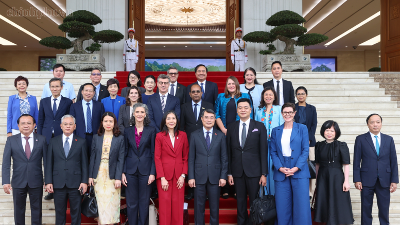
The Ministry of Justice (MoJ) on August 18 organized the ASEAN Law Forum 2026 under the theme: Applying Artificial Intelligence (AI) in Law-making and Law Implementation in the Digital Era.
Speaking at the opening ceremony, Deputy Prime Minister Le Tien Chau affirmed that Vietnam consistently values ASEAN's central role in the region's digital legal cooperation process.
"Principles, standards, and regulations regarding AI application in the legal and judicial sectors should be established first within ASEAN, led by ASEAN, and based on consensus and respect for each member state's sovereignty," he said.
Furthermore, the Deputy PM noted that ASEAN possesses a young population, one of the world's fastest digital transformation rates, and diverse legal systems. That diversity, if properly connected, will become the world's most vibrant "policy laboratory."
Accordingly, he called on ASEAN member states, development partners, and international organizations to join hands in implementing four major cooperation orientations:
First, collaborate on developing a common set of principles for AI application in law-making and enforcement, building upon the ASEAN Guide on AI Governance and Ethics.
Second, share legal data standards and experiences in digitalization and the review of legal normative documents. This aims to make the lookup and comparison of laws between ASEAN countries more convenient, thereby reducing compliance costs for citizens and businesses.
Third, cooperate in developing high-quality human resources in the legal and judicial sectors who are both legally proficient and technologically skilled. This includes mutual support in data infrastructure and technology transfer, with priority given to members facing difficulties, to gradually bridge the digital capacity gap and ensure no country or individual is left behind.
Fourth, maintain dialogue mechanisms, strengthen the sharing of experiences, and connect networks of experts in the legal and judicial fields.

Strengthening cooperation and knowledge sharing
At the forum, Minister of Justice Hoang Thanh Tung stated that in Vietnam, the development and perfection of institutions have always been identified as one of the strategic breakthroughs for national development.
For the justice sector, digital transformation is not merely the digitization of law-making processes or the construction of legal databases. More importantly, it involves innovating law-making methods, enhancing the effectiveness of law enforcement, and improving the quality of service provided to citizens and businesses through modern technological tools.
In this process, AI is opening up remarkable prospects but also presenting common challenges that Vietnam and many other nations must face. These include issues regarding personal data protection, cybersecurity, the accountability of AI systems, and algorithmic transparency.
“As AI knows no borders, legal and judicial agencies must strengthen international cooperation, share experiences, and jointly develop compatible approaches that respect differences while striving toward common values,” said Mr. Tung.
The MoJ is committed to creating an open, safe, and synchronized legal environment; and ready to partner with ASEAN ministries and judicial agencies, the ASEAN Secretariat, international organizations, the business community, and academia to enhance the exchange of experience, promote professional cooperation, share knowledge, and jointly research and propose legal solutions suited to the rapid development of artificial intelligence.
During the plenary session, delegates focused their discussions on the following key topics: The application of AI in law-making and institutional perfection in Vietnam: current status, challenges, and prospects; The application of AI in developing the National Law Portal: Enhancing accessibility, lookup capabilities, and law enforcement support in the digital era; Legal and policy frameworks of ASEAN countries regarding digital transformation and AI application in law-making and enforcement; and Experiences in applying AI to support citizens and businesses in accessing the law.









 Google translate