


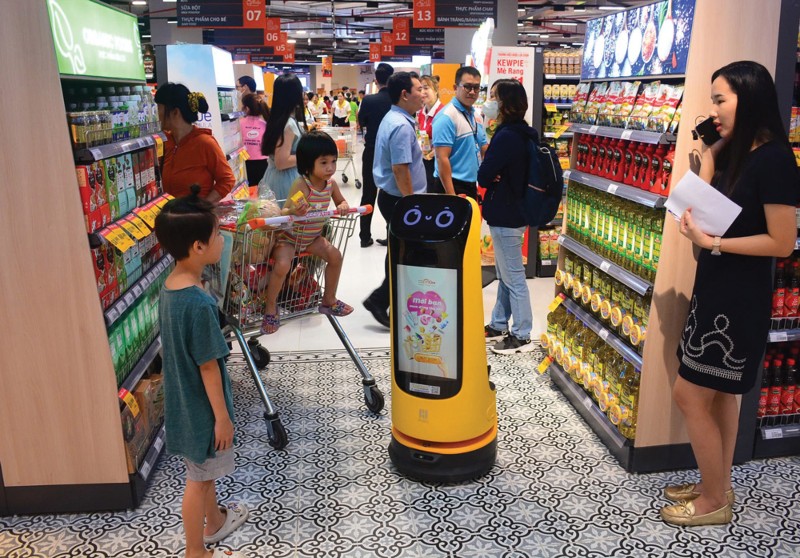
A place to hang out
A recent InsightAsia study found that customers are spending more and more time inside convenience stores, and not always for shopping.
By Diep Linh
Convenience stores long competed on a straightforward promise: they will be closer, stay open longer, and make shopping faster. Success depended largely on store density, extended operating hours, and the ability to provide everyday essentials within minutes. That formula is now beginning to lose its edge.
A new study by InsightAsia suggests that Vietnam’s convenience store industry has entered a different stage of development, one in which consumers no longer see these outlets simply as places to make quick purchases. Rather, they are becoming destinations where people have meals, meet friends, study after class, and spend time between work and home. The shift is particularly evident among younger urban consumers, who increasingly view convenience stores less as retail outlets than as part of their daily lifestyle.
Beyond convenience
Based on a survey of 1,236 convenience store shoppers in Hanoi and Ho Chi Minh City, the report found that 72 per cent visit a convenience store at least once a week, with 60 per cent of regular shoppers being under the age of 30. More tellingly, 38 per cent stay inside these stores for more than half an hour, suggesting that convenience stores are no longer merely facilitating transactions, they are increasingly providing a place to spend time.
The report’s most significant conclusion is that Vietnam’s convenience stores are evolving into what urban planners often describe as a “third place” - a space separate from both home and the workplace where people can comfortably spend time.
That evolution reflects broader changes in urban lifestyles. Younger consumers increasingly seek affordable, accessible, and comfortable environments where they can eat, study, charge their electronic devices, or simply escape the heat without committing to the higher prices typically associated with cafés. Convenience stores, many of which now offer seating areas, wi-fi, air conditioning, and freshly-prepared meals, have naturally filled that role.
The research shows that consumer behavior has already shifted to match this new function. While beverages remain the most commonly-purchased category, bought by 84 per cent of respondents during the previous month, ready-to-eat meals have become nearly as important. Sixty-three per cent reported purchasing hot meals or ready-to-eat food, and 41 per cent said their most recent visit was specifically to buy food or drinks for immediate consumption rather than groceries to take home.
Equally revealing is how consumers are using these spaces throughout the day. Traditional assumptions that convenience stores primarily serve morning commuters no longer hold. Only 19 per cent of visits now occur before 11am, while afternoon visits account for 28 per cent and another 31 per cent take place after 8pm. Together, those two latter periods represent nearly three-fifths of all visits, illustrating how convenience stores have become destinations throughout the day rather than simply stops during the morning rush.
These behavioral shifts are particularly pronounced among Gen Z consumers, who dominate afternoon and evening visits and increasingly choose convenience stores as casual meeting places instead of purely functional retail outlets. The finding helps explain why operators are investing in larger seating areas, more comfortable interiors, and expanded food service offerings despite the higher operating costs such investments entail.
No longer about location
For much of the industry’s development, location represented the single most important competitive advantage. The chain with the largest footprint generally attracted the greatest number of customers. That relationship has become considerably more complicated.
According to InsightAsia, nearly half of consumers under the age of 25 willingly walk past a closer convenience store to visit one that better matches their preferences for atmosphere, products, or overall experience. The report describes this as a transition “from the nearest one to the one with the vibe,” reflecting how brand identity is beginning to outweigh simple proximity among younger shoppers.
Food sits at the center of that competition. The research found that purchases including ready-to-eat meals generate baskets roughly 1.6-times larger than ordinary transactions. Average spending across all visits stands at approximately VND52,000 ($2), but rises to VND68,000 ($2.60) when consumers purchase meals intended for immediate consumption. Moreover, 57 per cent of respondents indicated they would willingly pay higher prices for healthier food options, reinforcing the idea that quality rather than discounting is becoming the primary driver of spending.
Those findings help explain the increasingly distinct positioning adopted by Vietnam’s major convenience store chains. FamilyMart receives the strongest ratings for food quality, cleanliness, and staff service, while GS25 leads in drink variety, trendy products, and digital capabilities. Circle K, meanwhile, continues to dominate perceptions of accessibility, location convenience, and around-the-clock availability through its extensive network of approximately 500 stores.
The growing importance of digital services further reinforces this competitive shift. More than three-quarters of respondents used cashless payment during their latest visit, while 34 per cent have ordered convenience store products through delivery applications. Digital payment systems, mobile apps, and loyalty programs are therefore becoming baseline expectations rather than value-added features, with retailers increasingly competing on the seamlessness of the customer experience as much as on their physical stores.
Experience over proximity
These changing consumer priorities also provide important context for the arrival of China’s Meiyijia, which entered Vietnam in May under the Ohmee brand. Known for operating more than 40,000 stores in China and leveraging a vertically-integrated supply chain to support highly-competitive pricing, the retailer might once have been expected to disrupt Vietnam’s convenience store sector through lower prices alone.
InsightAsia’s findings suggest the challenge facing the newcomer may be more complex. Though 22 per cent of respondents in Hanoi and Ho Chi Minh City were already aware of the Ohmee brand, only 6 per cent had visited one of its three pilot stores. More significantly, 58 per cent of those familiar with the chain said lower prices alone would not persuade them to switch from their preferred retailer.
The report argues that the industry’s next phase will therefore be shaped less by price competition than by operators’ ability to build stronger emotional connections with consumers. The most successful chains are likely to be those capable of combining high-quality ready-to-eat food, comfortable environments, digital convenience, and distinctive brand identities into a cohesive customer experience.
That conclusion reflects the broader trajectory of Vietnam’s convenience store market, which reached an estimated VND12.16 trillion ($486 million) in 2025 and continues to expand at an annual rate exceeding 13 per cent. While future store openings will remain important, particularly beyond Hanoi and Ho Chi Minh City, the industry’s defining competition increasingly appears to be taking place inside the stores themselves.
In many ways, the country’s convenience stores are becoming less like traditional retailers and more like compact urban living spaces. The chains that succeed over the years to come are unlikely to be those with the cheapest shelves or the most locations. They will be those that best understand that modern consumers are no longer simply looking for somewhere to shop, they are looking for somewhere to spend part of their day.
 Google translate