


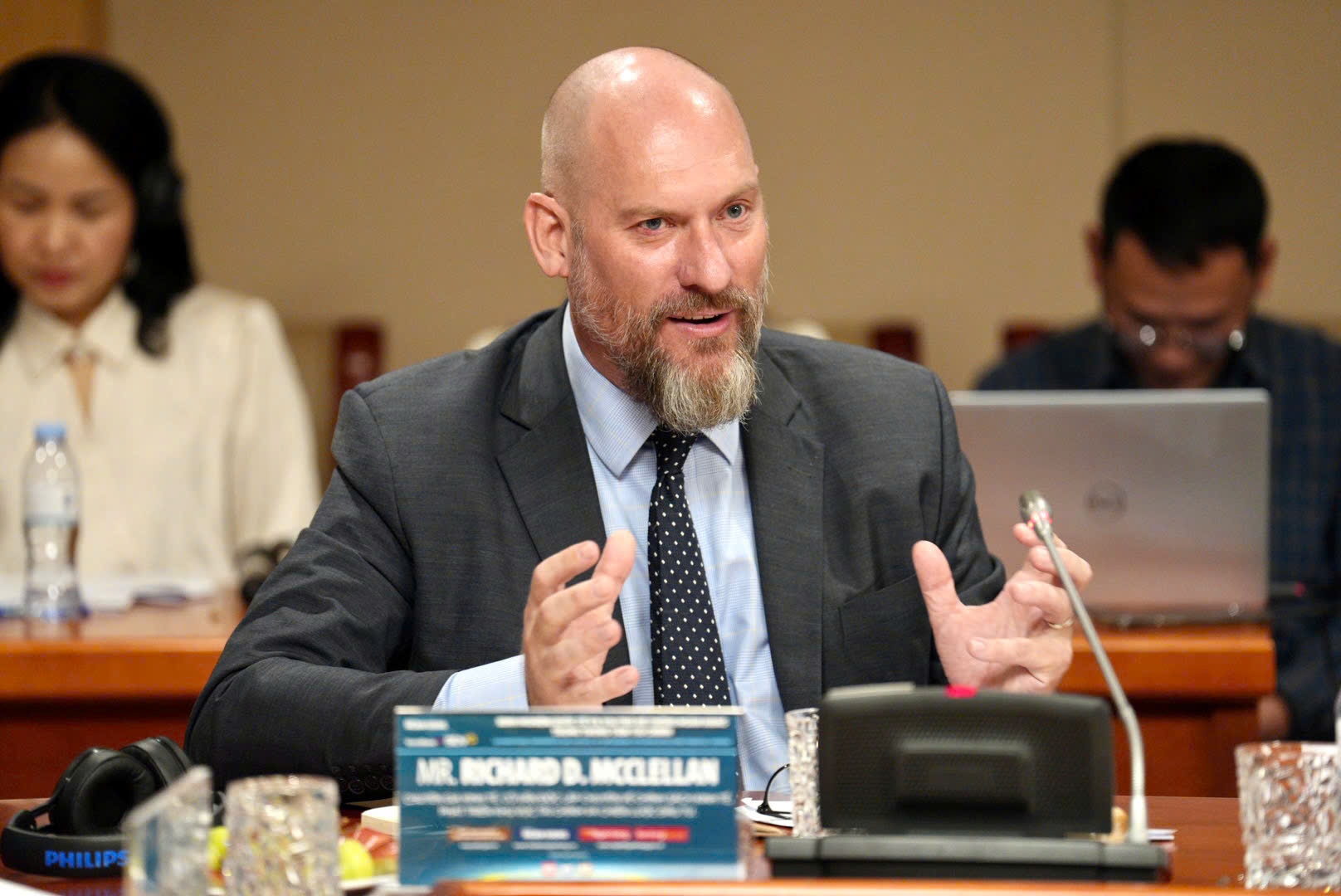
Vietnam has long been recognized as a manufacturing and investment hub. How do you see the Vietnam International Financial Center (VIFC) contributing to the country’s next stage of economic development?
Vietnam has built one of the world’s great manufacturing and trade stories. But much of the financial value of that growth - the capital raising, the fund management, the structuring - happens offshore, in other financial centers.
The VIFC is about Vietnam capturing more of that value at home. As the country moves up the value chain, it needs deeper capital markets, more sophisticated financial services, and a channel for the long-term investment that infrastructure and the energy transition require.
A financial center built to international standards gives Vietnam the tools to finance its own growth - on Vietnamese soil, with the benefits staying in the country. That’s the contribution we’re aiming for: not a separate enclave for money to pass through, but an engine for the broader economy.
As other ASEAN economies also attract global capital, what role do you envision the VIFC playing within the regional financial ecosystem?
We’re not trying to build another Singapore or Hong Kong (China) - those centers exist, and Vietnam doesn’t need to copy them. What Vietnam needs is its own gateway: a place where international capital can reach one of Asia’s fastest-growing economies through rules that global investors understand.
In the near term, our role is to connect the pool of international capital looking for exposure to Vietnam with the projects and companies that need it - infrastructure, the energy transition, and capital markets.
Over time, as the ecosystem deepens, we expect the VIFC to become a regional node in its own right. But we’re building in sequence, on the foundations the government has set: the core policy and legal frameworks are in place, and through the current 2026-2030 phase of the national development plan, we’re institutionalizing how the Center operates and piloting the first priority products, so early market participants can begin as those institutions come online.
Many international financial centers have developed distinct competitive advantages over time. What do you believe should become the defining strengths of the VIFC?
A financial center’s advantages are earned over time, not declared on Day 1, so let me answer in terms of what we’re building toward.
First, access: the VIFC’s core draw is proximity to one of the fastest-growing economies in Asia - investors come to a financial center for what it connects them to, and Vietnam’s compelling growth story is the connection. Second, trust: high-standard regulation, effective dispute resolution, and robust investor protection, embedded in the VIFC’s tailored legal framework and in line with international practice. Third, the advantage of building fresh - we can design our framework around what global investors need today, rather than retrofitting a decades-old system. And fourth, people: a young, capable, competitively-priced workforce.
None of these is automatic; each depends on execution over the coming years. But that combination - a high-growth economy, credible rules, a modern design, and strong talent - is what we intend to make the VIFC known for.
What types of international capital and financial institutions is the VIFC seeking to attract in its early stages of development?
Our priorities follow the national development plan for the Center. In this phase, we’re focused on attracting large international financial institutions, investment funds, and international banks, alongside the professional market participants and high-quality financial talent that a functioning center depends on.
On the product side, Ho Chi Minh City’s role is built around three areas: capital markets, including the bond market and core financial services such as capital raising, investment, payments, issuance, and trading; asset and fund management; and commodity markets and commodity derivatives linked to trade and logistics.
We’re being deliberate about sequencing rather than chasing volume - the first institutions to license here matter most for the confidence they establish, not the capital they bring on Day 1.
Beyond world-class infrastructure, what policy, regulatory, and institutional reforms will be most important in building investor confidence in the VIFC?
Infrastructure is the easy part; you can watch a building go up. The harder and more important work is institutional. Two things matter most on the reform side.
First, a regulator that international investors trust: a supervisory authority that applies its rules consistently and predictably. Second, dispute resolution investors have confidence in, which is why the VIFC’s framework includes an international arbitration center and a specialized court, so that international awards can be recognized and enforced. Those give investors the certainty they need: to know the rules and trust that they’ll hold.
My own role sits on the other side of that equation - the demand side. What I spend my time on is engaging international institutions, funds, and banks, understanding what they need to commit to a market like Vietnam, and bringing quality anchor participants to the table early. That engagement does two things: it builds the pipeline, and it feeds real investor requirements back into how the Center is designed. Confidence is built from both directions - credible institutions on one side, and serious participants choosing to be here on the other.
What feedback have you received from international financial institutions, and what do they see as the key areas Vietnam still needs to improve to establish a successful international financial center?
The feedback has been consistent, and it’s fair. International institutions are genuinely interested - Vietnam’s growth makes it hard to ignore, and a number of favorable factors are lining up, from the country’s macro-economic stability and deep integration into global trade to Ho Chi Minh City’s role as its commercial hub.
But interest isn’t the same as commitment, and the investors we talk to are clear about what they need to see. They want the regulatory institutions to be real and functioning, not just legislated. They want to see the practical framework for operating here come fully into place. And they want to see the first movers succeed. None of this surprises us; these are exactly the areas being built out now.
We’re still early in the journey, and I’d rather be open about that than oversell our progress. The institutions that engage with us seriously respect that transparency.
Looking ten years ahead, what would success for the VIFC look like - not only for the Center itself but for Vietnam’s broader economy?
The government’s development plan sets the horizon, so let me use it. By 2030, success is a center whose core institutions are working and whose first priority products and services are operating - the foundations genuinely in place. By 2035, it’s a modern, diverse financial ecosystem: deeper capital markets, green finance, digital finance, and fintech, connected into regional and global capital flows, with the ambition of ranking among the world’s leading financial centers and third in ASEAN.
But the deeper measure of success is what it does for Vietnam. Capital that used to route around the country now flows through it. Vietnamese companies raise money at home. The infrastructure and energy transition the country needs are financed, in part, through instruments created here. And the benefits reach beyond the Center itself - thousands of skilled jobs and a generation of Vietnamese professionals working to international standards. Financial centers are decade-long projects. Success is building this one carefully and credibly, so that a decade from now it’s is still standing, and still trusted.




 Google translate