


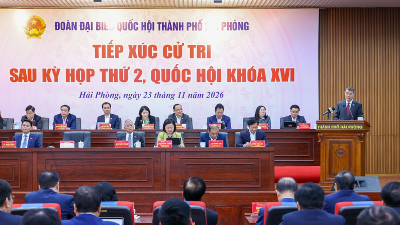
General Secretary and President To Lam, along with National Assembly deputies from Hanoi's Electoral Unit No. 1, on November 25 met with constituents from 10 wards following the second session of the 16th National Assembly.
Politburo member, Secretary of the Hanoi Party Committee, and Head of the Hanoi National Assembly Delegation Tran Duc Thang also attended the meeting.
At the conference, voters expressed satisfaction with the success of the second session of the 16th National Assembly, which adopted numerous decisions aimed at institutionalizing Party guidelines, perfecting legal frameworks, resolving bottlenecks, and creating fresh development momentum and space for the country.
Constituents proposed expanding allowances for individuals aged 70 to under 75 who lack pensions or stable income and face difficult circumstances, even if they are not classified as poor or near-poor households. Up to now, individuals aged 75 and older who lack pensions have been eligible for an allowance.
Other proposals focused on accelerating the North-South high-speed railway project, improving policies for grassroots Youth Union officials, establishing mechanisms to utilize public assets for creative activities, and strengthening oversight of grassroots democracy enforcement.
Responding to these proposals, General Secretary and President To Lam stated that the Hanoi National Assembly Delegation would recommend that the Government evaluate the implementation of urban allowance policies, taking living costs and budget capacity into account when proposing a roadmap to expand beneficiaries and gradually lower the eligible age.
The city and the Hanoi Youth Union were urged to review support policies and professional training for Youth Union officials, particularly ward-level Youth Union secretaries.
The city was also directed to guide wards in utilizing public assets for their intended purposes, publicizing cooperation activities, and protecting creators' rights. Ministries and municipal agencies must enhance data connectivity, reuse authenticated data, and safeguard personal information. Agencies handling administrative procedures must not require citizens to renew valid documents solely due to organizational restructuring, unless otherwise stipulated by law.
Regarding key projects, Hanoi needs to promptly prepare cleared land and provide transparent information on planning and timelines to households subject to land acquisition so residents can proactively arrange their lives. Investment prioritization must balance the interests of both the capital region and the country as a whole, according to the top leader.
General Secretary and President To Lam affirmed that Hanoi's development must generate broader opportunities for neighboring localities. The city needs to strengthen regional coordination in developing transport infrastructure, identifying connectivity hubs, and forming production and service centers.
Hanoi must contribute more to national competitiveness through Vietnamese knowledge, technology, and creativity, promoting the commercialization of research into production, helping businesses raise product value, and ensuring fair compensation for skilled workers.
Capital development must go hand in hand with improving residents' quality of life and preserving Hanoi's cultural identity. Urban planning for new residential areas must allocate land for schools, medical stations, and playgrounds, ensuring suburban residents have access to quality essential services.
The city needs to consult residents when renovating old apartment complexes, transparently define eligibility criteria for social housing, consider affordability alongside access to workplaces, schools, and hospitals, and synchronously develop wastewater collection and treatment along rivers.
General Secretary and President To Lam particularly stressed that the greater Hanoi's autonomy, the higher its accountability to the people in land and budget management. The city needs to concentrate capital on completing unfinished components to put projects into operation.
When reporting to the People's Council and constituents, heads of managing agencies must clearly state project progress, obstacles, accountability for resolution, and completion timelines.
Citizens have the right to know which projects will continue, which require adjustments, and which agencies or individuals are responsible for providing answers. For surplus office buildings following administrative restructuring, the city needs to publicize repurposing plans, prioritizing schools, elderly care facilities, and cultural institutions in underserved areas. In operating the two-tier local government model, the city must ensure adequate authority, staffing, and funding for grassroots units to fulfill their duties.
During the meeting, General Secretary and President To Lam extended condolences to the families of the victims and asked after those injured in the gas explosion in Dong Da ward on the morning of November 24.
He urged the city to promptly address the aftermath, help residents stabilize their lives, and strengthen accountability in fire and explosion prevention.





 Google translate