


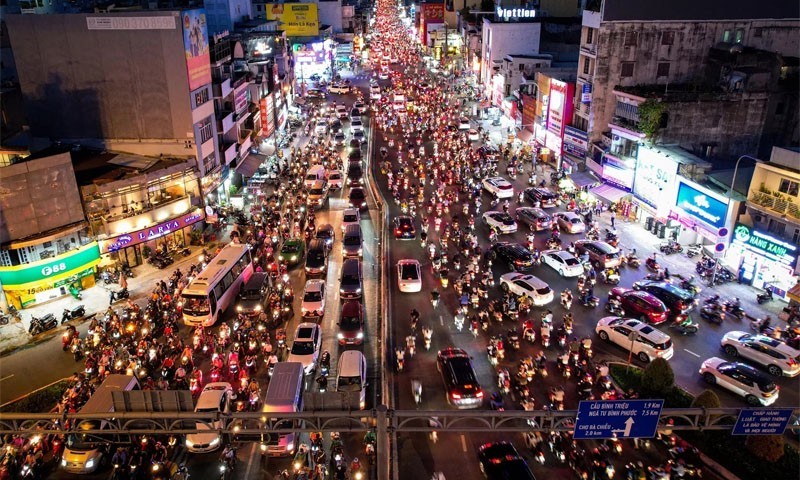
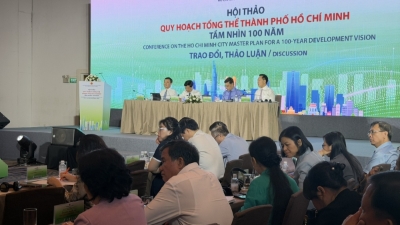
At a recent appraisal session for the draft resolution approving Ho Chi Minh City's Master Plan for the 2025-2050 period with a 100-year vision, the HCM City Real Estate Association (HoREA) urged municipal authorities to align the long-term blueprint with demographic shifts and corresponding housing supply
According to HoREA, population forecasting is one of the most important foundations for determining housing demand and planning urban space. For the city, declining birth rates, population aging, and changes in migration patterns require a reassessment of long-term population growth scenarios.
Specifically, HoREA called for a more cautious calculation of the city's future population size and recommended adding targets for the development of social housing and rental housing to meet the needs of different population groups.
Under the draft master plan, the city's population after administrative consolidation is estimated at around 14 million people and is projected to increase to 15.5-16 million by 2030, 17-18 million by 2035, 20-21 million by 2045, and 22-23 million by 2050.
HoREA Chairman Le Hoang Chau said that these figures should be reviewed based on changes in both natural population growth and migration. Declining fertility rates, an aging population, and a slowdown in migrant inflows could result in actual population figures differing from current projections. The association suggested considering both a scenario in which the city's population reaches 22-23 million by 2050 and a more moderate scenario where growth levels off at around 21-22 million.
The number of elderly residents is expected to exceed 3 million by 2038 and reach approximately 4.6 million by 2048, accounting for about 18% of the city's population. According to HoREA, HCM City officially entered the population-aging phase in 2017, and this trend is unlikely to be reversed in the foreseeable future.
In addition to natural population growth, migration trends also need to be reassessed. Over the past two decades, the former HCM City (excluding Binh Duong and Ba Ria-Vung Tau, which have been merged with HCMC since July 2025) attracted an average of about 200,000 migrants annually, most of whom were low-skilled workers. However, industrialization in neighboring provinces has created new growth centers and employment opportunities, helping retain workers in their home localities.
This shift could reduce the city's rate of population growth through migration while gradually changing the profile of migrants toward more highly skilled and qualified workers. As a result, relying on a single population growth scenario may not adequately reflect future changes in the size and structure of the city's population over the coming decades.
Based on the need for more realistic population forecasts, HoREA proposed adding housing security for all social groups as an objective within the city's overall development strategy and socio-cultural development goals.
The association also emphasized that urban planning should account for diverse housing needs, ranging from homes for high-income residents, foreign experts, and overseas investors to social housing and rental accommodation. In particular, social housing and rental housing should be linked to broader social welfare policies, public services, and housing accessibility across different development zones.
In addition, HoREA noted that the city's planning framework should also take into consideration the projected growth in international tourist arrivals.




 Google translate