



Intel has marked a major milestone in Vietnam as its total export turnover surpassed $110 billion. This achievement serves as a testament to the rapid growth of the country's semiconductor industry and underscores Intel's strategic role in Vietnam's digital economy.
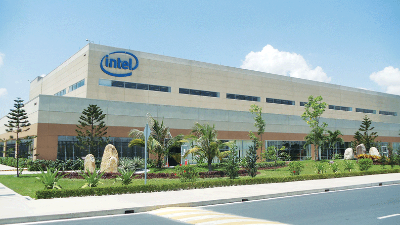
With a total committed investment of $4.1 billion since its entry in 2006, the corporation established its largest Assembly and Test facility in its global network at the Saigon Hi-Tech Park (SHTP) in Ho Chi Minh City.
Over the past two decades, Intel Products Vietnam (IPV) has shipped more than 4 billion units, contributing significantly to the nation’s export volume. In 2025 alone, IPV’s export value reached approximately $11.67 billion, accounting for 57% of SHTP’s total exports and 12% of Ho Chi Minh City’s total export turnover.
Intel’s presence has created a powerful "spillover effect," driving Vietnam's semiconductor market scale to over $21 billion and attracting more than $14 billion in FDI across 240 projects.
Speaking at the 20th-anniversary ceremony of Intel's operations in Vietnam on June 12, Minister of Science and Technology Vu Hai Quan emphasized that semiconductors are no longer just an industry but have become a strategic national capability. To realize the ambition of becoming a high-income developed nation by 2045, Vietnam has identified science and technology, digital transformation, and semiconductors as the core drivers of growth.
Looking toward the next 20 years, Vietnam aims to partner with Intel to achieve three major transitions: moving from simply participating in the value chain to mastering higher-value-added stages within the global semiconductor ecosystem; shifting from attracting investment to technological co-creation to jointly researching, developing, and producing new tech products for the global market; and transitioning from general workforce training to elite talent development, fostering a generation of engineers, experts, and scientists capable of leading the technologies of the future.






 Google translate