


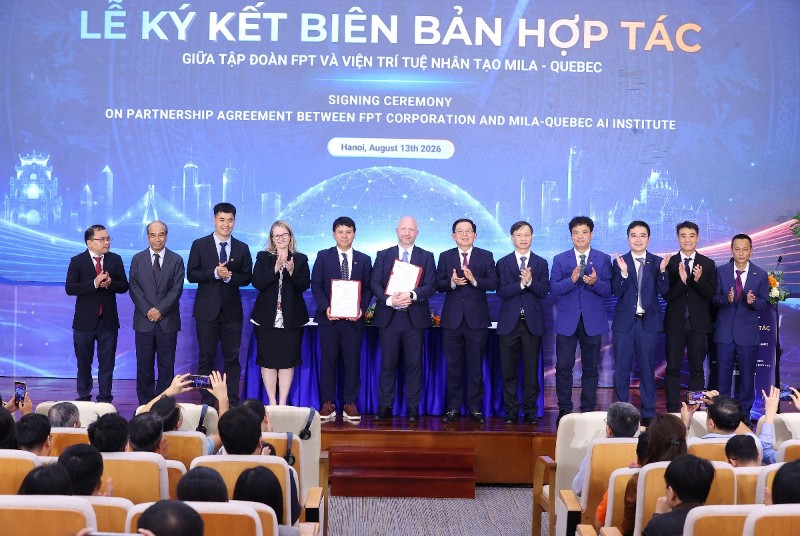
FPT Group and Mila – Quebec AI Institute (Canada), the world’s leading artificial intelligence research institution, recently signed a cooperation agreement focused on AI research, high-quality human resource development, and knowledge transfer.
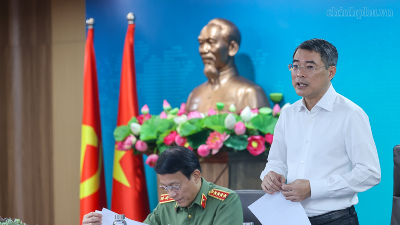
Speaking at the signing ceremony, Deputy Prime Minister Ho Quoc Dung emphasized that, under the Politburo's Resolution No. 57-NQ/TW, AI is one of the strategic technologies that Vietnam must focus on developing and eventually mastering.
According to the Deputy Prime Minister, this vision is being institutionalized by the Government through several key policies, including Decree No. 142/2026/ND-CP on the implementation of the Law on Artificial Intelligence; Decision No. 804/QD-TTg on data for AI development; Decision No. 33/2026/QD-TTg regarding high-risk AI systems; Decision No. 1528/QD-TTg on AI human resource development; and Decision No. 21/2026/QD-TTg concerning strategic technologies.
The Deputy PM also noted that the Government is directing the formulation of a new National AI Strategy and a National AI Transformation Strategy (AIX). These initiatives aim to further refine the direction for AI development, application, and governance in Vietnam.
In this context, the expansion of the FPT-Mila partnership is highly consistent with Vietnam’s AI development goals. Acknowledging the results achieved over the past six years, the Deputy Prime Minister expressed his expectation that this collaboration will provide practical solutions to the nation’s major challenges, bring tangible value to the community, and enable Vietnam to proactively participate in the global AI value chain while helping shape international AI governance standards.
Moving forward, he urged FPT and Mila to focus on four key pillars.
First, prioritize practical products as the ultimate benchmark. There must be a strong shift from pure research to quantifiable outcomes, ranging from core technologies and inventions to commercialized solutions.
Second, place high-quality human resources at the core of development. Efforts should be intensified to train and develop a team of elite AI experts and engineers.
Third, develop AI in a safe, reliable, and responsible manner. Transparency, data security, and system safety must be prerequisites from the design stage. Both parties should take a leading role in contributing to and shaping AI governance frameworks and standards that align with international norms while remaining suitable for Vietnam’s practical needs.
Fourth, expand a collaborative ecosystem with a ripple effect. This involves promoting the "Triple Helix" (State–Research Institute–Enterprise) model. Resources should be prioritized to definitively solve key issues in manufacturing, healthcare, education, and digital infrastructure, using real-world effectiveness as a basis for large-scale replication.







 Google translate