


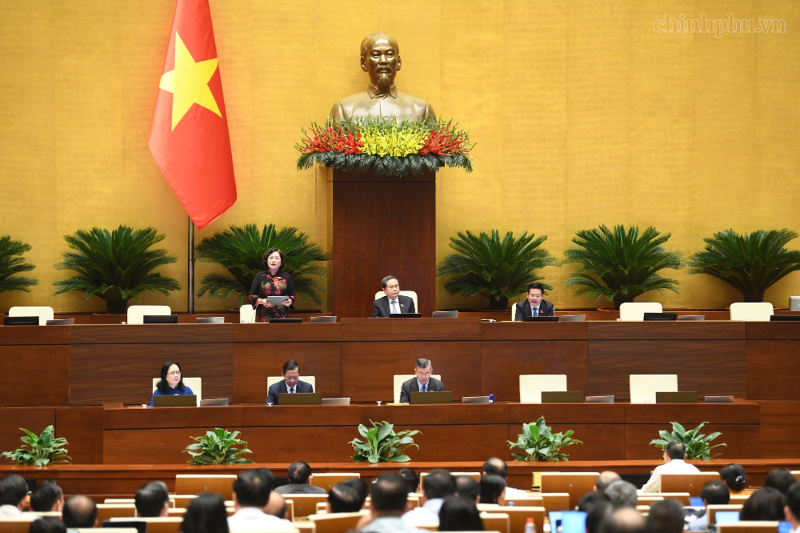
During the ongoing second session of the 16th National Assembly, lawmakers on October 29 held plenary discussions on the draft Law on the Development of Small and Medium Enterprises (Amended), according to the Government online newspaper (chinhphu.vn).
Discussions focused on finalizing transitional mechanisms for restructuring support funds, clarifying criteria for determining enterprise scale, and overhauling policy implementation frameworks to improve business access and uptake.
Contributing to the criteria for defining enterprise scale, National Assembly deputy Dao Chi Nghia from southern Can Tho City noted that short-term volatility in revenue and workforce size can cause an enterprise’s classification to fluctuate constantly. Meanwhile, the draft law lacks specific guidelines for determining total capital for multi-sector enterprises and newly established firms, leaving room for inconsistent interpretations.
The deputy urged the drafting committee not only to re-evaluate the proposed ceilings—300 employees, VND150 billion ($5.8 million) in capital, and VND400 billion ($15.5 million) in revenue—but also to refine the structural design of these criteria. This would ensure accurate classification, sectoral equity, and seamless implementation of support policies.
Deputy Phan Thi Thuy Linh from northern Thanh Hoa Province emphasized that small and medium-sized enterprises (SMEs) account for more than 98% of all operational businesses in Vietnam. Alongside millions of household businesses, they play a vital role in generating employment, securing livelihoods, and maintaining social stability.
However, she pointed out that current support delivery lags behind the enterprise upgrading cycle. To meet the compliance demands of major corporate clients, an SME often requires one to two years of operational and production upgrades. In contrast, existing support initiatives are largely concentrated in the final six months of the fiscal year, primarily consisting of advisory sessions, training workshops, and trade fair participation. High-impact technical assistance, such as trial production runs and standard verification testing, has not been widely deployed.
Citing data from a review report by the Ministry of Finance, the deputy noted that in a survey of nearly 500 SMEs, only about 9% reported having accessed and benefited from state support policies. Consequently, a comprehensive overhaul of policy execution is required so that support measures tangibly reach enterprises.
Ms. Linh proposed that the selection of policy-implementing entities must be conducted transparently, in strict accordance with statutory regulations, and with disbursements tied directly to verified deliverables. Alongside well-calibrated policy formulation, effective rollout mechanisms must be established to ensure businesses are aware of, can easily access, and fully utilize support programs.
Clarification on classification thresholds and support frameworks
Explaining the classification criteria and support frameworks, Minister of Finance Ngo Van Tuan stated that the draft law establishes threshold caps: an average workforce not exceeding 300 employees, total capital capped at VND150 billion, or maximum annual revenue of VND400 billion.
According to the Minister, these thresholds were formulated by building upon prior legal frameworks while factoring in national GDP growth rates and accumulated inflation since 2017. The drafting agency also reviewed international benchmarks, consulting with the Vietnam Association of Small and Medium Enterprises (VINASME), the International Finance Corporation (IFC), the OECD, and several foreign governments. The draft law authorizes the Government to specify detailed criteria tailored to particular industries and sectors.
Regarding support programs, the draft bill structures 11 general support policies alongside four targeted initiatives. The corporate income tax relief program covering the first three years from operational licensing is carried over from the National Assembly's Resolution No. 198/2025/QH15 enacted in 2025, designed to facilitate adaptation, survival, and growth for startups and newly established firms.
On premises and production land access, the draft expands the policy scope by enabling local authorities to develop infrastructure within industrial parks and industrial clusters specifically earmarked for SMEs. According to Ministry of Finance statistics, since Resolution No. 198/2025/QH15 took effect, 110 industrial parks have set aside fully serviced land plots to attract SMEs.
On public procurement, Minister Tuan stated that the policy mandates allocating a minimum of 20% of public procurement budgets to SMEs, prioritizing contract packages valued at VND20 billion ($776,000) or below.
He also noted that ongoing administrative red-tape reductions have delivered a 53% reduction in compliance time and a 54% decrease in compliance costs. The draft law continues to target reductions in statutory compliance overheads while encouraging SMEs to accelerate adoption of information technology, big data, and artificial intelligence.







 Google translate