


August 1 marked the sixth anniversary of the official entry into force of the EU-Vietnam Free Trade Agreement (EVFTA). While six years is just a short chapter in the 36-year journey of establishing formal diplomatic relations between Vietnam and the bloc, the Agreement has had a significant impact on the bilateral economic corridor. It has successfully transformed political goodwill into high-value trade integration, strengthened the confidence of the business community, and firmly established Vietnam’s position in the global value chain.
Positive results
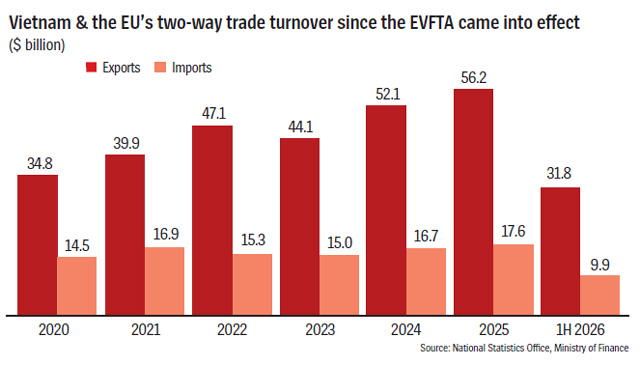
According to Vietnam Customs and the National Statistics Office (NSO) at the Ministry of Finance, the scale of this integration process is clear, with total bilateral trade between Vietnam and the EU exceeding $900 billion in the period from January 1995 to June 2026. Notably, $383.8 billion, equivalent to 42.6 per cent of total trade over three decades, was generated in just six years after the EVFTA officially came into effect in August 2020.
Bilateral trade reached $41.7 billion in the first half of 2026. Of this, Vietnam exported goods worth $31.8 billion and imported $9.9 billion worth from the EU, resulting in the former posting a massive trade surplus of $22 billion in just six months. Notably, this first-half surplus even surpassed the surplus for the entire year of 2019 ($21.7 billion); before the Agreement officially came into effect.
The commercial value of the EVFTA is also evident in how deeply European businesses are integrating its provisions into their core operations. According to EuroCham’s Q2 2026 Business Confidence Index (BCI), 55 per cent of surveyed European enterprises now regard Vietnam as a core operational base or major growth location, while a further 22 per cent identify it as an important component of their regional footprint. Vietnam has matured into a competitive regional platform for long-term expansion across Asia.
Among European enterprises in Vietnam actively engaged in bilateral trade, half directly benefit from the EVFTA’s tariff preferences. Furthermore, 33 per cent apply preferential rates to at least one-fifth of their trade volume, and nearly 20 per cent apply them to more than half of their trade flows.
These statistical findings mirror concrete operational experiences on the ground. One European importer participating in the BCI explained that more than 80 per cent of its Vietnam-EU trade now benefits from the Agreement’s tariff preferences. While the resulting savings have marginally improved profit margins, the greater value lies elsewhere: lower import costs have enabled the company to reduce prices by between 5-15 per cent, making its products more competitive in the Vietnamese market while expanding opportunities for growth.
For logistics providers, increased client utilization of the EVFTA has driven steady growth in freight forwarding, warehousing, and distribution services across the supply chain.
Mr. Bruno Jaspaert, Chairman of EuroCham, said that nearly half of the value generated over three decades of EU-Vietnam trade has taken place under the framework established by the Agreement, highlighting how rapidly commercial integration accelerates once market access barriers begin to lift. “Six years ago, the EVFTA was an ambitious political commitment,” he added. “Today, its impact is measurable and concrete: it has reshaped trade flows, deepened business confidence, and established Vietnam as one of Europe’s most vital economic anchors in Asia.”
Addressing bottlenecks
However, as explicit tariff walls fall, administrative complexity and compliance overheads replace them as primary friction points. According to EuroCham, among businesses encountering utilization obstacles, 50 per cent report delays in domestic tax procedures. Streamlining procedures and digitizing paperwork will be crucial levers to ensure smooth trade flows. Notably, some specialized industries are struggling to navigate multiple domestic tax streams. Despite benefiting from preferential tax rates under the EVFTA after customs clearance, these additional taxes and fees have inadvertently neutralized the preferential advantages, significantly reducing the price competitiveness of goods in the market.
Furthermore, the verification process and documentation for Certificates of Origin (C/O) are a major burden for approximately one-third of businesses. The core reason lies in the lack of consistency in the interpretation and application of regulations across jurisdictions, not only between localities in Vietnam but also between ports in Europe.
Equally important, 17 per cent of businesses believe that compliance costs are currently too high compared to the tax savings. This is also a persistent challenge highlighted in BCI reports over the years, with most businesses citing delays in administrative procedures, inconsistent policy implementation, and a lack of transparency in tax management as the biggest obstacles to long-term expansion plans. Simultaneously, increasingly complex issues related to product certification, testing, and standards have emerged as a factor contributing to increased operational pressure, reflecting the increasingly stringent demands of the Vietnamese economy in its new development phase.
The impact of these barriers is not limited to paperwork, but is directly eroding business resources. One-third of businesses reported that administrative procedures slow down project implementation, 29 per cent had to allocate resources to administrative tasks instead of focusing on core business activities, and 27 per cent stated that the complexity of the regulatory system reduces competitiveness and limits market access.
The fact that management teams have to spend too much time dealing with multi-tiered licensing procedures, repetitive approval processes, and overlapping documentation requirements has turned the administrative burden into a “hidden cost” for innovation, limiting the ability to reinvest in R&D or expand production facilities in Vietnam.
Addressing regulatory friction is becoming even more essential as European sustainability frameworks take effect. Mr. Jean-Jacques Bouflet, Vice Chair of EuroCham, added that unlike earlier generations of FTAs, the EVFTA extends well beyond tariff reductions to encompass customs cooperation, technical standards, intellectual property, sustainable development, and regulatory transparency. “As environmental standards, product traceability requirements, and due diligence expectations continue to evolve, particularly under the European Green Deal, the Carbon Border Adjustment Mechanism (CBAM), and the EU Deforestation Regulation (EUDR), a company’s ability to understand and implement these requirements will become an increasingly important determinant of competitiveness,” he noted.
Looking ahead
EuroCham’s analysis indicates that, entering its seventh year, the EVFTA has reached a highly significant tariff milestone. The EU has officially completed its trade liberalization roadmap, opening the door to tariff-free access for 99 per cent of Vietnam’s exports. In fact, the majority of Vietnamese goods have already entered the EU market under preferential tariff rates of around 80 per cent, and this complete tariff elimination will maximize market access opportunities for domestic producers. On Vietnam’s side, the tariff reduction process for EU goods will continue according to the roadmap over the next four years and be completed by 2030, the tenth anniversary of the EVFTA.
Notably, the EVFTA has established a deeply complementary economic ecosystem where each side optimizes its internal strengths to thrive. European goods such as high technology, advanced machinery and equipment, and pharmaceuticals directly boost Vietnam’s industrial productivity. Conversely, Vietnam’s strengths in electronics, mechanics, textiles, footwear, wooden products, and agricultural products are the perfect complement to strengthen European supply chains and serve millions of consumers there.
However, Mr. Bouflet believes that there is still significant room for deeper cooperation. He pointed out that, currently, the EU accounts for approximately 12 per cent of Vietnam’s total global exports, but imports from Europe account for only 4 per cent. “We encourage Vietnam to increase imports of high-value technology solutions from Europe to support its industrial modernization strategy and master the production value chain,” he added. “Acquiring more high-value technologies from Europe will not only help rebalance the bilateral trade balance, but also provide a solid foundation for enhancing Vietnam’s long-term competitiveness, propelling its domestic industry further up the global value chain.”





 Google translate