


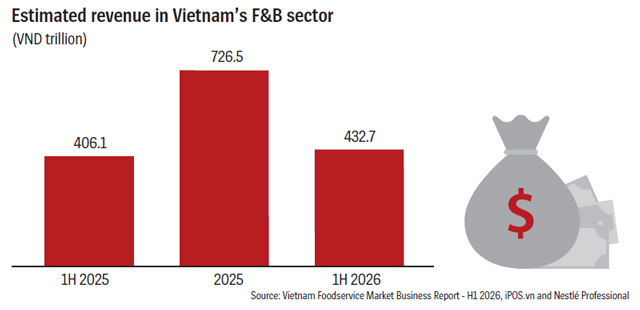
Vietnam’s food and beverage (F&B) revenue came in at an estimated VND432.7 trillion ($17.3 billion) in the first half of 2026, up 6.55 per cent year-on-year, according to the H1 2026 Vietnam F&B Market Report published by iPOS.vn and Nestlé Professional. The pace outstripped the 5.5 per cent growth the sector posted for 2025 as a whole; a headline figure that on its surface pointed to accelerating momentum.
The report’s other data, however, suggested that the growth was driven far more by rising prices than by rising demand, and that it was concentrated among a shrinking pool of winners rather than spread across the market.
Higher prices
Out-of-home dining prices climbed 6.85 per cent in the first half of 2026; almost identical to the 6.55 per cent growth in total industry revenue, the report noted. When menu prices rise at nearly the same rate as total revenue, there is little possibility of attributing increases to genuine volume growth. The near-equivalence of the two figures suggested real, volume-driven growth in the sector was close to flat, and possibly slightly negative once price effects are taken out.
That reading lined up with the report’s ticket-size breakdown. For dinner, the share of diners spending under VND50,000 ($2) fell from 47.61 per cent to 36.93 per cent, while the share of those spending above VND71,000 ($2.85) rose from 28 per cent to nearly 39 per cent. For lunch, the pattern repeats: spending under VND30,000 ($1.20) was down more than 18 per cent, while spending above VND51,000 ($2.05) surged 37 per cent.
Yet the report also stated that evening dining frequency remained constant year-on-year. Consumers, in other words, were not eating out more often - they were being pushed into higher spending brackets while dining out the same number of times.
The report attributed the price pressure to a spike in domestic LPG costs in April and May, compounded by rising labor and real estate overheads, which it noted made low-margin pricing unsustainable for many operators.
Mr. Nguyen Do Anh Quan, Brand Director at iPOS.vn, said this shift reflected cost pressure rather than consumers trading up to premium dining. “Following Tet [the Lunar New Year] each year, operators lacking sufficient cash reserves or robust operating fundamentals generally exit the market,” he said, adding that businesses that survive that particular period are increasingly run with more financial discipline.
Market polarization
The report stated that the number of active F&B outlets fell just 0.1 per cent nationwide in the first half, to roughly 329,200, and framed this as a sign of a stabilizing market. Separately, it stated that average revenue per store “remained flat or contracted slightly.” Both claims are difficult to reconcile with the 6.55 per cent revenue growth figure. If total revenue rose 6.55 per cent while store count stayed essentially flat, average revenue per store should have risen by a similar margin, not stayed flat or declined.
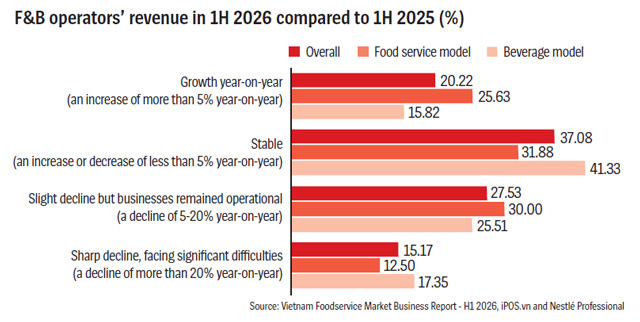
The report’s own survey data offered a likely explanation, even though the report did not explicitly draw the connection. Among 481 businesses surveyed across 15 localities, 43 per cent reported lower revenue than a year prior, 27.53 per cent reported 5 to 20 per cent less, and 15.17 per cent reported more than 20 per cent less, while only 20.22 per cent grew by more than 5 per cent and 37.08 per cent held steady. That distribution suggests the industry-wide average is being pulled upward by a relatively small group of strong performers, while typical businesses are flat or shrinking.
Mr. Vu Thanh Hung, CEO of iPOS.vn, described this as a reallocation of spending rather than a retreat from the market. “Capital has not left the market; it has simply reallocated toward differentiated concepts,” Mr. Hung said, pointing to businesses with similar cost structures and locations posting very different financial results.
Also, the report’s sub-sector data showed a similar rate of revenue contraction between food and beverage concepts, but a meaningfully different growth rate: 25.6 per cent of food establishments grew revenue by more than 5 per cent, compared with 15.82 per cent of beverage outlets. That gap means food businesses surveyed were roughly 60 per cent more likely to post strong growth than a comparable beverage business, despite facing similar downside risk.
Budget matters
The budget-tier competition intensified over the period: 88.5 per cent of operators said they had seen more low-cost concepts open nearby, and 58.2 per cent said they felt direct competitive pressure from them. Yet only 22.81 per cent of all surveyed operators responded by cutting prices or introducing cheaper product lines. A larger share, 35.39 per cent, held pricing unchanged and accepted some loss of volume instead. Combined, roughly 58 per cent of operators either resisted discounting entirely or discounted only selectively, suggesting that, even under direct pressure from budget competitors, most of the market chose to protect margins rather than compete on price.
On where growth actually came from, the report’s figures are direct: 43 per cent of operators cited dine-in customers as their top growth driver, more than double the 18.52 per cent who cited food delivery apps, with a further 16.24 per cent citing takeaway sales at the counter. Combined, nearly 60 per cent of operators pointed to store-based channels as their primary source of growth, versus well under a fifth for delivery - underscoring that despite the prevalence of delivery platforms in Vietnam, in-store experience remained the dominant driver of performance in the first half of 2026.
Despite the pressures described above, 52.01 per cent of F&B businesses said they plan to open new locations or expand their footprint in the second half of 2026, down only slightly from the 57.31 per cent posted in the previous survey cycle.
Mr. Quan said he expects the market to keep expanding through the second half of the year, but predicted that gains would increasingly favor operators with disciplined site selection and efficient unit economics over those pursuing store growth for its own sake. “The upcoming market phase will reward operators expanding with disciplined site selection and lean unit economics, rather than aggressive, untargeted store growth,” he explained.
Taken together, the report pointed to a market where the 6.55 per cent revenue growth is real, but where much of it reflects rising prices rather than rising demand - and where that growth is increasingly captured by a smaller group of operators who can defend margins, while the wider market, according to the report’s own survey, remains close to flat or in decline.






 Google translate