


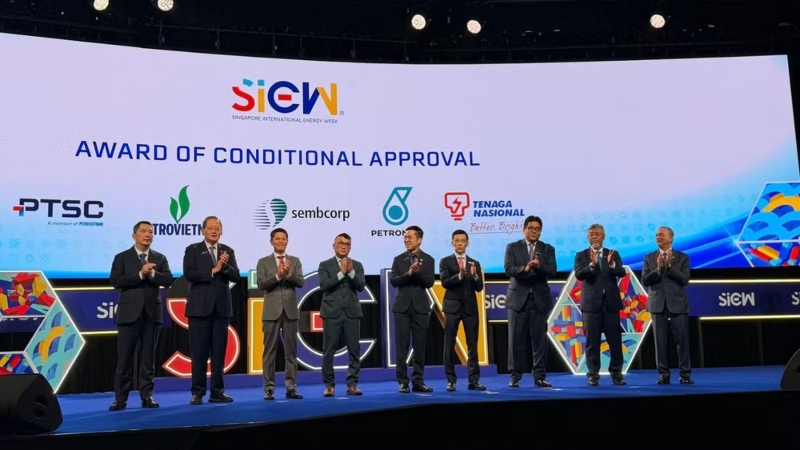
Singapore’s Energy Market Authority (EMA) has granted Sembcorp Utilities Pte Ltd (SCU) conditional approval to act as the electricity importer for the Vietnam–Malaysia–Singapore (VMS) renewable energy export project.
The announcement was made during Singapore International Energy Week 2026 (SIEW 2026), held from October 26 to 30.
The VMS project builds on a Joint Development Agreement signed in May 2025 between the VMS consortium and the MY Energy Consortium (MYEC).
The VMS consortium comprises Vietnam Petroleum Technical Services Corporation (PTSC), a subsidiary of state-owned Vietnam National Industry–Energy Group (Petrovietnam), and SCU. MYEC brings together Malaysia’s national electricity utility Tenaga Nasional Berhad (TNB) and national oil and gas company PETRONAS.
The project aims to deliver up to 1.3 gigawatts (GW) of renewable electricity to Singapore through a transmission corridor connecting Vietnam, Malaysia and Singapore.
Under the proposed plan, most of the electricity would come from offshore wind projects in Vietnam, supplemented by solar power and battery energy storage systems (BESS) in Malaysia. Electricity generated in Vietnam would be transmitted through Malaysia to serve both markets, with Malaysia consuming part of the supply while acting as a transit country for exports to Singapore.
Electricity imports are expected to begin in 2035. PTSC plans to conduct surveys on Vietnam’s continental shelf in November, followed by detailed engineering design and financial planning. The project is targeting a final investment decision (FID) for its first phase in 2029.
If implemented as planned, the project would unlock Vietnam’s offshore wind potential, strengthen cross-border energy cooperation in Southeast Asia and advance the ASEAN Power Grid (APG) initiative.



 Google translate