Dear readers,
Significant achievements in modern science and technology enable humanity to utilize various layers of space to develop a socio-economic landscape. In addition to land and sea, underground space (within the earth, within the sea, on the seabed, and beneath the seabed), outer space, and low-altitude space are also areas that can be exploited for economic development.
In the economic dictionary, the terms “space economy” and “low-altitude economy” have long been established.
The space economy is defined by the OECD as the full range of activities and the use of resources that create value and benefits to human beings in the course of exploring, researching, understanding, managing, and utilizing outer space.
The low-altitude economy, meanwhile, as explained by LowAltitudeEconomy.aero, is an emerging economic sector encompassing all commercial activities, services, and businesses conducted in airspace below 1,000 meters (3,280 feet) above ground level. In some applications and jurisdictions, it extends to 3,000 meters. Three components that define the industry include the aircraft themselves (electric Vertical Take-Off and Landing (eVTOLs), autonomous drones, helicopters, and airships, among others), the infrastructure (vertiports, charging stations, and air traffic management systems), and the services they enable (passenger transport, cargo delivery, emergency response, tourism, and surveillance).
Both the space economy and the low-altitude economy have been identified by many countries and territories as new growth drivers in the transition to a development model based on productivity, knowledge, technology, and human resources.
The US is considered the world leader in developing the space economy and is also a pioneer in building a low-altitude economic ecosystem based on digital technology. China, the EU, Japan, and South Korea are also among the top economies focusing on investing in the development and exploitation of the space economy and the low-altitude economy.
These two economic models not only create high-tech industries with significant added-value but also promote the transformation of growth models through the application of technology to enhance labor productivity and optimize supply chains.
According to data from Novaspace, the global space economy was estimated to have reached a scale of $596 billion in 2024 and this is projected to increase to $944 billion by 2033.
At the “Development of the Space Economy and Low-Altitude Economy in Vietnam” dialogue, organized on August 21 by Tap chi Kinh te Viet Nam / Vietnam Economic Times / VnEconomy, many experts, scholars, and scientists focused on analyzing and evaluating the global race to develop the space economy and low-altitude economy, while also making recommendations for creating an environment and legal framework for Vietnam to accelerate investment in these two promising economic endeavors, especially in the context of the country transforming its development model based on productivity, knowledge, technology, and human resources, as outlined by Resolution No. 19-NQ/TW from the 3rd Plenum of the 14th Party Central Committee, issued on July 28, 2026.
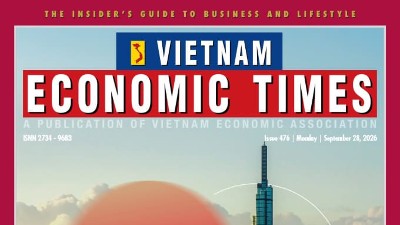
Our Cover Story in this edition will provide readers with the latest information on the space economy and the low-altitude economy, as well as the potential and prospects for Vietnam in its efforts to explore, invest in, and exploit these emerging economic sectors.
Warmest regards
Dr. CHU VAN LAM
CHAIRMAN OF THE EDITORIAL BOARD






![[Interactive]: Economic overview - September 2026](https://premedia.vneconomy.vn/files/uploads/2026/10/06/9e0f403040dd4384ad690004bc1911ab-124594.png?w=400&h=225&mode=crop)