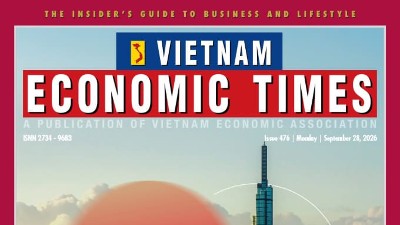
Dear readers,
The development of industrial parks (IPs) in Vietnam has long been a strategic orientation to attract domestic and foreign investment, thus accelerating the country’s industrialization process in line with the policy of restructuring the national economy. Its network of IPs has helped integrate and connect infrastructure resources, created millions of jobs, formed a modern production ecosystem, and contributed to environmental protection.
After nearly 40 years of the “Doi Moi” (Economic Renewal) process, Vietnam has developed a widespread network of IPs around the country, initially meeting the needs of domestic and foreign investors for infrastructure to build and operate factories and other manufacturing facilities. According to official figures, as of the end of 2025 there were 478 IPs nationwide, including 421 outside economic zones, 49 within coastal economic zones, and eight in border economic zones; attracting over 50 per cent of FDI projects, focusing on industrial sectors, especially manufacturing and processing.
However, in the face of the rapid development of science and technology, particularly high-technology, as well as the trend toward modern industrial development globally, traditional IPs have struggled to meet the modern infrastructure and operational space requirements of new-generation factories.
Consequently, policymakers and investors in IP development have had to change their mindset, shifting toward planning, designing, and constructing IPs based on a production-innovation-service ecosystem model, in connection with urban areas and social amenities, logistics services, and transportation systems including roads, railways, seaports, and airports, to expand new development spaces, with a focus on developing new-generation IP models that integrate production space with R&D facilities, logistics services, housing, urban services, and other amenities for workers.
Politburo Resolution No. 10-NQ/TW on developing the foreign-invested economic sector, issued on June 8, 2026, envisages a transformation of IPs, free trade zones, high-tech zones, and economic zones. Rather than functioning solely as manufacturing locations, these areas are expected to evolve into integrated industrial ecosystems that combine production, logistics, innovation, and supporting services, according to the Resolution.
It is expected that, at its upcoming plenum, the Party Central Committee will consider and issue a resolution on renewing Vietnam’s development model, with the new growth model playing a particularly important role.
Traditional IPs must inevitably change to meet the demands of industrial growth in particular and the economy in general, according to the above orientation.
It is clear that renewing the traditional IP model in Vietnam is no longer a trend but a necessity, in response to the demands of national development in the new era.
To further clarify, both in theory and practice, the necessity of developing new-generation IPs toward integrating production infrastructure with logistics, service, and social infrastructure, while developing clusters that enable strategic industries to be linked with development spaces, local planning, and environmental treatment, as defined by Politburo Resolution No. 10, our Cover Story in this edition focuses on developing new-generation IPs in service of industrial growth, on the basis of synchronous technical infrastructure and modern industrial production ecosystems.
Warmest regards
Dr. CHU VAN LAM
CHAIRMAN OF THE EDITORIAL BOARD
![[Interactive]: Economic overview - September 2026](https://premedia.vneconomy.vn/files/uploads/2026/10/06/9e0f403040dd4384ad690004bc1911ab-124594.png?w=400&h=225&mode=crop)