


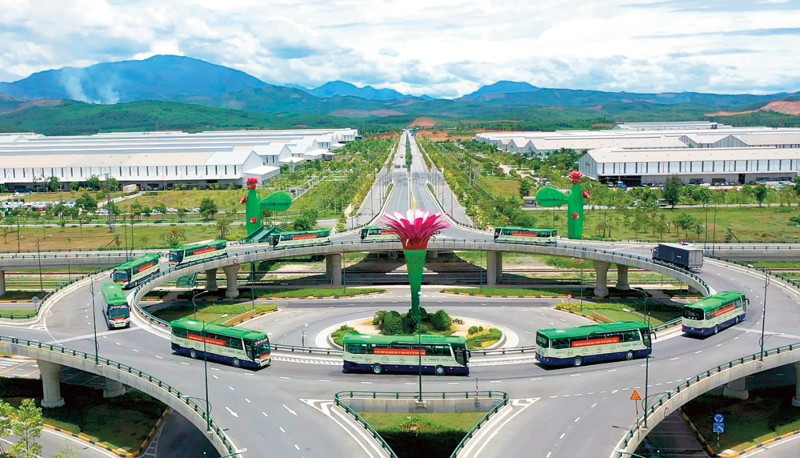
Vietnam attracted more than $34.6 billion in registered FDI during the first half of 2026, up nearly 61 per cent year-on-year, according to the National Statistics Office at the Ministry of Finance. Disbursed FDI totaled $13.03 billion; the highest in many years. These figures underscore Vietnam’s ongoing appeal to international investors as global supply chains continue to realign.
Yet as investment inflows steadily grow, so too do investors’ expectations. While land availability, physical infrastructure, and investment incentives once defined an industrial park (IP)’s competitiveness, high-tech and high-value projects increasingly assess locations based on access to skilled talent, supporting industries, logistics networks, innovation ecosystems, and sustainability performance. The shift reflects not only changing site selection criteria but also a broader transformation in how IPs themselves are designed and developed.
This evolving landscape was a recurring theme at the Vietnam Industrial Park Summit 2026. Whether representing international organizations, government agencies, local authorities, or IP developers, speakers converged on the same question: how can IPs create greater value for investors long after a project is established, rather than simply providing manufacturing space? The answer is reshaping the competition for FDI in Vietnam’s next phase of development.
Beyond the gates
Land bank size and occupancy rates were long the standard indicators of an IP’s success. The more land developed and projects attracted, the more successful a park was considered. This approach suited a period when Vietnam focused on attracting labor-intensive manufacturing, where production space, investment costs, and basic infrastructure were the primary competitive advantages.
As Vietnam shifts toward attracting higher-quality FDI, however, these strengths have become baseline requirements rather than differentiators. Semiconductor plants, research centers, and other high-tech investments evaluate locations not only by land lease costs and infrastructure but also by their ability to access suppliers, recruit skilled workers, collaborate with research institutions, meet sustainability standards, and support long-term expansion. Increasingly, an IP’s competitiveness is determined by factors that lie beyond its physical boundaries.
According to Ms. Le Thi Thanh Thao, Country Representative of the United Nations Industrial Development Organization (UNIDO) in Vietnam, the country has made significant progress in attracting FDI over nearly four decades, but the quality of investment still has room for improvement. Localization rates remain relatively low, links between FDI enterprises and domestic companies are still limited, and technology transfer has yet to meet expectations.
Against this backdrop, Ms. Thao called for shifting the focus from the quantity of FDI to quality, emphasizing innovation capacity, technology transfer, supplier development, workforce upskilling, and greater domestic value creation. If these become the defining measures of investment quality, IPs can no longer compete solely on land supply and physical infrastructure.
The changing expectations are also reshaping IP models. Ms. Sinem Demir Duru, Decarbonization Expert / Eco-Industrial Parks Lead for Asia at the International Finance Corporation (IFC), said eco-industrial parks (eco-IPs) are designed not only to improve resource efficiency and reduce emissions but also to strengthen governance, enhance business services, promote industrial symbiosis, facilitate access to green finance, and meet the international standards increasingly prioritized by multinational corporations when selecting investment locations. For the IFC, eco-IPs are therefore a competitiveness strategy rather than simply an environmental initiative.
Mr. Tran Van Nam, a representative of the Vietnam-China Nexus Center, Vice Principal of FPT Polytechnic College, and Vice Chairman of the Vietnam Semiconductor Alliance, said high-quality human resources, business support services, innovation capacity, and the readiness of the broader industrial ecosystem will increasingly determine the ability to attract semiconductor projects, high-tech manufacturing, and R&D centers.
Experts agreed that the role of IPs has fundamentally changed. While their primary value once lay in providing land and infrastructure, they are now expected to connect businesses with suppliers, skilled workers, research institutions, logistics providers, and local innovation ecosystems. Roads, electricity, and water remain essential, but they offer little competitive advantage if investors cannot recruit qualified engineers, find capable local suppliers, or integrate into global supply chains.
IP boundaries may still define the footprint of an investment project, but they no longer define its competitiveness. A factory may occupy only a few dozen hectares, yet its long-term success depends on the quality of the local workforce, regional supplier networks, logistics infrastructure, and innovation environment. Increasingly, it is these assets beyond the IP’s gates that determine whether high-quality FDI can be attracted and retained.
Ecosystem advantage
Competition for FDI is no longer defined by how many new IPs a locality can develop, but by how effectively those parks are integrated into a broader regional ecosystem. While IPs were once planned as largely self-contained manufacturing zones, high-tech industries, semiconductor projects, and data centers increasingly depend on seamless connections to logistics, digital infrastructure, research institutions, financial services, and regional business networks.
Mr. Nguyen Cong Tien, Standing Deputy Head of the Da Nang Hi-Tech Park and Industrial Parks Authority, said this thinking underpins Da Nang’s industrial development strategy. Rather than promoting individual IPs, the central city is building an integrated development ecosystem linking logistics infrastructure, seaports, the international airport, digital infrastructure, the Hi-Tech Park, the Free Trade Zone (FTZ), and the International Financial Center. Within this framework, IPs are no longer the final destination for investment but one component of a broader value chain spanning research, manufacturing, logistics, and services.
Vietnam’s first FTZ, covering nearly 1,900 ha, is being developed alongside Lien Chieu Port and the International Financial Center, with a focus on logistics, trade, digital technologies, innovation, semiconductors, data centers, and cross-border e-commerce. The National Hi-Tech Park, spanning 1,128 ha, is targeting industries such as semiconductors, aerospace, robotics, unmanned aerial vehicles, and high-speed rail technologies.
Meanwhile, the Chu Lai Open Economic Zone, covering more than 27,000 ha, is expanding industrial development linked to seaports, airports, and large-scale manufacturing. Rather than competing with one another, these developments are designed to extend the value chain within a single integrated ecosystem.
This approach aligns closely with the IFC’s vision for eco-IPs. Ms. Demir Duru believes the value of an IP should be measured not only by occupancy rates or infrastructure utilization but also by the quality of its governance, business services, supplier networks, job creation, and capacity to generate local economic value. In other words, IPs are increasingly judged by their ability to provide an environment where businesses can grow over the long term rather than simply offering a place to build factories.
According to Ms. Tran Huyen Yen Phuong, Deputy Director of Strategic Development at the IDICO Corporation, as differences in land availability, infrastructure, and rental costs narrow across localities, competitive advantage will increasingly depend on service quality and the ability to support investors throughout the entire project lifecycle. That means developers must move beyond building infrastructure for lease and instead provide comprehensive services ranging from investment procedures and logistics connectivity to operational support and business expansion.




 Google translate