


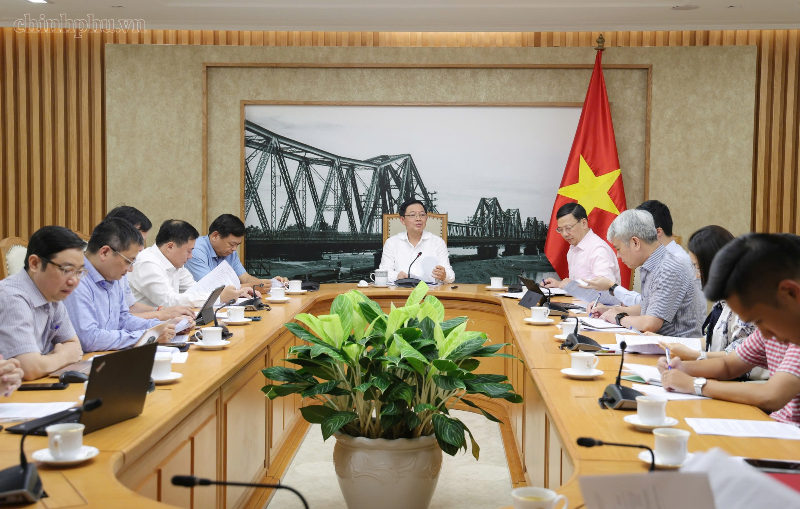
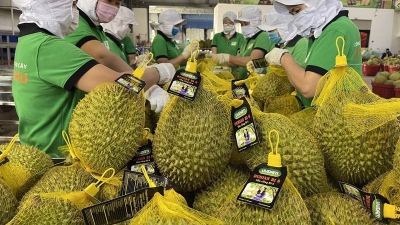
Deputy Prime Minister Ho Quoc Dung on August 10 chaired a meeting to review the implementation of Resolution No. 36/2026/NQ-CP on simplifying administrative procedures for planting area codes and packing house codes to facilitate the consumption and export of durians, according to a report by the Government News.
The Deputy PM noted that as a rapidly growing sector, the durian industry requires fundamental and long-term solutions to reorganize production, control quality, expand markets, and increase product value.
The first priority is to review and reorganize production, specifically focusing on the zoning of durian-cultivating regions as well as other fruit-growing areas, he said.
Drawing lessons from the current state of the industry, he urged the agricultural sector to strictly manage cultivation acreage while increasing advisory efforts to ensure farmers have sufficient information before making production decisions. He stressed the importance of preventing a situation where farmers "rush" to expand durian areas, which could eventually lead to a product surplus, negatively impacting production efficiency and farmers' livelihoods.
Furthermore, he encouraged export businesses to heighten their social responsibility and build stronger ties with local farmers and authorities. He called for transparent and professional production practices, stating that exporters must actively support farmers and contribute to building a national brand for Vietnamese durians.
Building the Vietnamese durian brand
The Deputy PM directed ministries, sectors, and local authorities to prioritize the development of the durian brand.
The goal is to gradually establish a brand identity so that the international market immediately associates durians with Vietnam. Simultaneously, this effort aims to affirm the quality of Vietnamese durians, particularly products from high-advantage regions such as the Central Highlands.
He emphasized that this is a mission of long-term significance. He warned that without a strong brand, high quality, and a competitive edge, Vietnamese durians will struggle to compete in the international market over the long term.
According to Deputy Minister of Agriculture and Environment (MAE) Nguyen Hoang Hiep, by 2026 the country’s total durian cultivation area is estimated to reach approximately 200,000 ha, doubling the initial industry master plan of 100,000 ha.
In the first seven months of 2026, Vietnam harvested 768,000 tons of durians. For the remaining five months, an additional 1.3 million tons are expected to hit the market, primarily concentrated in the Central Highlands.
Given that the harvest is concentrated in a short window from August to October, Mr. Hiep emphasized the urgent need for efficient harvesting, testing, preliminary processing, and logistics to prevent congestion and reduce pressure during peak periods.
According to the MAE, Vietnamese durians are mainly exported through official channels as fresh fruit. In 2025, exports reached nearly 1 million tons of fresh fruit and 117,000 tons of frozen durian. In the first seven months of 2026 alone, the country exported 493,000 tons, valued at approximately $950.7 million—a 31% increase compared to the same period last year.
Mr. Hiep expressed confidence that durian export turnover will certainly exceed $4 billion this year.
Vietnamese durians are currently exported to over 20 countries. In July, India officially granted market access for fresh Vietnamese durians. The MAE is also negotiating with Australia, New Zealand, and other markets to further expand export outlets.
Regarding the Chinese market, as of July 2026, there are over 1,200 active planting area codes and 120 active packing house codes. Additionally, more than 1,100 codes are currently awaiting approval from Chinese authorities.
Addressing challenges for sustainable growth
Despite these achievements, the durian industry faces several hurdles. The rapid expansion of cultivation area has not been matched by equivalent supply chain integration, leading to potential risks of oversupply and difficulties in quality control.
Furthermore, importing markets are imposing increasingly stringent requirements regarding food safety and traceability. Preservation and deep-processing technologies remain limited, leaving the industry heavily dependent on fresh fruit exports.
According to MAE, Resolution No. 36 has fundamentally resolved the legal and procedural bottlenecks for major durian-producing regions. The ministry is currently collaborating with local authorities to build and deploy comprehensive plans for the implementation of the resolution in provinces where key export crops are approaching peak harvest season, most notably Dak Lak, Lam Dong, Gia Lai, and Quang Ngai.
Speaking at the event, Deputy Minister of Industry and Trade Nguyen Sinh Nhat Tan stated that overseas trade missions have been tasked with coordinating with MAE to further promote the image of Vietnamese durians. Efforts are also being ramped up to expand into new markets and accelerate negotiations for broader market access.
Regarding the domestic market, the Ministry of Industry and Trade urged the immediate development of a comprehensive traceability system, not only for durians but for all agricultural products in general.




 Google translate