


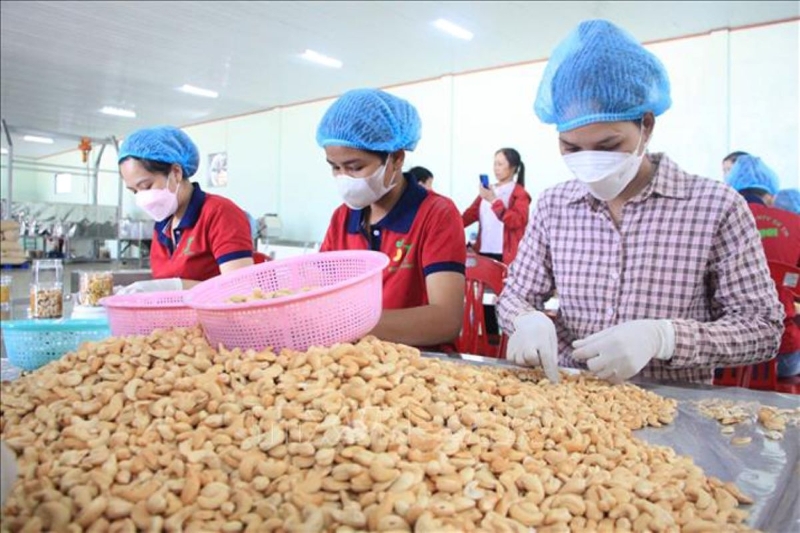
Vietnam exported 74,107 tons of cashew nuts in May 2026, generating $528.54 million in revenue, an increase of 7.7% in volume and 8.2% in value compared to the previous month, according to the Vietnam Customs.
As a result, in the first five months of 2026, the country exported a total of 268,408 tons worth $1.87 billion, representing a 3% decrease in volume and a 0.3% decrease in value compared to the same period last year.
While the two largest markets remain China and the United States, several other markets have shown positive signs. The Netherlands imported 22,349 tons worth nearly $160 million, a slight increase year-on-year. Germany recorded particularly strong growth with over 11,000 tons valued at more than $78 million, a 24% surge in value. Other markets such as Canada, Australia, Thailand, and Spain also reported favorable growth rates.
Despite these gains, the industry has struggled to compensate for the significant downturn in the Middle East. Mr. Bach Khanh Nhut, Permanent Vice Chairman of the Vietnam Cashew Association (Vinacas), noted that after three consecutive years of double-digit growth, the industry entered 2026 with high expectations. However, the conflict in the Middle East has severely disrupted the entire sector’s export outlook.
While export activities were relatively smooth during the first two months of the year, volumes to the Middle East plummeted in mid-March as regional tensions flared. In March alone, exports to the region fell by approximately 50%, and by April, virtually no new contracts were signed. By the end of May, trade with the Middle East had reached a state of near-total "freeze."
Vinacas reports that a combination of logistics stagnation, maritime shipping hurdles, and a cautious stance from importers has brought transactions to a standstill. Consequently, Vietnam's total cashew exports in the first four months of 2026 fell by roughly 3.8% compared to the previous year.
The Middle East currently stands as the third-largest export market for Vietnamese cashews, trailing only the US and China, and accounted for about 12% of total export turnover in 2025. As a result, the market's decline has had a massive impact on domestic enterprises.
According to Mr. Nhut, finding alternative markets to replace the Middle East is no simple task. Vietnamese cashews are already present in over 112 countries and territories, suggesting there is little remaining room for market expansion.
Developing new markets requires significant time to establish distribution networks, understand consumer habits, and build customer relationships. Therefore, it is unlikely that the industry can achieve an additional 5-7% growth elsewhere in the short term to offset the losses from the Middle East, according to the Vinacas leader.







 Google translate