


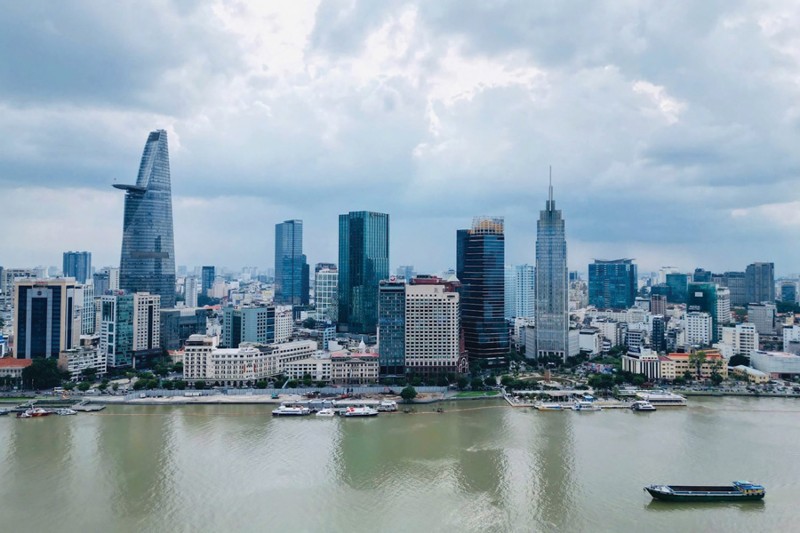
Despite boasting one of Vietnam’s most dynamic innovation ecosystems and the country’s highest concentration of businesses, Ho Chi Minh City faces a paradox: a shortage of corporate champions capable of leading the economy forward. If Vietnam’s private sector is to compete regionally and globally, both the southern city’s government and its businesses must undertake strategic transformations.
According to a 2025 report from the Vietnam Chamber of Commerce and Industry (VCCI) and the World Bank, released in May this year, Ho Chi Minh City retained its leading position in the Private Sector Performance Index (DPI) with a score of 5.67. The city’s business density reached an impressive 23.75 enterprises per 1,000 residents, or three-times the national average.
However, the business standing of the country’s economic hub appears to be losing momentum relative to other localities, particularly Hanoi. Mr. Huynh The Du, a Member of the Institute for Vietnam Initiatives and a Public Policy Lecturer at the Fulbright School of Public Policy and Management, noted a concerning trend: the market capitalization of listed companies based in Ho Chi Minh City accounted for only about one-third, or 33 per cent, of the national total as of the end of 2025; a sharp decline from more than 50 per cent a decade earlier. Even more troubling, Ho Chi Minh City-based companies are gradually disappearing from the ranks of Vietnam’s ten largest enterprises and from the Fortune Southeast Asia 500 list.
Major bottlenecks
Analyzing the root causes of existing barriers, Mr. Dinh Hong Ky, Chairman of the Saigon Construction & Building Material Association and Chairman of the Secoin Group, noted that as many as 98 per cent of Vietnamese businesses are micro, small, and medium-sized enterprises. (MSMEs). The expansion capacity of domestic firms is alarmingly limited, with even private companies that have operated for 30 to 40 years remaining largely stagnant and showing little breakthrough growth.
Though the government has demonstrated strong political commitment to developing the private sector and accelerating public investment, implementation continues to face significant capital constraints. Heavy reliance on bank credit has left businesses vulnerable, as tighter lending conditions and higher interest rates from late last year through to early 2026 have severely strained cash flow for small and medium-sized enterprises (SMEs).
Many businesses are reluctant to borrow or expand operations when 93.5 per cent of loans require collateral. The resulting capital shortage has directly undermined market development and technological innovation.
A 2025 VCCI survey found that 60.2 per cent of businesses struggled to find customers. During the opening months of 2026, market conditions in several key industries became even more challenging due to supply shortages. Limited access to capital, weak management capabilities, and insufficient investment in R&D have stalled innovation efforts. Even large companies have adopted a more cautious approach, breaking three- to five-year projects into shorter phases to better manage risk.
Mr. Le Phung Hao, CEO of Global AAA Consulting, said that while Ho Chi Minh City is home to a large number of SMEs that benefit from operational flexibility, many have fallen into a “short-term mindset trap.” Rather than consistently building core competencies, some pursue opportunistic ventures or diversify into multiple sectors based on market trends.
When market conditions shift, these firms often lose direction, contributing to a growing wave of business closures. In 2025, the number of suspended businesses increased by more than 10 per cent, while nearly 20,000 companies exited the market each month on average; a direct consequence of short-term thinking.
The city’s economy is also confronting a generational succession challenge among family-owned businesses. Many major brands that helped define Ho Chi Minh City’s commercial landscape over the past three to four decades have opted to sell outright to investment funds or foreign corporations rather than transfer leadership to the next generation.
At the same time, the business ecosystem remains incomplete, lacking both horizontal links between domestic firms and vertical connections with foreign-invested enterprises (FIEs). Domestic companies largely operate in isolation. Even when they participate in foreign-invested value chains, they tend to occupy low-value segments focused on basic processing or contract manufacturing.
From a macro-economic perspective, Mr. Do Thien Anh Tuan, Public Policy Lecturer at the Fulbright School of Public Policy and Management, argued that the city lacks large corporations capable of anchoring and coordinating the broader economy. Vietnam’s strongest private enterprises today are concentrated primarily in non-manufacturing sectors such as finance, real estate, and securities.
As a result, the economy lacks industrial champions in manufacturing and processing industries that could serve as growth engines for smaller firms. In addition, retrospective policy changes and an increasingly fragmented policy environment have weakened business confidence, discouraging companies from making long-term plans.
Elevating enterprises
To strengthen the competitiveness of Ho Chi Minh City businesses within ASEAN and global markets, Mr. Ky recommended that companies immediately shift their strategic mindset from pursuing growth through scale alone to focusing on productivity, quality, and innovation.
Private enterprises should prioritize upgrading governance capabilities and professionalizing family-business structures to ensure sustainable succession. Integrating green standards, advanced technologies, and sustainable practices into core operations is no longer optional but essential for overcoming increasingly stringent international trade requirements.
At the same time, businesses must improve their capacity to absorb new technologies and actively pursue cross-sector partnerships to move beyond isolated business models and increase their participation in global supply chains.
From a strategic advisory perspective, Mr. Hao emphasized that rising land costs and tighter financing conditions require businesses to move away from accumulating bulky physical assets with low returns. Instead, companies should focus on intangible assets, including R&D capabilities, design expertise, brand development, and advanced management technologies. These areas generate the highest value-added returns within modern supply chains.
Businesses must also embrace ecosystem-based growth strategies by integrating more deeply into regional networks, establishing stronger partnerships with supporting industries, and upgrading manufacturing standards to meet the requirements of major FIEs. Investment in international quality standards is effectively a prerequisite for participating in global markets.
In addition, data-driven management systems have become essential. Companies need to abandon decision-making based primarily on intuition or personal experience and pursue meaningful digital transformation across procurement, production, and customer experience management.
From a broader policy perspective, Mr. Tuan argued that efforts to elevate businesses must begin with institutional reform. The challenge is not simply competition between enterprises but also competition among governments in terms of regulatory effectiveness.
Every administrative procedure in Ho Chi Minh City should be benchmarked against those of Singapore, Malaysia, and Thailand. Until the city can compete with these regional peers on policy efficiency and ease of doing business, domestic companies will continue to face obstacles in scaling up.
The city administration must serve as a genuine enabler through bold and practical institutional reforms. Rather than relying on formal dialogue sessions, authorities should focus on resolving specific obstacles faced by individual projects and businesses. Government performance should be measured by the number of real bottlenecks eliminated.
The southern city should also pioneer mechanisms that expand access to financing based on intellectual capital and cash-flow lending models, providing critical support to asset-light businesses.
Finally, Ho Chi Minh City must accelerate investment in integrated technical and social infrastructure while minimizing unofficial administrative transaction costs. Doing so would create a more transparent, efficient, and business-friendly environment capable of supporting the next generation of corporate leaders.





 Google translate