


How have relations between Vietnam and Azerbaijan developed over the years, and in which areas has this been most evident?
For Azerbaijan, Vietnam is a particularly important partner in Asia because our two countries share a unique historical relationship dating back to 1959, when President Ho Chi Minh visited Azerbaijan. That visit laid the foundation for a longstanding friendship that has endured for decades.
Cooperation between our two countries began in the oil and gas sector. Forty years ago, Vietnam and Azerbaijan stood side-by-side in laying the first foundations of Vietnam’s petroleum industry, helping produce the country’s first barrels of oil. Those achievements created a solid foundation for Vietnam’s “Doi Moi” (Economic Renewal) reforms and subsequent economic development. We celebrate this year the 45th anniversary of Vietsovpetro, an organization that has played a pivotal role in supporting and laying the groundwork for Vietnam’s successful economic development.
We share a rich historical legacy, but today our responsibility is not only to preserve that legacy but also to build upon it and take our partnership to a new level.
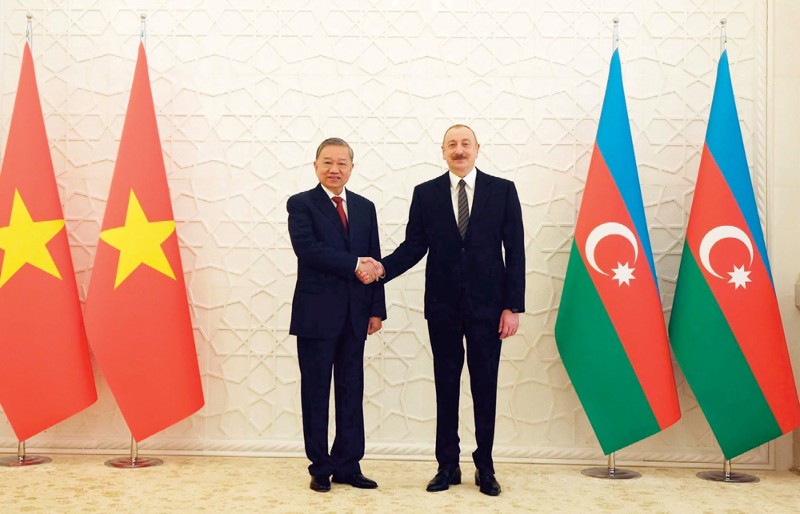
Last year, Party General Secretary and State President To Lam paid an official visit to Azerbaijan on May 7. During the visit, the leaders of our two countries elevated bilateral relations to a Strategic Partnership. Following that milestone, Azerbaijan sent around eleven ministerial-level delegations to Vietnam within a relatively short period, and this momentum has continued into this year.
This year, Azerbaijan also launched its first direct cargo flights between Baku and Hanoi, connecting Europe and Asia, operated by our national cargo carrier, Silk Way West Airlines. This will provide a strong boost not only to trade between Vietnam and Azerbaijan but also to trade between Vietnam and its European partners, as the airline is one of Europe’s leading air cargo operators.
At the same time, I am pleased to share that several major joint investment projects involving leading Vietnamese and Azerbaijani companies, both in Vietnam and Azerbaijan, will be announced in the near future. These projects will be significant not only for our two countries but also for the wider region.
Moreover, amid today’s increasingly complex geopolitical environment, Vietnam, Azerbaijan, Central Asia, and Türkiye together form one of the most reliable land and air transport corridors linking Europe and Asia. Azerbaijan, Kazakhstan, and Türkiye, together with other partners, are working to connect Vietnam to the Middle Corridor, which links Asia and Europe. We believe this connectivity will strongly support Vietnam’s economy, particularly as it pursues double-digit growth this year and requires reliable transport routes to European markets.
We also look forward to strengthening tourism, one of the most promising areas of bilateral cooperation. For Azerbaijan, Asia represents a relatively new but highly dynamic and comprehensive tourism market. Compared with some of our Central Asian partners, our tourism cooperation with Vietnam is still at an early stage. However, I believe tourism can serve as an important catalyst for expanding cooperation in many other areas. Oil and gas, tourism, and transportation will remain priority sectors for future collaboration.
What changes in bilateral relations have you observed since Party General Secretary and State President To Lam’s visit to Azerbaijan in May 2025?
Party General Secretary and State President To Lam and Azerbaijani President Ilham Aliyev made the strategic decision to elevate Vietnam-Azerbaijan relations to a Strategic Partnership. The two leaders identified two overarching priorities: strengthening economic cooperation and expanding cultural exchanges, reflecting the significant potential in both areas.
Within the economic partnership, priority sectors include energy, oil and gas, renewable energy, tourism, transportation, and construction. Construction, in particular, offers considerable opportunities for companies from both countries to collaborate and exchange expertise on major infrastructure projects.
Another highly-promising area is digital transformation and e-government. Azerbaijan has already digitized virtually all public services, making them available online. Today, Azerbaijani citizens can renew a passport or driver’s license at a single service center in just 10 to 15 minutes through the ASAN (Azerbaijani Service and Assessment Network) service model, and we are ready to share this experience with Vietnam. I believe there are valuable opportunities for both countries to exchange knowledge and learn from each other’s experience in delivering citizen-centered public services.
In addition, we are preparing to launch several major projects in oil and gas, power generation, transportation, and infrastructure development. These are all highly promising areas of cooperation. I hope that by the end of this year we will be able to announce specific projects in which businesses from both countries can participate.
Are Vietnam and Azerbaijan currently cooperating to strengthen energy security?
I believe that, under the guidance of our respective leaders, energy companies from both countries will deepen direct cooperation and explore concrete projects, particularly in the supply of petroleum products.
Azerbaijani crude is among the highest-quality oil grades in the world. Our petroleum experts are also very familiar with the Vietnamese market, as many of them spent more than a decade working in Vung Tau with Vietsovpetro and have built strong professional and personal relationships there.
To further strengthen energy cooperation, I believe it is important to expand direct engagement between energy companies in both countries. Such cooperation will naturally reinforce broader economic ties, because energy not only powers economies but also builds trust and confidence across other areas of partnership.
I hope that, in the near future, the leading oil and gas companies of both countries will meet, launch new projects, and further deepen the strong relationship that already exists.
In your view, which Vietnamese products have the greatest potential in the Azerbaijani market?
I believe Vietnamese products, particularly agricultural goods and electronics, are highly competitive and have strong potential not only in Azerbaijan but across our wider region.
We have developed a major free economic zone on the Caspian Sea, integrating all four modes of transport, and Baku is emerging as one of the region’s most important logistics hubs. Our ambition is not only to import Vietnamese goods into Azerbaijan but also to serve as a distribution gateway to markets in the north, south, east, and west.
That is why Vietnamese food products, seafood, agricultural products, textiles, and electronics all have strong export potential, and this process has already begun.
Though Vietnam does not yet have an embassy in Azerbaijan, every July we organize Vietnam Day in Baku to commemorate President Ho Chi Minh’s visit to the city. Following Party General Secretary and State President To Lam’s historic visit last year, the successful Vietnam Day celebrations, and the inauguration of the Ho Chi Minh Hall at the Azerbaijan State Oil and Industry University, we have seen growing interest among Vietnamese businesses, many of which have begun exporting food and agricultural products to Azerbaijan.
Last May, the first large Vietnamese restaurant opened in Baku and has attracted a strong customer following. Vietnamese food products are becoming increasingly popular across our region, and I believe agricultural products, textiles, and electronics will also enjoy considerable opportunities.
We also need to strengthen rail logistics, with air freight connectivity already beginning through Silk Way West Airlines cargo services. Together, these developments create promising opportunities to make Vietnamese products more widely available across our region.
In July 1959, President Ho Chi Minh paid a historic visit to Azerbaijan, laying the foundation for the enduring friendship between Vietnam and the Caucasus nation. More than six decades later, in May 2025, this longstanding relationship was elevated to a Strategic Partnership during Party General Secretary and State President To Lam’s official visit to Azerbaijan.
After nearly seven decades of development, cooperation between Vietnam and Azerbaijan continues to expand in both scope and depth across a wide range of sectors, including investment, trade, tourism, and logistics, creating new opportunities for mutually-beneficial growth and delivering tangible benefits for both countries.
Does the Azerbaijani market have any specific requirements for imported agricultural and seafood products?
Consumer preferences naturally differ from market to market. Azerbaijanis, for example, traditionally consume more meat, particularly lamb. Seafood has not historically been as common or as developed in Azerbaijan as it is in Vietnam. However, the new direct cargo flights between our two countries will make it possible to bring Vietnamese seafood to Azerbaijan. In my view, Vietnamese seafood is among the finest in the world and has excellent prospects in our market.
Vietnam’s fresh agricultural products, especially tropical fruit, are also highly attractive to consumers in our region. Until now, logistics constraints have limited access, but direct cargo services now make these exports much more feasible.
Companies from both countries have already begun discussions. From Azerbaijan’s side, we are also interested in introducing Azerbaijani lamb as well as other meat products to Vietnam. We also hope to bring fresh Azerbaijani fruit, including white, red, and black cherries, apricots, and pomegranates, all of which are among our country’s best-known agricultural products.




 Google translate