


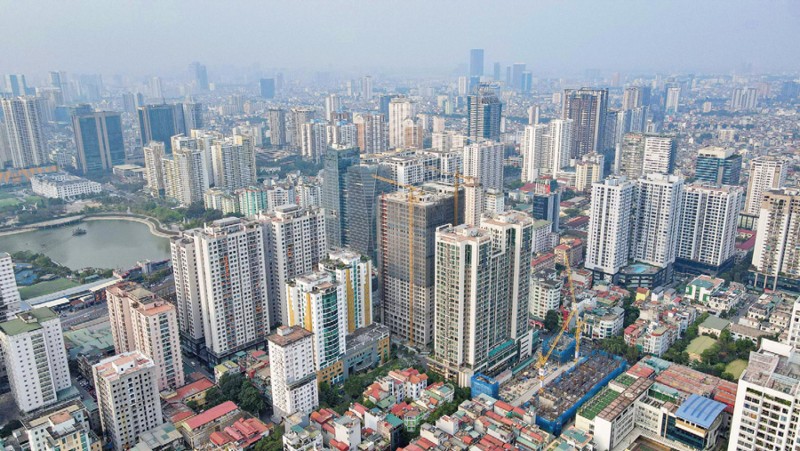
Many observers argue that Vietnam’s real estate market has grown rapidly but lacks stability. How do you view this assessment?
The rapid growth of Vietnam’s real estate market over the past several years has contributed significantly to economic expansion, infrastructure investment, urban development, and the growth of related industries. However, behind this strong performance lies a major structural imbalance: supply is heavily concentrated in the high-end segment, while housing that is affordable for the majority of the population remains scarce.
Vietnam has developed a robust market for homes for sale but has yet to establish a professional, long-term rental housing system with clear State guidance. Today’s rental market remains largely fragmented, small-scale, and unplanned, often failing to provide stable and quality living conditions.
Traditionally, Vietnamese people have preferred homeownership over renting. Do you believe rental demand is strong enough to support a professional rental housing market?
According to the Vietnam General Confederation of Labor, around 4.5-5 million workers are employed at industrial parks, most of whom rent accommodation, often with inadequate living conditions. In Hanoi and Ho Chi Minh City, the number of renting households continues to rise, particularly among young people, migrant workers, and those at the beginning of their careers. Yet quality rental housing remains in short supply.
Hanoi is a clear example. As northern Vietnam’s largest education and employment hub, the capital attracts hundreds of thousands of students and young workers each year. Demand for rental housing rises sharply between June and September as students prepare for the new academic year.
At the same time, urban renewal and infrastructure projects are creating new waves of population displacement. According to the Hanoi People’s Committee, local authorities are currently carrying out land clearance for about 1,428 projects, including major developments such as the Hoang Cau - Voi Phuc section of Ring Road 1, Tu Lien Bridge, and Tran Hung Dao Bridge, directly affecting thousands of households.
Between 2026 and 2030, Hanoi plans to recover nearly 24,824 ha of land for more than 3,100 socio-economic development projects. This will continue to drive demand for temporary and rental housing during the resettlement process.
Current resettlement housing supply cannot immediately meet demand. Many affected households choose to rent homes near their former residences to maintain jobs, schooling, and social ties, placing additional pressure on the rental market.
Rental demand extends beyond students and displaced households. For many young professionals, workers, and young families, homeownership requires years of savings. Long-term renting therefore becomes the most practical option before they are financially ready to buy a home. This demand creates a strong foundation for developing a professional rental housing sector that supports social welfare, labor mobility, and sustainable urban growth.
Some argue that privately-built boarding houses can meet housing demand without large-scale participation from developers. What is your view?
Most workers still live in informal rental housing developed by individuals around industrial parks and suburban areas. These properties are often small, overcrowded, poorly equipped, and vulnerable to fire safety risks. Following several serious boarding-house fires in Hanoi and Ho Chi Minh City in recent years, concerns over rental housing quality have become increasingly urgent.
In this context, rental housing with clear legal status, reliable quality, convenient connectivity, and reasonable pricing will become increasingly important. Such developments are not only an alternative for those unable to buy homes but also a way to create a healthier balance between housing demand and investment demand.
The recent surge in boarding house demand reflects a deeper issue: the growing shortage of entry-level housing. In the past, young people had access to affordable options such as small apartments, renovated collective housing, and reasonably-priced suburban developments. These products served as the first step toward homeownership.
Today, rising land prices and construction costs have made affordable housing increasingly difficult to develop. As a result, the market has become more polarized, with demand continuing to outpace supply.
The challenge is not simply a lack of social housing or affordable housing. Vietnam needs a broader “starter housing ecosystem” that allows young people to access suitable housing early in their careers before gradually progressing toward homeownership. Within that ecosystem, professional rental housing should be regarded as a key component alongside social housing and affordable commercial housing.
Ultimately, the goal is to ensure access to quality housing at reasonable costs. This is why many developed countries view rental housing as a pillar of social welfare and urban stability.
How have other countries successfully developed rental housing, and what lessons can Vietnam learn?
Germany has a homeownership rate of only about 46 per cent - the lowest in Europe - yet it consistently ranks among the world’s best places to live. Its success stems from strong tenant protections, including the Mietspiegel system, a reference rent index published by local authorities to regulate rent increases. This allows residents to view rental housing as a stable long-term option.
Singapore has taken a different approach, with the State playing a central role in housing development. More than 80 per cent of the population lives in housing developed by the Housing and Development Board (HDB). Alongside its ownership model, Singapore maintains a heavily subsidized public rental housing system for low-income households. These developments are integrated with schools, healthcare, transportation and public amenities, creating high-quality communities.
South Korea has expanded long-term rental housing through the Korea Land and Housing Corporation (LH). The government directly develops or acquires apartments and leases them for 20-30 years to students, newly-married couples, and low-income households. Long-term financing from the National Housing and Urban Fund helps support the model.
International experience shows that the State’s role is decisive. Unlike homes for sale, rental housing projects often require 15-25 years to recover investment costs while generating relatively modest returns. Under normal market conditions, private developers have limited incentives to participate at scale.
If rental housing projects require such long payback periods, how can more developers be encouraged to participate?
The State must play a leading role in creating supportive policies and coordinating resources, particularly in planning, land allocation, financing, rent management and ensuring benefits reach the intended groups.
Authorities could allow developers to defer land-use fee payments, reduce financial obligations during the early years of operation, or link payments to project performance. This would ease initial capital pressure while preserving government revenues.
Vietnam could also explore flexible mechanisms allowing projects to shift between rental and for-sale models. Units converted for sale would fulfill all land-related obligations, while long-term rental units could continue benefiting from phased payment arrangements.
In addition, long-term financing tools such as housing savings funds, low-interest credit programs and tax incentives should be developed. Without a specially-designed institutional framework, it will be difficult to attract large-scale private investment.
International experience shows that success depends less on capping profits and more on providing access to long-term, low-cost capital. Returns should be determined through market-based mechanisms that reflect financing costs and project risks. This approach balances the interests of government, developers, and tenants while supporting a sustainable rental housing market.

Authorities could allow developers to defer land-use fee payments, reduce financial obligations during the early years of operation, or link payments to project performance. This would ease initial capital pressure while preserving government revenues.

Vietnam also needs a dedicated legal framework for rental housing to better protect tenants’ rights.
If the rental market expands significantly, could it reduce people’s desire to own property?
For many years, real estate has been viewed as a safe and important store of wealth in Vietnam. While this has supported market growth, investment demand has at times overshadowed genuine housing needs.
Global experience suggests that a sustainable housing market is one that offers a wide range of options suited to different income levels and needs. Those with sufficient resources can pursue homeownership, while lower-income groups should have access to quality rental housing at affordable costs.
This is the foundation for a more efficient, inclusive, and sustainable real estate market in Vietnam. It is also consistent with the housing policy direction outlined by Party General Secretary and State President To Lam.
Expanding rental housing does not mean limiting legitimate ownership or investment aspirations. Rather, it helps create a more balanced market structure that better accommodates housing, ownership, investment and rental needs.
,






 Google translate