


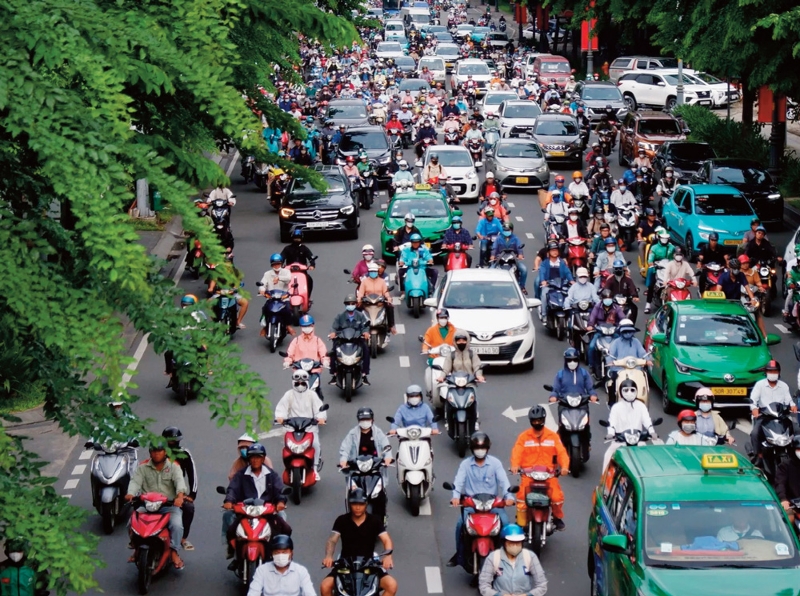
Vietnam’s economy continues to post strong growth despite a volatile global environment. GDP expanded by an estimated 8.02 per cent in 2025, taking the economy to approximately $514 billion and lifting GDP per capita to around $5,026. Momentum carried into 2026, with first-quarter GDP rising 7.83 per cent year-on-year.
This rapid economic expansion, coupled with urbanization and digital transformation, is reshaping Vietnam’s social landscape. While poverty has declined and the middle class has grown, inequalities in income, assets, skills, geography, and social protection are becoming more visible, creating new policy and governance challenges.
Stratified social structure
According to the Vietnam Household Living Standards Survey 2024, conducted by the National Statistics Office at the Ministry of Finance, average monthly income per capita reached VND5.4 million ($208), up 9.1 per cent from 2023. Significant geographic disparities remain. Urban residents earned an average of VND6.9 million ($265) a month, or more than 1.5-times the VND4.5 million ($173) recorded in rural areas. Regionally, the Southeast ranked highest, at nearly VND7.1 million ($273) per person per month, while the Northern Midlands and Mountainous Region recorded the lowest average income at around VND3.8 million ($146).
The poverty rate continued to decline, falling to 2.3 per cent nationwide in 2024, down 1.1 percentage points from a year earlier. While this marks a significant achievement in poverty reduction, poverty is no longer the only concern. Within the multidimensional poverty framework, employment deprivation accounted for 40.3 per cent of total deprivation, followed by deficiencies in adult education attainment at 30.7 per cent and nutrition at 21.4 per cent.
Vietnam’s labor market has also improved, though structural challenges persist. In 2025, the workforce aged 15 and above reached approximately 53.5 million people, with 52.4 million employed. The average monthly income rose 8.9 per cent year-on-year to VND8.4 million ($323), before increasing further to VND9 million ($346) in the first quarter of 2026. The proportion of workers holding formal qualifications or certifications reached 29.6 per cent during the same period.
However, youth unemployment remains a concern. The unemployment rate among those aged 15 to 24 stood at 8.86 per cent; significantly higher than the overall working-age unemployment rate of 2.21 per cent. More fundamentally, decent work remains a major challenge. According to the International Labour Organization’s 2026 framework, informal employment accounted for 62.2 per cent of total employment in the first quarter of 2026, including 71.1 per cent in rural areas and 48.4 per cent in urban areas. A large share of Vietnamese workers therefore continue to lack stable contracts, social insurance coverage, and protection against economic shocks.
Against this backdrop, social stratification in Vietnam is not evolving into a broad-based divide between the very rich and the very poor. Rather, it is increasingly defined by five interrelated dimensions.
The first is income inequality. Though Vietnam’s income Gini coefficient stood at 0.372 in 2024, indicating a moderate level of inequality, the wealthiest 20 per cent of the population earned an average of VND11.8 million ($454) per person per month, or 7.4-times higher than the VND1.6 million ($62) earned by the poorest 20 per cent. Such disparities directly influence access to education, healthcare, housing, and skills development, increasing the risk of inequality being passed from one generation to the next.
The second dimension is asset inequality. The growing importance of real estate, land ownership, equity holdings, and business assets is widening social divides. Those with substantial assets enjoy advantages that differ markedly from younger generations who rely primarily on wage income. If property prices continue to rise faster than earnings, opportunities for upward mobility among young people and migrant workers could become increasingly constrained.
The third dimension is geographic inequality. Differences between urban and rural areas, as well as between regions, reflect unequal access to infrastructure, employment opportunities, and public services. Without stronger regional development policies, these disparities risk persisting across generations.
The fourth dimension is inequality in skills and job quality. While the share of trained workers has risen to 29.6 per cent, most employment remains informal. As Vietnam moves toward a higher-value-added economy, highly-skilled workers are likely to benefit from expanding opportunities, while lower-skilled workers face growing pressure from automation and technological change.
The fifth dimension concerns access to social protection. Though health insurance coverage reached 95.16 per cent in 2025 and social insurance coverage expanded to 45.1 per cent of the workforce, equivalent to 21.53 million people, significant gaps remain. As Vietnam continues its transition toward an aging society and could become an aged society by 2035, according to the World Bank, disparities between those with pensions and those without adequate social protection are expected to become increasingly pronounced.
Five social groups
Based on these patterns of differentiation, Vietnam’s social structure can be broadly grouped into five major strata.
The first comprises the wealthy and ultra-wealthy, whose status is largely derived from asset ownership. This group includes major business owners, investors, and individuals with substantial holdings in real estate, land, equities, financial assets, and businesses. They have been among the biggest beneficiaries of economic growth, urbanization, infrastructure development, financial market expansion, and the rise of the private sector. Their wealth is generated primarily through assets and investment rather than labor income.
The second group is the upper middle class, including professionals, managers, senior officials, entrepreneurs, and highly-skilled workers in sectors such as finance, technology, logistics, healthcare, education, professional services, and foreign-invested enterprises. While they generally enjoy comfortable incomes and the ability to invest in education, healthcare, and housing, they also face growing pressure from rising living costs, intense professional competition, and the need for continuous reskilling.
The third group consists of the mainstream middle class and lower middle class. It includes civil servants, office workers, skilled workers, small business owners, and households with stable incomes but relatively limited accumulated wealth. As one of the country’s largest social groups, it plays a vital role in domestic consumption and social stability. However, it remains vulnerable to employment disruptions, illness, education costs, mortgage obligations, and income shocks.
The fourth group comprises industrial, service-sector, and informal workers. This includes factory workers, construction workers, transport workers, delivery drivers, retail and hospitality employees, seasonal workers, freelancers, and those employed in household businesses. Though they contribute significantly to economic growth and urban economic activity, they typically face lower incomes, less stable employment, and limited social protection. As a result, they are particularly exposed to fluctuations in demand, automation, inflation, and economic downturns.
The fifth group includes the poor, near-poor, and other vulnerable populations. It encompasses ethnic minority communities, residents of remote areas, small-scale farmers, elderly people without pensions, people with disabilities, and households affected by natural disasters, climate change, or unstable livelihoods. Despite substantial progress in poverty reduction, many continue to experience multidimensional deprivation in employment, education, nutrition, healthcare, and market access.
Five transformative trends
Driven by sustained growth, urbanization, digital transformation, and international integration, Vietnam’s social structure is expected to undergo five transformative shifts.
First, the middle class will continue to expand as the service sector, digital economy, and private sector grow. However, rising healthcare, education, and housing costs may place increasing pressure on this group, potentially creating a segment of the “vulnerable middle class.”
Second, wealth inequality may emerge as the most significant axis of social stratification. Those who own property and equity assets are likely to strengthen their position, while younger generations and migrant workers dependent on wage income could find upward social mobility increasingly difficult if housing prices continue to rise rapidly.
Third, skills-based differentiation will accelerate under the influence of AI, automation, and the green economy. Society will become divided not only by wealth, but also by the ability to reskill, adapt to technological change, and remain competitive in evolving labor markets.
Fourth, population aging is creating a new form of social division between older people with pensions and accumulated assets and those who spent their working lives in informal employment and face the risk of relative poverty in retirement.
Fifth, climate change threatens to deepen regional disparities. According to World Bank estimates, climate-related losses could reach between 12 and 14.5 per cent of GDP annually by 2050 and push as many as 1 million people into extreme poverty by 2030. Farmers, fishermen, and informal workers are expected to bear the greatest risks.
Challenges for social stability
Changes in social structure are a natural consequence of economic development and can generate positive outcomes, including stronger consumption, greater innovation, and improved accountability in governance. However, if not managed effectively, these changes risk transforming natural differences into unequal opportunities, entrenching social stratification, and creating major challenges for governance and social stability.
Among the most significant challenges are growing pressure on social equity and public trust; increasing demands for interest representation and conflict management; the risk of vested interests distorting resource allocation in the absence of transparency and effective oversight; mounting pressure on urban management, migration, and public services; greater risks of localized social tensions arising from insecure employment and incomplete social protection coverage; widening digital divides; increasing fiscal pressure on the State; and the potential erosion of social cohesion if unequal opportunities persist across generations.
To manage social differentiation while ensuring inclusive development, policymakers must move beyond traditional poverty alleviation toward a broader framework focused on expanding opportunities. The objective should not simply be to reduce poverty, but to ensure that all citizens have access to quality education, employment, housing, social protection, and public services.
First, reducing inequality of opportunity must become the central focus of social policy. Second, wealth disparities should be addressed through transparent housing and land management policies.
Third, improving skills and job quality remains the most fundamental long-term solution to social stratification. Fourth, social insurance and social protection coverage should be expanded for informal workers.
Fifth, social governance should become more transparent, responsive, and data-driven.
And sixth, regional development and climate adaptation strategies should be pursued through a framework of climate justice and equitable transition.
(*) Associate Professor Phung The Dong is from the Ministry of Finance.






 Google translate