


The government’s target of average annual growth of around 10 per cent over 2026-2030 should be understood as an average for the entire period, rather than requiring growth to exceed 10 per cent each and every year. Such an approach avoids pursuing growth at any cost while giving policymakers greater flexibility to respond to changing economic conditions. Achieving this goal will require a reassessment of Vietnam’s growth model and a clear identification of the country’s key growth drivers for the next stage of development.
One of Vietnam’s key policy challenges is how to sustain strong economic growth while preserving macro-economic stability, containing inflation, and ensuring long-term sustainable development.
Productivity at the forefront
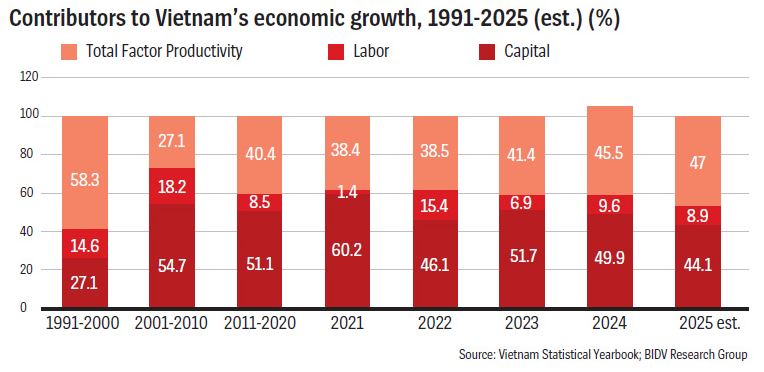
According to traditional economic theory, growth is determined by three main factors: labor, capital, and Total Factor Productivity (TFP). Capital encompasses not only financial resources but also non-financial assets such as technology, machinery, equipment, and human capital. Estimates for 2025 suggest that labor contributes around 9 per cent of economic growth, capital some 44 per cent, and TFP about 47 per cent. By 2030, Vietnam aims to increase TFP’s share to around 55 per cent, signaling a transition from a growth model driven primarily by capital and labor toward one centered on productivity gains.
It is also important to distinguish between a growth model and a development model. A growth model focuses on quantitative indicators such as GDP growth, employment, and incomes, typically over a medium-term horizon of three to five years. A development model, by contrast, takes a longer-term perspective aimed at improving people’s quality of life across a broad range of areas, including the economy, politics, society, the environment, and national defense and security. Rapid economic expansion alone is therefore insufficient; sustainable and inclusive development is essential to ensure that growth translates into tangible improvements for businesses and households.
An assessment of the previous development period shows that Vietnam achieved most of its key objectives, though several important targets fell short. Economic growth remained below expectations due to the effects of the pandemic and an increasingly volatile global environment. Labor productivity rose by just over 5 per cent annually, below the target range of 6.5-7 per cent. The digital economy also underperformed against expectations, contributing only some 14 per cent of GDP compared to the 20 per cent target, despite expanding at an annual rate of 18-20 per cent. Looking ahead, Vietnam aims to raise the digital economy’s contribution to around 30 per cent of GDP, requiring a faster pace of digital transformation and e-commerce development.
Vietnam will need to continue shifting its growth model toward one driven increasingly by productivity rather than the continued expansion of capital and labor. Both capital and labor have natural limits, whereas productivity still has significant room for improvement through technological innovation, higher-quality human capital, better corporate governance, and stronger institutions.
According to World Bank research, productivity depends not only on technology and capital but also on five critical factors: science, technology and innovation; a highly-skilled workforce; efficient resource allocation; high-quality infrastructure; and strong institutions with effective policy implementation. Among these, efficient resource allocation is particularly important because it enables capital and labor to move from less productive sectors to those with higher productivity. Institutions, meanwhile, extend beyond the legal framework to include the government’s ability to implement policies effectively.
Research scenarios suggest that sustaining double-digit economic growth will require TFP to contribute 53-55 per cent of overall growth, while total social investment must reach 39-40 per cent of GDP and annual investment must increase by 12-13 per cent. At the same time, labor productivity will need to rise by 8-8.5 per cent annually; significantly higher than in previous years. These projections underscore that Vietnam’s next phase of growth will depend increasingly on improving the quality of growth drivers rather than simply expanding the scale of investment.
Outlook amid global uncertainty
Against a challenging backdrop, global economic growth is projected to slow to around 2.5 per cent this year from 2.9 per cent last year, reflecting the impact of geopolitical conflicts that have fueled inflation, disrupted supply chains, and weakened global investment and consumer demand. If geopolitical tensions ease, however, global growth could recover to around 3 per cent next year, creating a more favorable environment for trade and supporting Vietnam’s economic outlook.
Global inflation is forecast to rise to about 4.7 per cent this year, above earlier expectations of below 4 per cent, largely because geopolitical conflicts have disrupted supply chains and driven up energy prices. The outlook for next year is more favorable, with inflation expected to fall below 4 per cent if geopolitical conditions improve. A projected decline in average oil prices from around $85 per barrel to $70-75 would also help ease commodity prices and inflationary pressures worldwide.
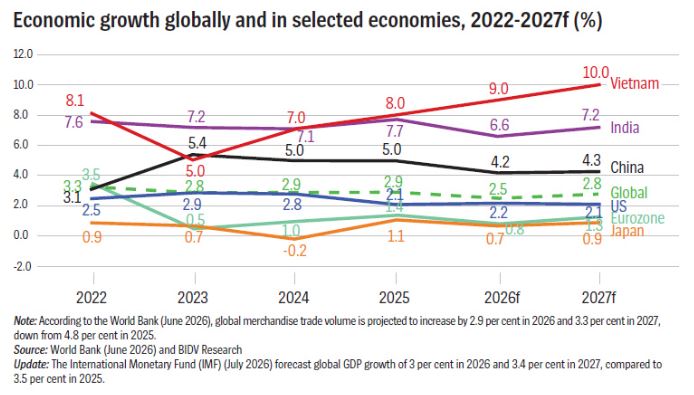
Three positive trends stand out in the global economy. First, global growth is expected to remain relatively resilient at around 2.5-2.8 per cent this year and next. Second, while inflation remains elevated, it has begun to stabilize, reducing the likelihood of further sharp increases in global interest rates. Third, investment remains robust, particularly in AI, data, and digital infrastructure, as governments and businesses continue to commit hundreds of billions of dollars to these sectors.
At the same time, significant risks remain, including geopolitical instability, persistent inflation, elevated interest rates, and challenges related to energy security, food security, supply chains, and broader economic resilience. These risks are especially significant for Vietnam given its highly-open economy and reliance on international trade and foreign investment.
Most international organizations forecast Vietnam’s economy to grow by around 7 per cent this year, while some institutions, including Standard Chartered Bank, have raised their forecasts to approximately 8.2 per cent. Domestic assessments, however, suggest Vietnam could achieve growth of around 9 per cent this year and move toward 10 per cent in subsequent years if it successfully develops new growth drivers. Inflation is projected to remain within a manageable range of 4-4.6 per cent.
On the supply side, growth is driven by three main sectors: agriculture, forestry, and fisheries; industry and construction; and services. Agriculture contributes around 5 per cent of GDP growth, industry and construction about 45 per cent, and services roughly 43 per cent, underscoring their role as the economy’s primary growth engines.
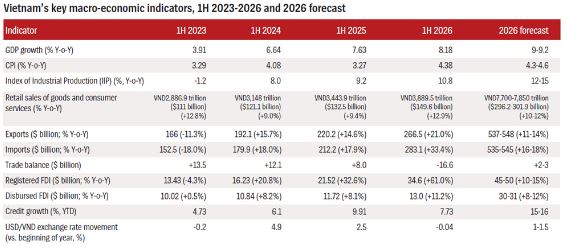
On the demand side, consumption and investment remain the two most important drivers. During the first half of 2026, consumption contributed some 68 per cent to economic growth, while investment accounted for about 60 per cent. Net exports, by contrast, made a negative contribution of around 3.6 per cent as imports grew faster than exports. This suggests current growth is being driven primarily by domestic demand rather than the trade balance. Sustaining double-digit growth will require continued momentum in both investment and consumer spending.
Rapid import growth has raised concerns about a widening trade deficit. However, much of the increase reflects three factors. Businesses have accelerated imports of raw materials and intermediate goods to build inventories ahead of potential global disruptions. Higher global energy and commodity prices have also inflated import values, while Vietnam’s large-scale investment projects have boosted demand for imported machinery and equipment. As long as imports continue to support investment and production, the current trade deficit is not viewed as a major concern.
Another positive factor is the relative stability of the exchange rate, which has helped preserve macro-economic stability at a time when many economies continue to face significant currency volatility and inflationary pressures. This remains one of the key foundations supporting Vietnam’s investment environment.
Containing inflation remains a top macro-economic priority. Around 87 per cent of movements in the CPI are driven by several key categories, with food accounting for roughly 39 per cent of overall inflation. Education and healthcare also contribute to price pressures, making the control of essential goods prices critical to maintaining price stability.
Public investment continues to play a pivotal role in supporting growth. The government’s public investment disbursement plan totals approximately VND1,100 trillion ($42.3 billion) this year, up about 31 per cent from 2025. If fully implemented, it could add around 1.8 percentage points to GDP growth, potentially lifting overall growth from about 7 per cent to nearly 9 per cent.
FDI inflows remain resilient, though investment continues to be dominated by Asian economies. This suggests that Vietnam has yet to attract significant volumes of high-tech investment from advanced economies such as the US and Europe, highlighting considerable room to diversify its FDI sources.
Achieving double-digit growth in the years to come will require total social investment to increase by approximately 12-13 per cent annually. During the first half of this year, total investment rose by around 13 per cent, with private sector investment expanding by more than 13 per cent for the first time. While encouraging, this remains below the roughly 16 per cent growth recorded prior to the Covid-19 pandemic, indicating that further improvements to the investment and business environment are needed for the private sector to become a sustainable growth engine.
Retail sales, meanwhile, increased by approximately 13 per cent at current prices. After adjusting for inflation, however, actual retail growth was only around 7.3 per cent; below pre-pandemic levels. This suggests consumer demand has yet to fully recover and may require additional policy support.
Monetary policy has limited space for further interest rate cuts. Credit growth has consistently outpaced deposit growth for several years, placing increasing pressure on banking system liquidity. Outstanding credit now exceeds total deposits by roughly VND2,000 trillion ($76.9 billion). In this environment, further rate cuts could discourage deposits and weaken banks’ ability to provide credit. Maintaining stable interest rates this year is therefore widely regarded as a successful policy outcome.
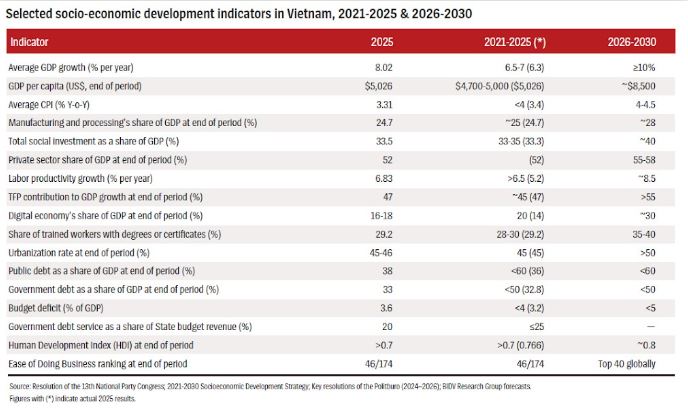
Vietnam’s credit-to-GDP ratio is already high by international standards and is expected to rise further if the economy achieves sustained double-digit growth. If credit expands by around 15 per cent annually while GDP grows by approximately 10 per cent, outstanding credit could reach around 180 per cent of GDP by 2030; significantly higher than in many economies at a similar stage of development. This underscores the need to strengthen non-bank financing channels.
The corporate bond market also has considerable space for expansion, though issuance declined during the first half of the year and remained concentrated among property developers and banks. Manufacturing companies have yet to make effective use of the bond market as a funding source. The government’s comprehensive financial market reform strategy through 2045 is expected to diversify funding sources, reduce dependence on bank credit, and support the long-term development of Vietnam’s capital markets.
Finally, improving the quality of growth will require more efficient use of investment capital. Vietnam’s Incremental Capital-Output Ratio (ICOR) remains relatively high at around 6.4, compared with the target of reducing it to approximately 4.5-4.6. By comparison, South Korea and China maintained ICOR levels of around 3-4 during their periods of rapid economic expansion, suggesting that Vietnam still has substantial scope to improve investment efficiency, strengthen growth quality, and enhance long-term competitiveness.
Policy priorities
Achieving double-digit economic growth will require a coordinated package of policy measures and a new approach to economic management rather than relying on traditional policy frameworks. The focus should be on maximizing both traditional growth drivers and emerging sources of growth.
On the demand side, Vietnam must continue strengthening its traditional growth engines - exports, investment, and consumption - while fostering balanced development across the three main sectors of the economy: agriculture, forestry, and fisheries; industry and construction; and services. At the same time, greater emphasis should be placed on new growth drivers, particularly innovation, the digital economy, and high-tech industries.
A key priority is closer coordination between fiscal and monetary policy. With liquidity in the banking system under pressure, accelerating public investment disbursement would not only support economic growth but also inject liquidity into the economy, improve financial conditions, and enhance the effectiveness of monetary policy. Successful policy coordination depends not only on choosing the right tools but also on deploying them at the right time and with the appropriate scale to match economic conditions.
At the same time, Vietnam needs to mobilize and allocate resources more efficiently. This includes implementing the government’s comprehensive financial sector reform strategy, unlocking resources tied up in delayed investment projects and underutilized public assets, and developing new financing mechanisms such as carbon markets. Establishing an international financial center is also viewed as an important step toward expanding the economy’s access to capital.
Throughout this process, maintaining macro-economic stability and safeguarding key economic balances, particularly energy security, while improving the quality of growth must remain overarching priorities. These are the fundamental conditions for sustaining long-term economic expansion.
Another important priority is strengthening the strategic autonomy of Vietnamese businesses by increasing localization. Vietnam’s average localization rate currently stands at around 36.6 per cent; well below Thailand’s approximately 56 per cent. Localization stands at around 50-55 per cent in the textile and garment industry but remains just 10-15 per cent in electronics, highlighting the country’s continued dependence on imported materials and components. Strengthening domestic enterprises and expanding support industries would improve the economy’s resilience to external shocks.
New engines of growth
Under the baseline scenario, Vietnam’s next phase of growth could be supported by five new growth drivers in addition to its traditional engines.
The most significant is science, technology, and innovation, which could contribute around 1 percentage point to annual GDP growth if effectively implemented.
The second is institutional reform, particularly administrative reform and improvements to the investment and business environment. Comprehensive reforms in these areas could add roughly 0.5 percentage points to annual growth.
The third is strengthening the role of key economic hubs and leading localities. Vietnam’s seven centrally-governed cities currently account for about 64 per cent of national GDP. If these were to increase their growth rates by just 0.5 percentage points, national economic growth could rise by approximately 0.6 percentage points.
Another priority is unlocking stalled investment projects to release capital and other resources currently tied up in the economy.
At the same time, accelerating the green transition would create additional medium and long-term growth opportunities by raising productivity and supporting the development of new industries.
Estimates suggest that, if implemented in a coordinated manner, these new growth drivers could add around 3-3.5 percentage points to annual economic growth. Combined with traditional growth engines, they could provide the foundation for Vietnam to achieve annual growth of 9-10 per cent in the years to come.
Ultimately, achieving double-digit growth will require Vietnam to strengthen its existing growth drivers while cultivating new ones, with a particular focus on innovation, institutional reform, more efficient resource allocation, and greater self-reliance among domestic businesses. Together, these measures will help sustain rapid economic expansion while improving the quality and long-term sustainability of growth.
(*)Dr. Can Van Luc is Chief Economist at the Bank for Investment and Development of Vietnam (BIDV) and President of the BIDV Training and Research Institute)







 Google translate