


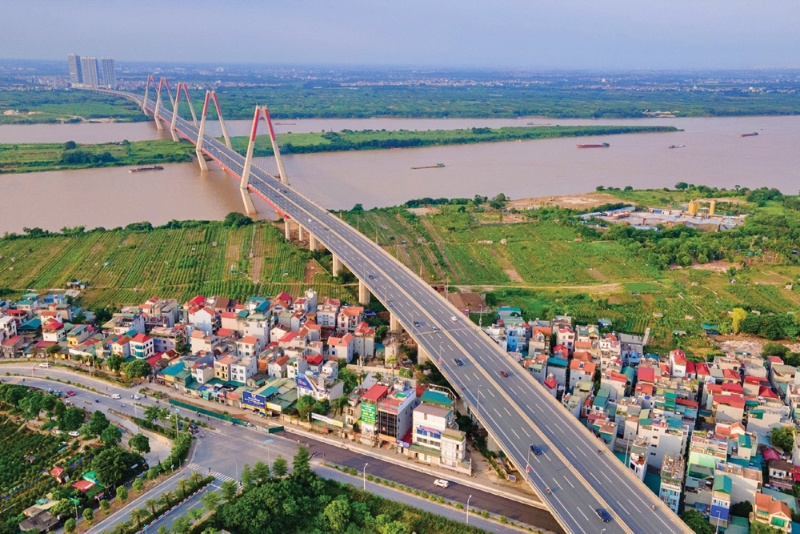
The Resolution from the 14th National Party Congress in January and Conclusion No. 18-KL/TW from the Second Plenum of the 14th Party Central Committee, on April 2, consistently identify an average annual economic growth rate of 10 per cent or higher during the 2026-2030 period, alongside the establishment of a new growth model based on science and technology, innovation, and digital transformation as the primary drivers. This foundation is intended to enable Vietnam to break through the middle-income trap, become a developing country with modern industry and upper-middle income by 2030, and realize the 2045 vision of becoming a developed, high-income nation.
The Resolution from the 14th National Party Congress also set forth the guiding principle of “Strategic autonomy, renewing the development model, using development to maintain stability and stability to accelerate the country’s rapid and sustainable development, improve the people’s living standards and happiness, and firmly safeguard the Socialist Republic of Vietnam.”
Recent conclusions from the Secretariat, the Politburo, and Party General Secretary and State President To Lam have also underscored the urgent need to review and study the country’s development model, particularly in conjunction with the 100th anniversary of the Party’s leadership of the Vietnamese revolution, while shaping national development with a vision for the next 100 years.
Theoretical foundations
According to the Organization for Economic Co-operation and Development (OECD) (1962), a “development model” refers to a system of theoretical and practical frameworks used to understand and analyze the socio-economic and political development process of a country or territory.
A “national development model” is a system of theoretical and practical frameworks designed to explain, guide, and establish the interactive relationship between the State, the market, and society in order to optimize resource allocation while simultaneously achieving economic growth, improving quality of life, and enabling the comprehensive transformation of a nation from underdevelopment to a State of civilization, prosperity, and sustainability.
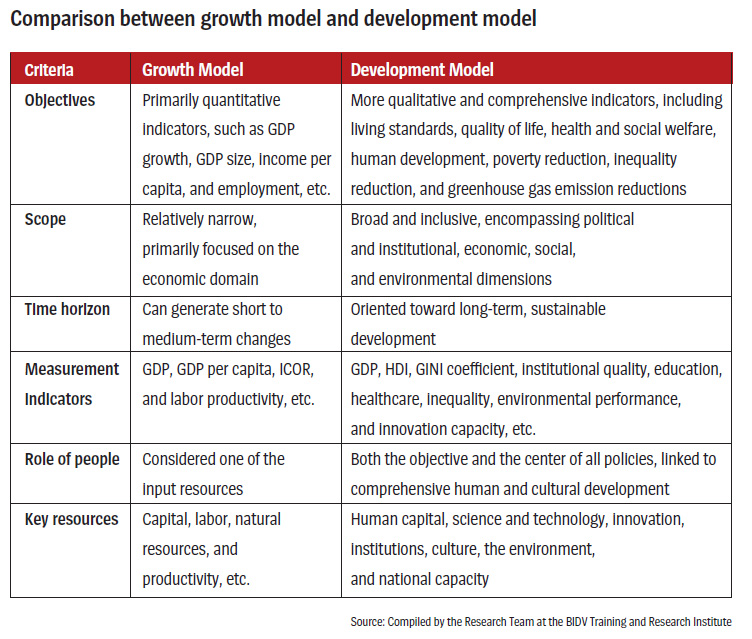
Though the terms “growth model” and “development model” are often used interchangeably, they are distinct concepts with different policy implications for a country’s socio-economic development. Broadly speaking, there are three major differences between the two.
First, a growth model primarily focuses on quantitative factors, measured through indicators such as economic growth, GDP size, income per capita, and employment. By contrast, a development model has a broader scope, placing greater emphasis on qualitative and more comprehensive dimensions, measured through indicators such as living standards, quality of life, health and social welfare, the Human Development Index (HDI), poverty reduction, inequality reduction (GINI coefficient), improvements in healthcare and education, progress in socio-economic structures, and environmental sustainability, including reductions in air and water pollution, greenhouse gas emissions, and ensuring that modernization does not compromise the well-being of future generations.
Second, a growth model generally seeks to achieve objectives over the short to medium term (three to five years), such as Vietnam’s 2026-2030 socio-economic development strategies and plans. In contrast, a development model is inherently long-term and more sustainable in nature, as reflected in Vietnam’s development strategies and orientations toward 2045, 2100, and beyond.
Third, achieving rapid, sustainable, and inclusive development requires high economic growth as a necessary condition, but this must go hand-in-hand with sustainability and inclusiveness as sufficient conditions. Therefore, while growth and development models are closely interconnected, the growth model serves as the necessary foundation for building a development model that places people as both the purpose and the center of all development policies.
Seven international lessons
Seven key lessons can be drawn from the experiences of China, South Korea, Nordic countries, and the Netherlands in developing and implementing national development models.
First, establishing a national development model is an inexorable trend. Maintaining growth models dependent on capital, low-cost labor, and natural resources has revealed increasing limitations as input resources become more constrained.
Therefore, alongside improving the efficiency of the two traditional growth drivers - labor and capital (including financial capital and machinery and equipment) - countries that successfully escaped the middle-income trap, particularly China and South Korea, as well as advanced welfare states in the Nordic region, have shifted toward growth models driven more heavily by Total Factor Productivity (TFP). These efforts focus on five key pillars: (i) advancing science and technology, innovation, and digital transformation; (ii) developing high-quality human resources; (iii) improving market efficiency to mobilize and allocate resources more effectively; (iv) developing infrastructure, including digital infrastructure; and (v) reforming economic institutions.
Second, building a strong developmental State alongside a dynamic and efficient market. The role of a “developmental State” includes strategic planning, resource coordination, infrastructure development, promoting science and technology, and ensuring macro-economic stability. It also involves designing sound institutions that foster competition, protect property rights, uphold the rule of law, and support innovation, while accompanying and assisting people and businesses in adapting to economic changes, promoting competition, attracting investment, expanding exports, and facilitating technology transfer, alongside ensuring social welfare.
The State should avoid excessive administrative intervention in markets and instead create favorable conditions for diverse economic sectors to thrive while preventing monopolistic behavior. Large corporations and nationally-championed enterprises may receive preferential treatment and support, but they must commit to and fulfill a leading role in promoting broader business development through supply chain linkage mechanisms, rather than constraining the growth of small and medium-sized enterprises (SMEs) and startups.
Third, developing inclusive institutions that balance broad participation with risk control. Inclusive institutions enable a broad range of stakeholders to access resources, compete fairly, have their rights protected, and contribute to development. As such, they “open opportunities” to the wider population rather than serving only a privileged minority. Inclusive institutions are critical to sustaining long-term development because secure property rights encourage business investment, fair competition drives innovation, and broad access to education, employment, and entrepreneurship allows societies to better mobilize resources. Transparent policymaking also lowers transaction costs and strengthens market confidence. However, for a developing economy such as Vietnam, institutional inclusiveness must strike an appropriate balance between encouraging participation and managing risks.
Fourth, reform should follow a gradual approach but be implemented decisively, avoiding incomplete execution. This important lesson from China is particularly relevant to Vietnam, given the country’s limited financial resources relative to development needs and limited experience in emerging sectors, especially the digital economy, the green economy, energy transition, AI, semiconductors, smart cities, free trade zones, international financial centers, digital assets, and carbon markets. Piloting new economic models through a prioritized reform sequence, from easier to more complex areas, would allow Vietnam to access advanced technologies and global best practices while drawing lessons from risks and shortcomings encountered elsewhere. This approach would support scaling up successful models while containing risks associated with less effective ones.
Fifth, creating effective mechanisms for resource mobilization, allocation, and benefit distribution aligned with long-term socio-economic development goals. Resources are critical for achieving rapid, sustainable, and inclusive development, and successful countries have developed mechanisms to mobilize, allocate, and utilize them efficiently. This requires the effective functioning of factor markets, including land, finance, labor, and science and technology. Rather than focusing on short-term objectives, resource allocation and welfare policies should be designed and adjusted with medium to long-term horizons in mind, contributing to more effective State governance, reduced social welfare pressures, and the mitigation of demographic challenges, while increasing public trust and social consensus, particularly as Vietnam enters the final stage of its demographic dividend and faces rapid population aging.
Sixth, people are the center of development. In addition to affirming the central role of citizens, China, South Korea, and Nordic countries have all prioritized investment in human capital, education, and training, including strong emphasis on Science, Technology, Engineering, and Mathematics (STEM) education, vocational training, and developing universities with world-leading teaching and research capabilities. These countries have also pursued major reforms in healthcare and social welfare systems to ensure fairness, inclusiveness, efficiency, and transparency, while strengthening public oversight and the role of civil society organizations, thereby enhancing transparency across government institutions, businesses, and the broader economy.
Seventh, pursuing rapid, sustainable, and inclusive development while maintaining macro-economic stability. This includes consistently prioritizing macro-economic stability, inflation control, currency value preservation, and safeguarding major economic balances. It also requires strengthening national competitiveness and enhancing the economy’s resilience, self-reliance, and strategic autonomy amid increasing uncertainty and volatility. At the same time, countries must ensure economic security, energy security, food and water security, supply chain resilience, and cybersecurity and data security.
Proposed development model and recommendations
Vietnam can draw lessons from and combine development models adopted by countries in the region and globally. However, the model must be tailored to Vietnam’s specific conditions to address limitations, maximize effectiveness, seize opportunities, and strengthen the country’s position.
The development philosophy should be: “A sustainably developing economy; a civilized society; a healthy environment; with people and citizens’ happiness placed at the center.”
Regarding guiding principles, strategic orientation, and time horizon, Vietnam should establish a national development model based on productivity, innovation, green growth, sustainability, strategic autonomy, and inclusiveness through 2045, with a vision to 2100 (the end of the first century of the new millennium) or 2130 (marking 200 years since the founding of the Party). The research team recommends the 2100 horizon for two main reasons: (i) it marks the end of the first century of the new millennium - an important and memorable milestone adopted by many countries; and (ii) it is not excessively distant from the present, particularly in the context of increasingly rapid and unpredictable global changes.
The overarching objective should be rapid, sustainable, inclusive, and people-centered development, with human well-being and citizens’ happiness at the core.
The proposed development formula or model may be summarized as: Development Model = Economic Growth + Social Progress + Equity + Environmental Sustainability + Enhanced Human and Institutional Capacity (including implementation capacity).
To realize these development goals, the Research Team at the BIDV Training and Research Institute offers several recommendations. First, it is necessary to clarify the substance and scope of the new development model. Second, Vietnam should proactively update, clarify, and improve the model of the “socialist-oriented market economy” to ensure it remains relevant in the current context. Third, it is important to define a “national value system” and establish corresponding mechanisms, policies, and solutions to support it. Fourth, Vietnam should develop a standardized framework of indicators for the new development model, reflecting its core principles, objectives, and substantive content.
In terms of implementation, a number of major solution groups are proposed. The first group concerns national governance reform. This includes undertaking structural reforms based on three foundational pillars: a developmental State, a market economy with the private sector as the primary growth driver, and inclusive institutions. It also involves redefining relationships among the Party, the National Assembly, the government, and local authorities; among the State, the market, and social organizations; between the central government and localities; and among regions themselves. In parallel, Vietnam should undertake comprehensive reforms in the process of drafting, implementing, and evaluating laws and regulations.
The second group of solutions concerns economic development and the advancement of new productive forces. Vietnam should fundamentally renew its growth model by focusing on five key areas: (i) science and technology, innovation, and digital transformation; (ii) high-quality human resources development; (iii) greater market efficiency to improve resource mobilization and allocation; (iv) infrastructure development, including digital infrastructure; and (v) economic institutional reform, with strong emphasis on implementation effectiveness. These efforts should go hand-in-hand with maintaining macro-economic stability, controlling inflation, safeguarding major economic balances, and strengthening the economy’s strategic autonomy, resilience, and competitiveness amid a rapidly-evolving global environment marked by restructuring, protectionism, and growing fragmentation in trade and technology.
Vietnam should simultaneously pursue a “3i Strategy” - investment, infusion, and innovation, based on the World Bank’s 2024 framework.
At the same time, economic restructuring should be accelerated, including reform and modernization of the State sector, State-owned enterprises (SOEs), public service units, public investment, and the State budget, as well as restructuring the financial sector to improve resource mobilization and allocation. Stronger links between FDI enterprises and domestic firms should also be prioritized. Efforts should focus on improving growth quality, raising investment efficiency (with the Incremental Capital-Output Ratio (ICOR) targeted at 4-4.5 by 2030, then gradually declining to around 3), increasing localization rates, strengthening strategic autonomy and resilience, and safeguarding food security, energy security, supply chain security, and cybersecurity and data security amid growing uncertainty.
The third group of solutions focuses on social development, environmental protection, people-centered development, and strengthening social trust. This includes expanding access to healthcare and education services through a combination of “ability-to-pay” and “higher fees-higher support” models, improving access to housing, and enhancing the sustainability of the social insurance system.
Vietnam should also prioritize the development of high-quality human resources through major reforms in education, healthcare, and social welfare systems, including preferential treatment for engineers in high technology, IT, AI, data science, and cybersecurity, while implementing practical and effective policies to attract overseas Vietnamese scientists and professionals to contribute to national development. Improving the Human Development Index (HDI) should also remain a priority.
Comprehensive labor market reforms are equally important, including vocational training, reducing the informal workforce, slowing population aging, and improving access to healthcare, public health, and housing services.
Vietnam must also proactively adapt to climate change and strengthen environmental protection while ensuring harmony between economic growth and emission reductions. This requires integrating green transition objectives into national and local socio-economic development strategies and business planning; addressing environmental pollution in urban areas, industrial parks, and craft villages; updating climate adaptation strategies for the Mekong Delta; introducing carbon taxation and developing a carbon market to accelerate low-carbon technological transitions; and implementing a combination of incentives and enforcement measures to encourage green transition, environmental protection, and waste management. Pilot initiatives in one or two pioneering localities could be considered, alongside the development of a National Green Transition Strategy.
Science and technology, data, and digital platforms should also be leveraged to strengthen engagement with citizens and businesses and improve public service delivery. Institutionalized, substantive dialogue mechanisms should be established between the government, local authorities, business associations, and labor organizations, while encouraging citizens, experts, and social organizations to participate in monitoring and providing feedback on major economic projects to maximize harmony between three goals: economic prosperity, social equity, and environmental sustainability.
Vietnam should also comprehensively promote the development of Vietnamese culture and people by building an advanced culture imbued with national identity, grounded in national values, Vietnamese cultural values, family values, and standards of human behavior and business ethics. Citizens should remain at the center of cultural development, not only as beneficiaries but also as creators and promoters of cultural values, particularly in social order, public safety, social welfare, diplomacy, tourism, and cultural exchange.
Lastly, Vietnam should formulate a comprehensive strategy for mobilizing and allocating development resources, combined with a consistent commitment to thrift, waste reduction, stronger socio-economic and environmental risk management, and decisive economic restructuring, which fundamentally means restructuring national resources.
The Resolution from the 14th National Party Congress also set forth the guiding principle of “Strategic autonomy, renewing the development model, using development to maintain stability and stability to accelerate the country’s rapid and sustainable development, improve the people’s living standards and happiness, and firmly safeguard the Socialist Republic of Vietnam.”





 Google translate