


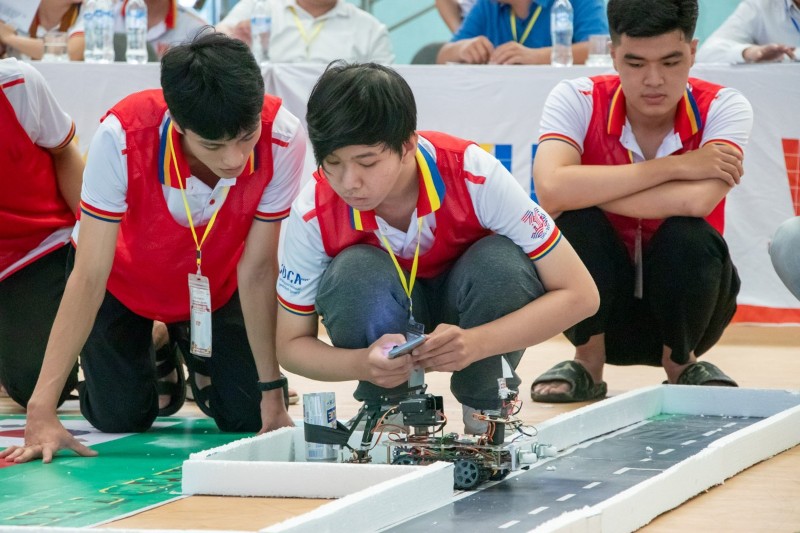
The municipal Department of Science and Technology is currently soliciting public feedback to finalize the draft resolution before submitting it to the Municipal People's Council at its upcoming year-end session.
The draft outlines mechanisms to commission or tender training services from domestic and international higher education institutions, vocational centers, research institutes, and certified organizations. Designed to materialize the Urban Development Law 2026, the policy empowers the city to actively select elite training providers and mobilize internal and external resources to drive socio-economic growth, scientific advancement, digital transformation, and the green transition.
Under the proposal, training initiatives must stem from practical demands aligned with municipal development strategies. Sponsoring agencies must clearly define target learner groups, required competencies, volume, timelines, and post-training employment commitments. Funding will be guaranteed by the municipal budget through annual operational budget allocations alongside legal socialized sources.
The draft identifies six priority sectors for high-quality workforce development, including specialized healthcare, high-tech biomedicine, and pharmaceuticals, covering specialist doctors, biomedical engineering, modern hospital administration, and pharmaceutical R&D.
The second group focuses on education, training, and pedagogy, emphasizing internationally standardized lecturers, advanced teaching methodologies, educational management, and digital learning materials.
The third sector encompasses smart cities, infrastructure, transportation, and urban planning, including urban railways, smart logistics, digital infrastructure, and climate-resilient planning.
The fourth sector targets finance, banking, commerce, and corporate governance, prioritizing human resources for the International Financial Center (IFC), fintech, wealth management, cross-border e-commerce, and international trade law.
The fifth group covers high-quality culture, tourism, sports, and heritage economy, focusing on international tourism management, luxury service industries, high-performance sports, and urban heritage conservation.
The final group centers on strategic technologies, digital transformation, green economy, and high-tech agriculture, featuring semiconductor microchips, artificial intelligence (AI), cybersecurity, carbon footprint accounting, carbon credit markets, renewable energy, and biotechnology.
Programs will offer flexible learning formats, including customized short courses, modules, or degree tracks held domestically, abroad, online, or via hybrid modes. Services will be delivered through task assignments for municipal public institutions, direct ordering for urgent or specialized overseas programs, or open tendering to ensure transparent competition and budgetary efficiency.
To support trainees, the city proposes fully covering tuition fees based on approved unit costs for up to 10 months per academic year. Recipients must fulfill service commitments post-training or refund the funding.
Notably, female trainees and ethnic minorities will receive an additional 1.5 percent reduction on their reimbursable obligations for each year of service, compared to 0.1 percent for other groups.
Municipal agencies will annually publish their training demands and post-graduation job placements to tightly align training with operational needs.





 Google translate