


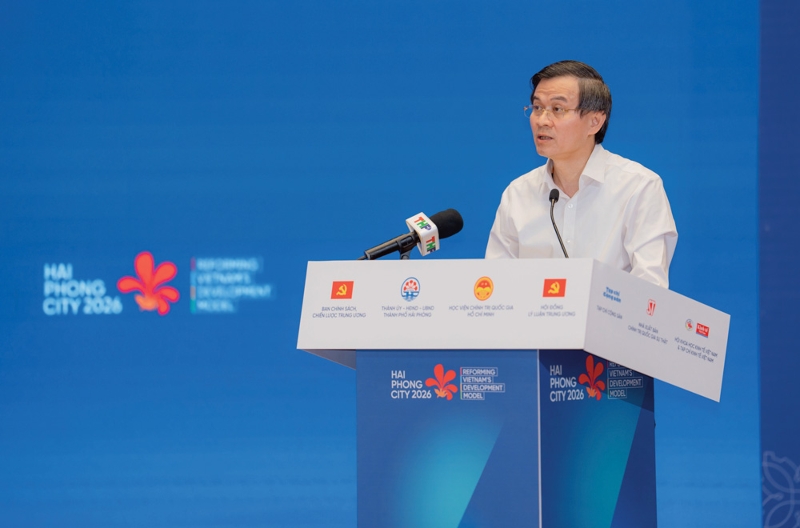
The outcomes from the national scientific conference are reflected not only in the number of reports and papers presented but also in the initial shaping of a relatively-systematic conceptual framework for the country’s development model in the new era, in which science, technology, innovation, and digital transformation serve as the foundation, central driving force, and key determinants of national governance modernization and the renewal of development approaches.
Clarifying the model
The conference further clarified the concept of a development model by distinguishing it from a growth model and placing it within the broader relationship with the overall development model of a social system, that is, as a socio-economic formation to be examined under the program reviewing 40 years of implementing the Platform for National Construction in the Transitional Period towards Socialism.
These three models may be likened to three concentric circles with close interconnections, in which the country’s development model possesses its own structure, function, and role, positioned within this framework of three concentric circles. The distinctions and interrelationships among these three models will provide an appropriate basis for defining the subject matter and scope of the project.
Many papers provided in-depth analyses of the context and urgent need to reform Vietnam’s development model as the country enters a new era, particularly amid the rapid advancement of science and technology, innovation, digital transformation, green transition, the development of new productive forces, intensifying strategic competition, and the growing global trend toward strategic autonomy.
In particular, to achieve the goal of becoming a high-income developed country by 2045, there is an increasingly urgent need to reform the national development model in a way that addresses not only the pace of development but also its quality and long-term sustainability.
Reforming the development model is not merely a matter of theoretical research; it also carries direct implications for strategic planning, policy-making, and implementation, ensuring coherence across short, medium, and long-term development.
Seven key elements
Based on assessments of current realities and the evolution of existing development models, many papers proposed a structural framework for Vietnam’s development model in the new era. While approaches varied in structure and categorization, there was broad consensus around seven core elements.
The first concerns the development vision and goals, together with governance mechanisms to realize them. Vietnam’s new development model should pursue rapid, sustainable, prosperous, and resilient growth.
The second is the development philosophy, centered on core values: people as the center and driving force of development; growth driven by knowledge, science, technology, innovation, cultural resources, and national aspiration; rapid development balanced with sustainability; modernization rooted in humanistic values; and deep international integration alongside independence and self-reliance.
The third concerns key actors within the model. The new framework calls for mobilizing the strength of society as a whole: the Party providing strategic leadership; the State enabling development through institutions and implementation; businesses serving as the center of innovation and knowledge commercialization; intellectuals and scientists generating new knowledge; citizens driving digital transformation while benefiting from and co-creating development.
The fourth element is governance, embedded within the modernization of national and local administration. This requires a shift from traditional administrative management toward data-driven, innovation-led governance, alongside digital government and greater integrity, transparency, and fairness.
The fifth relates to development resources and drivers. Beyond traditional factors such as capital, labor, and natural resources, the model must increasingly rely on science, technology, innovation, digital transformation, data, productivity, high-quality human resources, advanced institutions, culture, entrepreneurship, and deeper participation in emerging value chains. This also requires effectively mobilizing and connecting public and private, domestic and international resources.
The sixth concerns the model’s operating mechanism. The new framework must rest on enabling institutions, a modern market, an effective State, dynamic enterprises, a creative society, and data-driven governance.
And the seventh element concerns the pillars of the development model. Participants proposed different approaches, ranging from institutions, governance, the economy, culture, society, the environment, national defense, security, and foreign affairs.
In this sense, Vietnam’s development model in the new era may be viewed from multiple dimensions and perspectives. Yet participants shared a common goal of defining a coherent, integrated framework with clearly structured and interrelated components.
Proposed solutions
The papers, presentations, and discussions proposed a range of breakthrough solutions across multiple dimensions, including development-oriented institutions, enabling environments, new growth drivers, and ecosystems to support the effective operation of the development model. Governance-related solutions were also emphasized to ensure effective implementation in practice, backed by stronger execution discipline and measurable outcomes across sectors, industries, and localities.
Specific recommendations addressed economic and social development, human capital, demographic adaptation to population aging, labor market development linked to universal social protection, environmental sustainability, national defense and strategic autonomy, comprehensive security, deeper international integration, stronger global positioning, and the enhancement of soft power.
Many recommendations focused on ensuring that science and technology, innovation, and digital transformation genuinely become the central drivers of the new development model, laying the groundwork for new productive forces, new production methods, modernized national governance, and greater national competitiveness.
International experience was widely examined, with participants proposing ways to adapt suitable approaches while drawing lessons from both successes and failures abroad. Hai Phong’s experience was presented as a case study in transforming growth models and experimenting with new approaches to local governance based on science, technology, innovation, and digital transformation.
Delegates from Can Tho, Lai Chau, and An Giang provinces also shared valuable practical insights. Several papers further proposed implementation mechanisms tailored to Vietnam’s conditions, emphasizing consistency between policymaking and execution.
At the same time, the conference highlighted a number of major issues requiring deeper study. These include how science and technology can be translated into national productivity; how businesses can become genuine centers of innovation; how to develop science and technology and data markets; how to establish regulatory sandboxes for emerging sectors; and how to cultivate high-quality human resources in the AI era.
Participants also raised questions about preventing new forms of digital inequality, safeguarding data security, digital sovereignty, and technological autonomy, and balancing rapid growth with social equity, cultural identity, and sustainability. Another key challenge is how to integrate the latest advances in science, technology, and innovation into everyday life while effectively managing risks arising from technological change that is often advancing faster than forecasting capabilities.
Following the conference, the co-organizers will continue refining and systematizing its theoretical and practical foundations, translating outcomes into advisory reports and policy recommendations to support the formulation of the national development project and help shape Vietnam’s development model in the new era.






 Google translate