


Carbon markets are rapidly evolving from policy instruments into new arenas for international cooperation and economic competition. For Vietnam, early, proactive, and well-informed participation will be critical not only in delivering on its emission reduction commitments but also in unlocking new growth opportunities as the country transitions toward a green economy.
In pursuit of its commitment to achieve net-zero emissions by 2050, the Vietnamese Government has accelerated the development of a comprehensive legal framework for greenhouse gas (GHG) mitigation, the domestic carbon market, and its integration with international carbon trading systems.
The regulatory foundation is now largely in place. It includes Decree No. 06/2022/ND-CP on GHG mitigation and ozone layer protection, as amended by Decree No. 119/2025/ND-CP, and most recently Decree No. 112/2026/ND-CP, issued on April 1, 2026, governing the international exchange of GHG emission reduction outcomes and carbon credits.
The latest decree establishes the legal basis for transferring and exchanging emission reduction outcomes between Vietnam and international partners through mechanisms operating both within and outside the framework of the Paris Agreement. It is expected to support Vietnam’s climate targets while helping attract investment and low emissions technologies.

At the same time, growing interest from Vietnamese businesses, particularly in export manufacturing, energy, and agriculture and forestry, has driven increasing demand for guidance on developing carbon credit projects and accessing international carbon markets. Several local governments have also begun exploring ways to leverage emission reduction opportunities to support green economic development, highlighting the need for greater awareness, technical capacity, and stronger market connectivity.
Building capacity
As the State authority responsible for climate change policy and carbon market development, the Department of Climate Change recognizes that effective implementation of the new regulatory framework will depend on strengthening the capacity of both government agencies and the private sector.
Enhancing understanding of domestic regulations, international market requirements, and technical standards has become increasingly important as Vietnamese organizations prepare to participate in global carbon markets. Equally important is expanding cooperation with international partners, financial institutions, and market participants to create new opportunities for carbon credit transactions and climate investment.
Preparing adequate institutional arrangements, technical expertise, and financial resources will also be essential in ensuring that Vietnam’s participation in international carbon markets is transparent, credible, and effective.
Three priorities
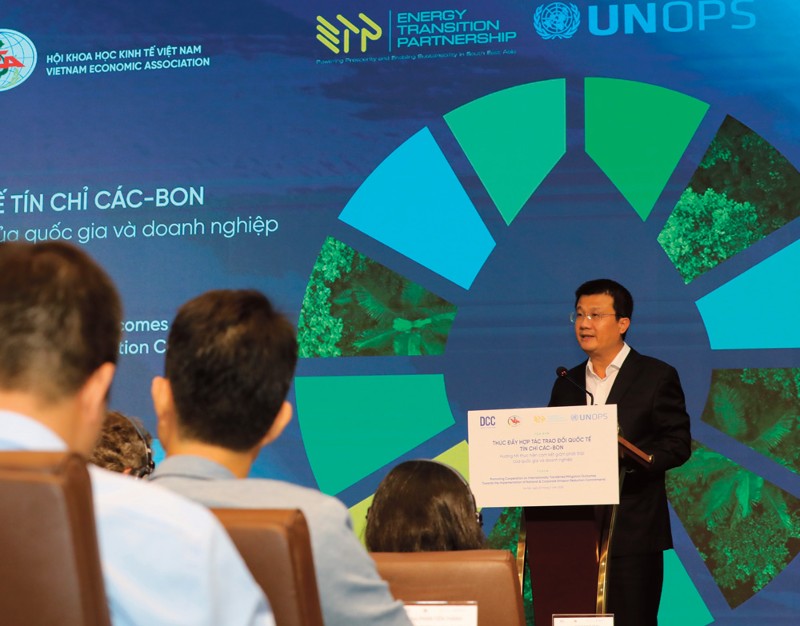
Against this backdrop, a July 23 forum entitled “Promoting Cooperation on Internationally Transferred Mitigation Outcomes Towards the Implementation of National and Corporate Emission Reduction Commitments” focused on three key priorities.
The first was updating participants on Vietnam’s latest legal framework governing the international exchange of GHG emission reduction outcomes and carbon credits. The discussions aimed to help businesses better understand the regulatory environment, including their rights, obligations, and the conditions for participating in international carbon markets.
The second priority examined emerging opportunities, market trends, and evolving requirements through insights from international organizations, financial institutions, and development partners. These discussions highlighted increasingly stringent global expectations surrounding carbon credit quality, data transparency, and technical compliance.
The “Promoting Cooperation on Internationally Transferred Mitigation Outcomes Towards the Implementation of National and Corporate Emission Reduction Commitments” forum was held on July 23 by the Department of Climate Change at the Ministry of Agriculture and Environment, in collaboration with the Southeast Asia Energy Transition Partnership (ETP), the United Nations Office for Project Services (UNOPS), and the Vietnam Economic Association.
The third focused on assessing and strengthening the readiness of Vietnamese businesses. Participants explored practical steps for developing carbon projects, selecting appropriate measurement, reporting, and verification (MRV) methodologies, and connecting projects with available sources of climate finance and technical assistance.
Strengthening collaboration
The active participation of policymakers, international experts, and businesses generated valuable insights that will help strengthen cooperation between government agencies and the private sector in using market-based mechanisms to achieve both national and corporate emissions reduction goals.
The dialogue also reinforced international cooperation on carbon credits by connecting Vietnamese businesses with global sources of financing, technical support, and market expertise while aligning those opportunities with national policy priorities.
As international carbon markets continue to expand, strengthening institutional capacity and deepening collaboration between governments, businesses, and global partners will be essential to enabling Vietnam to meet its climate commitments and compete successfully in the emerging green economy.
(*) Mr. Nguyen Tuan Quang is a Deputy Director of the Department of Climate Change at the Ministry of Agriculture and Environment.





 Google translate