


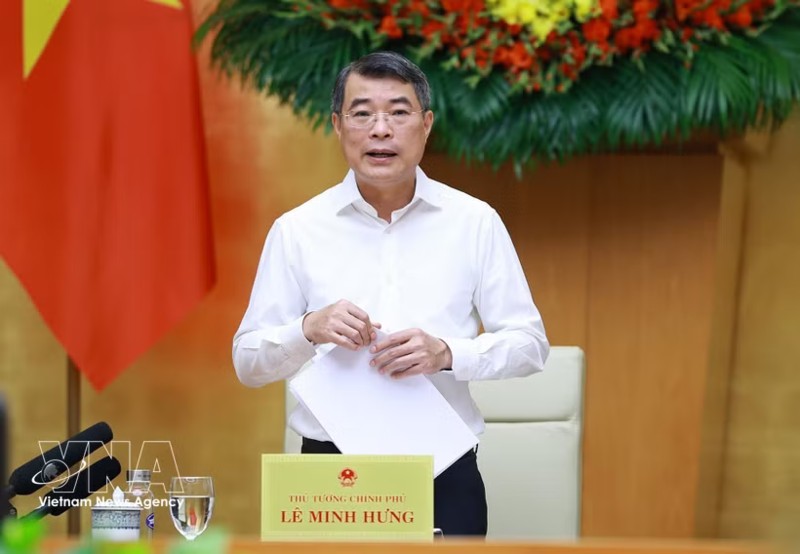
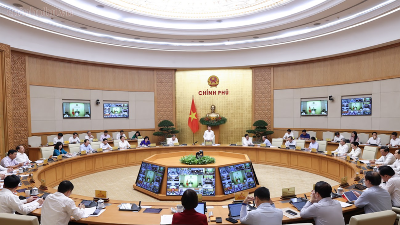
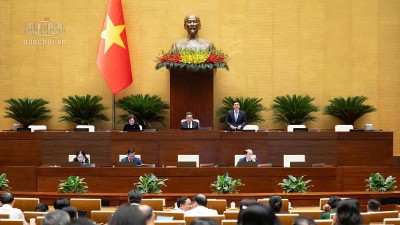
The Government’s regular meeting for October was held in Hanoi on November 4 under the chair of Prime Minister Le Minh Hung.
At the meeting, the Government reviewed socio-economic performance in October and the first 10 months of 2026, and discussed key tasks and solutions for the remaining months of the year.
Prime Minister Le Minh Hung, as quoted by the Vietnam News Agency, reaffirmed the Government’s determination to achieve double-digit economic growth while maintaining macroeconomic stability and controlling inflation, stressing that inflation control must be given the highest priority in the final two months of 2026.
According to reports presented at the meeting, Vietnam’s economy continued to record positive results across various sectors, with macroeconomic stability maintained and inflation kept under control. The consumer price index (CPI) rose 4.57% in the first 10 months, while state budget revenue reached nearly VND2.45 quadrillion ($95.2 billion), equivalent to 96.4% of the annual estimate.
Traditional growth drivers remained strong. Public investment disbursement reached VND720.5 trillion, or 75.4% of the assigned plan. Foreign direct investment (FDI) attraction remained a bright spot, with registered capital totaling $54.85 billion and disbursed capital reaching $24.08 billion. Notably, total export-import turnover exceeded $1 trillion for the first time, reaching nearly $1.011 trillion.
Science and technology, innovation and digital transformation continued to be promoted as new growth drivers, while progress on major infrastructure projects was accelerated. Social welfare, cultural development, national defense, security and external relations also received due attention.
Concluding the meeting, PM Hung, as cited by the news agency, acknowledged the achievements while pointing out persistent difficulties and challenges. He noted that public investment disbursement remains low at several ministries, agencies, localities and key projects. The handling of long-standing projects and surplus public buildings and land in many localities have also failed to produce the expected results.
He called for more concrete measures to boost exports, reduce the trade deficit, stimulate private investment, remove obstacles facing businesses and improve productivity through science, technology and the development of new economic sectors. He also stressed the need to accelerate the development and completion of databases, connect information systems and simplify administrative procedures through the reuse of existing data.
The Government must also step up efforts to stimulate domestic consumption towards the year-end, while addressing issues related to healthcare, education, culture, employment, social welfare and people's living conditions, he stressed.
For November and the final two months of the year, the Government leader instructed ministries, sectors and localities to proactively develop action plans to implement resolutions and conclusions of the fourth plenum of the Party Central Committee. Ministries and agencies were also asked to work closely with National Assembly bodies to finalize draft laws and resolutions, ensuring consistency and effective institutionalization of the Party’s guidelines, and prepare detailed documents for implementation to avoid delays once the legislation takes effect.
He instructed the steering committee for price management to work immediately with localities where CPI growth over the first 10 months exceeded the national average, particularly major cities, to devise appropriate measures to stabilize prices. Authorities must closely monitor the year-end growth scenario and implement measures to stimulate consumption and tourism, connect supply and demand, promote trade and organize trade fairs during the upcoming holiday and Lunar New Year period.
Regarding public investment, PM Hung called for reallocating capital from slow-moving projects to those with stronger disbursement capacity, aiming to achieve 100% disbursement of the assigned plan. He also urged stricter control over the number of projects, particularly the construction of administrative offices in provinces and cities, to priorities resources for essential infrastructure and projects with widespread socio-economic impacts. Major projects must be accelerated, with particular attention paid to site clearance and construction material supplies. The 100-day plan to address bottlenecks in digital transformation must also be completed on schedule.
On social welfare, the Government leader directed the implementation of the plan based on the conclusions of General Secretary of the Communist Party of Vietnam Central Committee and President To Lam regarding support for vulnerable groups. Priorities include accelerating the search for, recovery and identification of fallen soldiers’ remains, meeting the 2026 targets for social housing and rental housing, and ensuring progress in building inter-level boarding schools in border communes.
The Prime Minister assigned specific tasks to ministries to ensure coordinated implementation. The Ministry of Finance was asked to closely monitor price developments, update inflation scenarios and propose appropriate price management measures, while accelerating reforms in value-added tax and tax administration.
The State Bank of Vietnam was urged to proactively and flexibly manage the monetary policy to stabilize the value of the Vietnamese currency, interest rates and exchange rates, and create more favorable lending conditions for production, business, priority sectors and small- and medium-sized enterprises. It must also strengthen supervision to ensure the banking system safety. The Ministry of Industry and Trade was tasked with ensuring stable supplies of essential goods, particularly petroleum and electricity, accelerating adjustments to the Power Development Plan VIII and completing the draft decree on petroleum trading in November. It was also instructed to promote exports, control the trade deficit, diversify markets, make effective use of free trade agreements and step up negotiations on a reciprocal trade agreement with the US.
Meanwhile, the Ministry of Construction must closely monitor prices of building materials, housing and transport services, while coordinating with localities to remove obstacles and accelerate major infrastructure projects. The Ministry of Agriculture and Environment was asked to ensure stable supplies of essential food and agricultural products, balance domestic consumption and exports, and reorganize agricultural supply and distribution networks.
PM Hung also called for stronger application of strategic technologies, improvements in education and healthcare services, year-end tourism stimulus measures and the development of special policies to attract and retain talented people.
He assigned the Ministry of National Defense, the Ministry of Public Security and the Ministry of Foreign Affairs to strengthen strategic policy research and advice, and accelerate key projects in national defense and security.
The Prime Minister urged Deputy Prime Ministers and Government members to proactively implement their assigned tasks and contribute directly to the draft National Assembly resolution on the 2027 socio-economic situation, and continue working to ensure that key targets and tasks for the remaining months of 2026 are fulfilled.

 Google translate