



Vietnam’s human resources (HR) market has entered into the second half of 2026 with considerable momentum. Employment continues to grow, wages are posting their strongest real gains in years, and the digital economy is generating jobs at an unprecedented pace. At the same time, Vietnamese workers have emerged as some of Southeast Asia’s fastest adopters of AI, embracing generative AI technologies more quickly than many developed markets.
Yet behind those encouraging indicators lies a structural challenge that could determine the country’s long-term competitiveness. While businesses are investing heavily in digital transformation, the skills and capabilities of the workforce are struggling to keep pace. According to Tanca’s State of HR Vietnam 2026 and Vietnam HR Skills Report 2026, Vietnam’s talent challenge is no longer centered on labor shortages but on an increasingly wide gap between the skills employers need and those available in the market.
The headline labor market numbers, though, remain positive. Vietnam’s workforce reached 53.8 million people in the second quarter of 2026, with 52.7 million employed, and the unemployment rate was just 2.22 per cent. Average monthly incomes rose 8.7 per cent year-on-year to VND9 million ($346), while salaried employees earned an average of VND10 million ($385) per month. The country’s core digital economy attracted 1.5 million workers during the first half of the year, illustrating how rapidly technology-intensive industries are expanding. Meanwhile, the share of formally-trained workers edged up to 29.7 per cent, though informal employment still accounted for 61.9 per cent of total jobs and youth unemployment remained relatively high at 8.77 per cent.
These figures suggest Vietnam’s labor market remains fundamentally healthy. However, they also reveal that the challenge facing businesses has shifted. The question is no longer whether companies can hire enough workers, but whether they possess the necessary skills and capabilities in an economy where technology is changing jobs faster than education systems can respond.
New competitive advantage
The transformation underway in Vietnam reflects a much broader global trend. According to the World Economic Forum (WEF), 39 per cent of workers’ core skills will change or become obsolete by 2030. While technological disruption is expected to create 170 million new jobs worldwide, it will simultaneously displace 92 million existing roles, resulting in a net gain of 78 million jobs that require fundamentally different capabilities. Of every 100 workers globally, only 41 are expected to continue in their current roles without significant retraining. Twenty-nine will require upskilling, 19 will need to be reskilled into different positions, and eleven are at risk of receiving no training at all.
The challenge has become significant enough that 63 per cent of businesses now identify skill shortages as the single biggest obstacle to transformation. At the same time, the LinkedIn Work Change Report 2025 estimates that around 70 per cent of the skills used in today’s jobs will change before the end of the decade, highlighting how rapidly workforce requirements are evolving.
Perhaps more surprisingly, AI is not diminishing the value of human capabilities, it is increasing it. While AI and big data, cybersecurity, and technological literacy rank among the fastest-growing technical competencies, seven of the ten fastest-growing skills identified by the WEF are human capabilities, including creativity, resilience, curiosity, lifelong learning, leadership, talent management, and analytical thinking. Analytical thinking remains the single most sought-after competency across industries, reinforcing that competitive advantage increasingly depends on combining human judgment with technological capability rather than replacing one with the other.
For employers, this represents a fundamental shift in workforce strategy. Degrees remain relevant, but they are no longer sufficient. Skills now depreciate much faster than formal qualifications, requiring continuous investment throughout an employee’s career.
Deeper skills gap
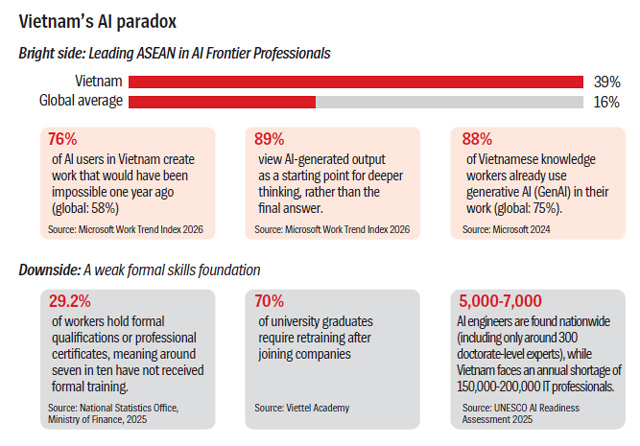
Few countries illustrate this transition more clearly than Vietnam. According to Microsoft’s Work Trend Index, 39 per cent of Vietnamese workers qualify as AI Frontier Professionals; the highest proportion in ASEAN and more than double the global average of 16 per cent. Some 88 per cent of Vietnamese knowledge workers already use generative AI in their jobs, compared with 75 per cent globally, while 76 per cent say AI enables them to produce work that would have been impossible only a year earlier. Nearly nine in ten respondents said they use AI outputs as a starting point for deeper thinking rather than accepting them as final answers, suggesting Vietnamese workers are moving beyond basic experimentation toward more advanced applications.
However, this rapid AI adoption stands in stark contrast to the country’s formal skills base. Only 29.7 per cent of Vietnamese workers hold formal qualifications or professional certificates, meaning roughly seven out of every ten workers lack structured vocational or higher education credentials. Around 70 per cent of university graduates still require retraining after entering the workforce, while Vietnam currently has only an estimated 5,000-7,000 AI engineers nationwide, including around 300 with doctoral-level expertise. At the same time, the information technology sector continues to face annual shortages of between 150,000 and 200,000 workers.
The contrast illustrates a uniquely Vietnamese paradox. Workers are learning AI faster than the education system can teach it. Instead of universities leading workforce preparation, employees are increasingly acquiring AI capabilities independently through experimentation, online learning, and workplace experience. That has enabled Vietnam to become an early AI adopter, but it also means businesses can no longer rely on external education providers to build the talent pipeline they need.
Beyond recruitment
The consequences are becoming increasingly apparent in recruitment. According to ManpowerGroup, 71 per cent of employers across Asia-Pacific and the Middle East struggle to fill vacancies, while 43 per cent say applicants lack the necessary capabilities. More than half of HR leaders admit they cannot accurately predict which skills their organizations will require in the years to come, making long-term workforce planning increasingly difficult.
The composition of talent shortages is also changing. For the first time, AI model development and practical AI application rank above traditional IT expertise as the hardest technical skills to recruit. Beyond technical capabilities, employers increasingly value communication, teamwork, adaptability, and professional ethics, while Vietnamese IT candidates continue to fall short in areas such as communication, critical thinking, and product thinking.
Yet the reports also highlight an important opportunity. The obstacle is not employee willingness to learn. According to Navigos, 89.45 per cent of Vietnamese workers are prepared to acquire new skills. Employers identified technology application as the most important capability over the next three to five years, cited by 76.8 per cent of respondents, followed by adaptability at 38.8 per cent and analytical problem solving at 26 per cent.
This suggests that the bottleneck lies less with workers than with organizational systems. Many companies still lack standardized skills frameworks, structured capability assessments, and measurable learning pathways, making it difficult to close skill gaps even when employees are motivated to do so.
Where learning meets work
Taken together, the two reports suggest the next phase of Vietnam’s competitiveness will depend less on expanding the workforce than on upgrading the capabilities of the workforce already in place.
Rather than treating learning as a support function, businesses are increasingly expected to build skills-based organizations supported by standardized skills taxonomies, internal learning management systems, continuous capability assessments, micro-learning programs, and clearer links between newly-acquired skills, compensation, and career progression. The reports also argue that AI adoption needs to progress beyond simple task automation toward redesigning workflows where people and AI collaborate effectively.
Tanca identifies five major shifts likely to define workforce strategies in 2027: moving from salary-based to skills-based pay; from hiring to improving long-term retention; from retaining employees through compensation to retaining them through career development; from degree-based recruitment to skills-based organizations; and from simply deploying AI tools to becoming AI-first organizations.
For Vietnam, the implications extend well beyond human resources. As the economy moves up the value chain, access to talent will increasingly depend on how quickly businesses can develop new capabilities internally rather than compete for an already limited pool of skilled workers. In an economy where technologies evolve faster than formal education, the companies that build the strongest learning ecosystems may ultimately prove to be the country’s most competitive businesses.






 Google translate