


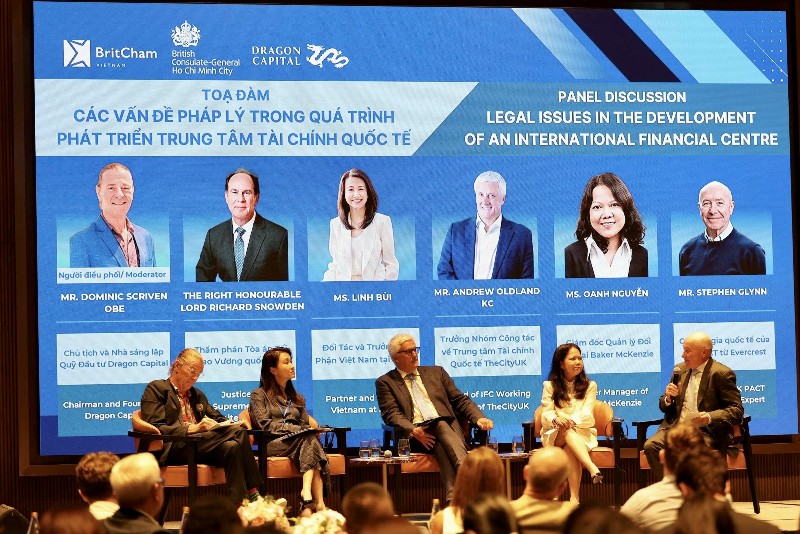
The Loseby Lecture Series 2026 took place in Ho Chi Minh City on August 25, with the participation of legal, judicial, and financial experts, along with representatives from the British and Vietnamese business communities.
The event was organized by the British Chamber of Commerce in Vietnam (BritCham Vietnam) in collaboration with Dragon Capital, with support from the British Embassy in Hanoi and the British Consulate General in Ho Chi Minh City.
Speaking at the event, Mr. Denzel Eades, Chairman of BritCham Vietnam, stated that a transparent legal framework and independent judicial institutions are a foundation of trust for international investors. As Vietnam accelerates its goal of developing a globally competitive International Financial Center (IFC), the British business community is ready to share its experience in commercial law, dispute resolution, and regulatory improvement.
Legal expertise for VIFC
During the discussion session "Legal Issues in the Development of International Financial Centers," experts exchanged views on factors affecting investor confidence, such as legal transparency, predictability, effective dispute resolution, and compatibility with cross-border financial transactions. They also shared operational experiences from international financial centers, highlighting areas Vietnam needs to improve in building its IFC.
According to Mr. Dominic Scriven OBE, Chairman and Founder of Dragon Capital, clarity, consistency, and predictability of the legal environment are fundamental to building trust, helping businesses strategize and commit long-term capital in Vietnam.
"With a long-term investment commitment in Vietnam, we highly appreciate Vietnam's continuous efforts in creating a favorable, stable, and efficient legal and business environment," Mr. Dominic shared.
From a financial management perspective, Mr. Stephen Glynn, an international expert from the UK PACT program, noted that regulatory bodies in an international financial center often perform multiple functions, from overseeing business operations and financial safety of institutions to licensing and identifying authorized entities.
This requires Vietnam to build a team with capabilities suited to the international financial environment. Experience from Dubai shows that new financial centers often need to attract experts from various markets such as the UK, USA, Australia, Singapore, and Hong Kong (China).
Vietnam does not necessarily need to complete its entire legal system before launching the Vietnam International Financial Center (VIFC). Instead, it can prioritize about 10 foundational legal groups related to licensing, corporate governance, business operations, financial safety, and solvency. Specialized regulations on capital markets, fintech, or digital assets can be further developed as the ecosystem evolves.
From the perspective of business consulting, Ms. Linh Bui, Partner and Head of Vietnam at Allens, believes that handling the relationship between general applicable laws in Vietnam and specialized regulations for the VIFC will be a concern for investors.
According to her, even under the current legal framework, businesses sometimes face different interpretations of the same regulation. When the VIFC adds a layer of specialized regulations, the requirement for clarity and consistency in legal application becomes even more important.
A notable feature of the VIFC model is the ability for specialized court judgments to be enforced directly, rather than undergoing recognition and enforcement procedures like some foreign court judgments. However, experts believe that the enforcement of judgments on assets outside the VIFC, as well as issues related to bankruptcy, secured assets, and real estate, still need clarification.
Three legal issues needing further improvement
In an interview with Vietnam Economic Times/VnEconomy, Mr. Andrew Oldland KC, Head of the International Financial Center Task Force at TheCityUK, stated that Vietnam has made progress in building a legal framework for the VIFC's specialized court.
Vietnam's political commitment to developing the International Financial Center through National Assembly Resolution No. 222/2025/QH15 is quite clear. Some activities can be implemented first, while other areas need more time to complete the legal and institutional framework. However, building a new legal model is just the beginning; the important thing is to build trust that the model is suitable and can operate effectively.
The current law has laid the foundation for court operations, allowing for the application of case law in adjudication and granting parties the right to choose applicable law in contracts. However, three main issues still need further improvement:
Firstly, ensuring judicial independence, including mechanisms related to the tenure and position of judges. Vietnam also needs to attract judges with experience in the common law system, capable of handling complex commercial disputes and delivering judgments with clear reasoning, helping parties predict how similar cases will be resolved.
Secondly, the finality of judgments. According to him, it is necessary to clarify the mechanism so that VIFC court decisions are not appealed to the people's court system. At the same time, the scope of jurisdiction also needs to be clearly defined, including disputes under the jurisdiction of the VIFC court and those that continue to be resolved in the people's court system.
Thirdly, the enforcement mechanism of judgments. Although the law provides for the direct enforcement of court judgments, the handling of assets outside the VIFC still needs clarification. This is a factor that directly affects the practical effectiveness of the specialized adjudication institution.
According to lawyer Oldland, Vietnam's commitment to developing an international financial center is clear, and this process is being revitalized. However, some areas can be implemented first, while others need more time to complete the legal and institutional framework.
Investors need to know the field they are investing in, how their rights are protected, and in case of unforeseen incidents not caused by them, how their capital recovery is ensured. According to Mr. Oldland, the VIFC is established to address an important part of this equation. A reliable legal environment not only helps reduce risks for investors but can also promote the development of Vietnam's financial services market according to international practices.
The VIFC can also create a suitable space for the development of fintech and new financial technologies before suitable models are expanded to the Vietnamese market.
Discussions at Loseby 2026 indicated that alongside financial policies and infrastructure, the legal foundation, judicial capacity, and dispute resolution mechanisms will be crucial conditions for the VIFC to build trust, attract international financial institutions, and gradually establish its position on the regional financial map.

 Google translate