


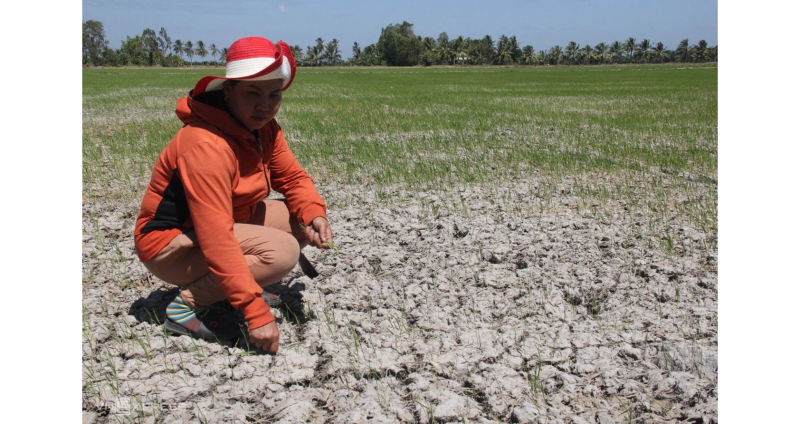
The Vietnam Meteorological and Hydrological Administration (VNMHA) has outlined two risk scenarios "High Risk and Very High Risk" for the 2026-2027 El Niño, warning of significant impacts on the nation’s water resources, hydropower generation, and agricultural production.
Against the backdrop of record-high global average temperatures, the 2026-2027 El Niño phenomenon has officially formed and is developing rapidly. Forecasts indicate a very high probability (over 95%) that El Niño will persist through the second half of 2026 and into 2027. Its intensity is expected to be moderate to strong, with the possibility of developing into a "very strong" event.
According to VNMHA, the emergence of El Niño poses significant challenges, increasing the risk of prolonged heatwaves, seasonal rainfall shortages, and depleted water sources. These factors lead to severe drought and saltwater intrusion, particularly in the South Central Coast, the Central Highlands, and the Mekong Delta.
The High Risk scenario reflects a situation where El Niño maintains moderate to strong intensity before weakening in the early months of 2027. Under this scenario, average temperatures across the country are projected to be 0.5–1°C higher than the multi-year average. The number of hot days will increase, especially in the North, North Central, South Central Coast, Central Highlands, and the South. Heatwaves are likely to arrive earlier and last longer than average, driving up demand for electricity, domestic water, and irrigation.
Rainfall during the 2026 rainy season is projected to be 10–20% below average, with localized deficits exceeding 25% in the South Central Coast. River flows in many basins are expected to decrease by 10–20%, hindering the water storage capacity of reservoirs ahead of the dry season.
The agency warns that the threat of drought, water shortages, and saltwater intrusion will remain high, concentrated in the South Central Coast, Central Highlands, and the Mekong Delta. Key sectors expected to face significant impacts include water resources, agriculture, energy, domestic water supply, forest fire prevention, and food security.
Under the Very High Risk scenario, average temperatures nationwide could rise 1–2°C above the multi-year average. Heatwaves are likely to occur earlier, last longer, and become more intense, particularly from March to June 2027.
Rainfall during the 2026 rainy season may see a widespread deficit of 20–40%, with localized drops exceeding 50% in the South Central Coast. Flow in many river basins could decrease by 20–40%, significantly reducing the water storage capacity of irrigation and hydropower reservoirs.
If El Niño persists into the seasonal transition period, the 2027 rainy season risks starting later than usual, especially in the Central Highlands and the South. This would prolong water shortages and delay the recovery of water sources, pushing the threat of drought and saltwater intrusion to critical levels.
Notably, the very high-risk scenario could trigger a "compounding effect" between prolonged heatwaves, a delayed 2027 rainy season, low reservoir levels, and a declining trend in upstream Mekong River flows caused by increased water extraction and regulation by riparian countries.
Should upstream Mekong flows remain low, saltwater intrusion in the Mekong Delta could reach levels comparable to the most severe El Niño events in history. Many small and medium-sized reservoirs in the South Central Coast and Central Highlands are at risk of failing to reach the necessary water levels for agricultural production and domestic supply.
VNMHA noted that these two scenarios serve as a meteorological basis for management agencies and local authorities to reference when developing response plans; they do not replace official disaster forecasts or executive decisions made by competent authorities.
Beyond providing meteorological data, the report quantifies direct risks to the economy. These range from water security and agriculture (warning of potential impacts on approximately 350,000 hectares of Winter-Spring rice in the Mekong Delta) to energy security (the risk of water shortages for hydropower generation, particularly on the Da River system during the May–June 2027 peak). Conversely, the report also identifies "conditional opportunities" for Vietnam to increase its agricultural export value if water resources are effectively managed.






 Google translate