


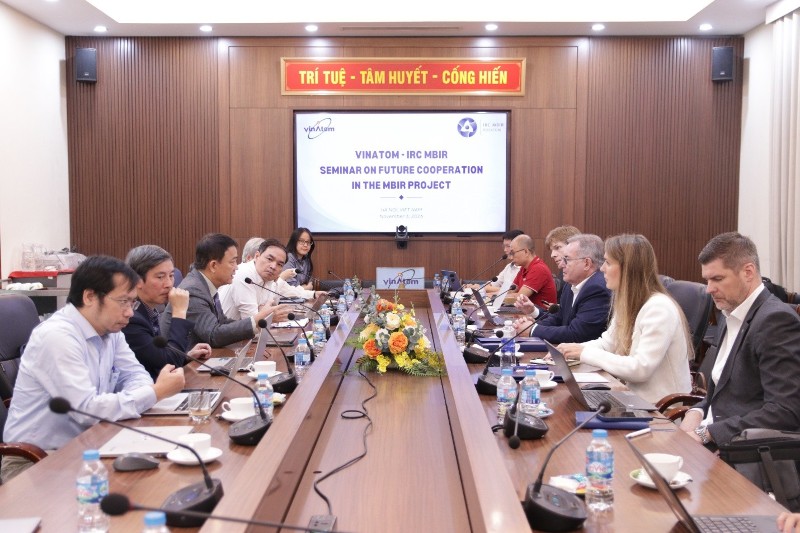
The Vietnam Atomic Energy Institute (Vinatom) and the Russian company leading the consortium of the International Research Centre based on the MBIR reactor have signed a memorandum of understanding (MoU) to promote scientific research and cooperation in nuclear technology.
According to Russia’s State Atomic Energy Corporation Rosatom, the agreement confirms both sides’ commitment to developing cooperation through the MBIR International Research Centre. This includes Vinatom’s participation in research activities conducted at the facility and discussions on the conditions for the Vietnamese institute to join the MBIR Consortium.
The agreement is expected to provide Vietnamese specialists with access to the experimental infrastructure of the MBIR reactor, currently under construction in Dimitrovgrad, Russia. The facility is a multipurpose fast-neutron research reactor designed to deliver an exceptionally high neutron flux for advanced nuclear technology research.
Expanding opportunities for nuclear technology research
One of the key aspects of the agreement is the prospect of Vinatom participating in research programmes at MBIR, focusing on areas considered important for the development of next-generation nuclear technologies.
Proposed research activities include testing structural materials and equipment under high-intensity irradiation conditions; validating computational codes used to assess the safety of nuclear projects; and studying the behaviour of different types of nuclear fuels and coolants.
Vietnamese scientists may also participate in research into the transmutation of minor actinides, as well as technologies and solutions to reduce the volume and radioactivity of nuclear waste.
These research areas are important for improving the safety, efficiency and sustainability of nuclear technologies. In particular, testing materials under intense neutron irradiation and assessing nuclear fuel behaviour are essential to the development and refinement of advanced reactor designs.
According to Rosatom, MBIR's high neutron flux and wide range of irradiation parameters will enable experiments that closely simulate the operating conditions of future reactor systems. This will provide Vinatom with additional opportunities to strengthen its research capabilities and build up its domestic scientific and technological foundation in support of Vietnam's national nuclear programme.
Dr. Tran Chi Thanh, President of Vinatom, described the new agreement as a strategic step towards strengthening cooperation in the peaceful use of nuclear energy. Both sides expect to pursue long-term joint research activities.
Mr. Vasily Konstantinov, General Director of the company leading the MBIR International Research Centre Consortium, for his part, said the MoU formalises the two sides' mutual willingness to cooperate and is expected to strengthen MBIR's international scientific research agenda.
MBIR: a 150 MW fast-neutron research reactor
MBIR is a multipurpose fast-neutron research reactor using liquid sodium as its coolant, with a thermal capacity of 150 MW. It is being constructed in Dimitrovgrad at the site of the Research Institute of Atomic Reactors (RIAR), which is part of Rosatom's Scientific Division.
The project is being implemented under Russia's national technological leadership programme, focusing on new nuclear and energy technologies.
According to Rosatom, installation work on the reactor's primary circuit equipment is currently underway. In 2025, cold traps belonging to the emergency heat removal system were successfully installed.
Subsequent work has included welding hot-pipeline transition sections to the reactor vessel, installing the first pipeline units and completing the installation of the main process equipment in the sodium storage building.
Fuel handling equipment and steam-water washing stations for spent fuel assemblies have also been delivered. In 2026, two emergency heat exchangers, each weighing 7.3 tonnes, standing 5 metres tall and measuring 1.5 metres in diameter, were installed in their designated positions.
Once operational, MBIR will support a wide range of research and applications, including experimental studies, radioisotope production, the development of modified materials, and testing of new equipment and technological systems.
A particularly important research objective is to advance two-component nuclear power technology and close the nuclear fuel cycle. These technologies are attracting growing attention in the development of next-generation nuclear energy systems, as they are expected to improve uranium resource utilisation while reducing the volume and radiotoxicity of nuclear waste.
International consortium opens doors to new partners
The International Research Centre has been established around the MBIR reactor in the form of an international consortium. Its members are given priority access to the reactor's research capabilities to conduct experiments supporting their respective national programmes for the peaceful use of nuclear energy.
According to Rosatom, the consortium model provides flexibility in allocating MBIR's research resources to meet the needs of the international scientific community. The consortium remains open to new institutional and corporate partners.
Its existing members include the Joint Institute for Nuclear Research (JINR), the Institute of Nuclear Physics of the Academy of Sciences of Uzbekistan, and China's Shanghai ZDAN International.
For Vietnam, establishing cooperation between Vinatom and the MBIR International Research Centre represents an opportunity to expand its international scientific partnerships, gain access to large-scale experimental facilities and strengthen specialised research capabilities.
As Vietnam continues to develop its nuclear science and technology sector and prepare the necessary human resources, research capacity, safety frameworks and technical infrastructure, participation in international research programmes could help the country accumulate scientific knowledge, technical expertise and technological capabilities.
However, the newly signed MoU establishes only the framework for cooperation and the exploration of conditions for Vinatom to join the MBIR Consortium. Formal membership and the specific scope of research activities will depend on further discussions and implementation arrangements between the two sides.





 Google translate