


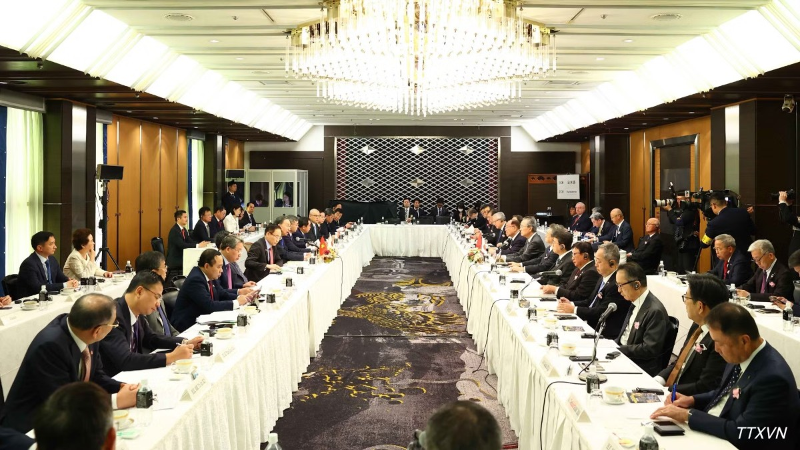
Emphasizing the need to enhance the quality of cooperation in the new context, General Secretary and President To Lam stated that Vietnam and Japan should move from the traditional model of cooperation based on “acceptance and transfer” to one of “co-creation and deep integration of value chains and supply chains,” aiming for high-quality growth and stronger strategic self-reliance for both countries.
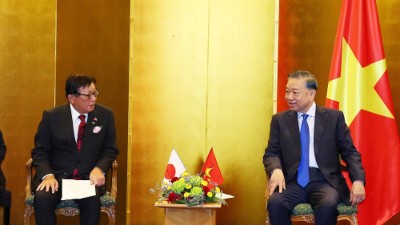
The top Vietnamese leader made the remarks during a meeting and dialogue with leaders and senior representatives of major Japanese corporations in Tokyo on the morning of November 9, as part of his official visit to Japan from November 8-11.
The event was attended by Japan Chamber of Commerce and Industry Chairman Kobayashi Ken, Japan Business Federation (Keidanren) Chairman Tsutsui Yoshinobu, and representatives from numerous major corporations. Keidanren currently brings together more than 1,500 leading Japanese companies.
General Secretary and President To Lam called on Keidanren member companies to view Vietnam not merely as a manufacturing base or a promising consumer market, but as a long-term strategic partner for jointly creating products, testing new business models, and developing strategic technologies.
Particular emphasis was placed on building ecosystems for high-tech industries, semiconductors, artificial intelligence (AI), large-scale data centers, and AI-driven solutions.
He also urged Japanese businesses to increase investment in smart infrastructure, green energy, green logistics, and environmentally friendly industries. He encouraged cooperation in research and development of emissions-reduction technologies, ensuring energy security at reasonable costs, and enhancing the overall competitiveness of the economy.
In addition, finance and banking, internationally standardized capital markets, advanced healthcare, pharmaceuticals, and biotechnology were identified as promising areas for future cooperation.
To facilitate the expansion of Japanese investment, General General and President To Lam affirmed Vietnam’s commitment to maintaining political and social stability, providing confidence for long-term investment plans.
Vietnam will continue pursuing institutional reforms, reviewing and reducing administrative procedures, removing bottlenecks, building a transparent and consistent legal framework, and protecting the legitimate rights and interests of investors.
At the same time, Vietnam is committed to ensuring a stable and adequate supply of essential conditions for production and business activities, including electricity, water, telecommunications infrastructure, ready-to-use industrial land, and human resources.
At the dialogue, representatives of Keidanren expressed their desire for Vietnam to play a greater role in the regional economic architecture, help ensure supply chain resilience, uphold free trade, continue improving the investment environment, and strengthen bilateral cooperation mechanisms.
Representatives of Japanese corporations highly valued the effectiveness of their investment and business activities in Vietnam. They reaffirmed their long-term commitment to contributing to sustainable growth through technology transfer, high-quality workforce development, innovation, and the development of transportation infrastructure, urban areas, industrial parks, energy projects, and digital transformation initiatives.
 Google translate