


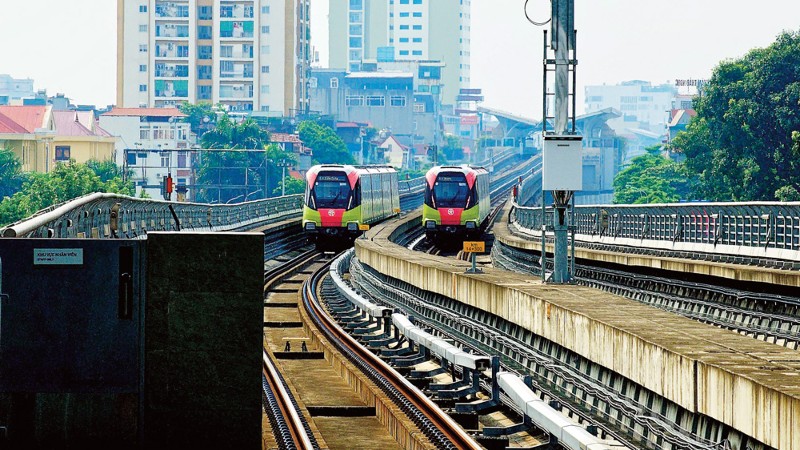
After more than a decade of constructing its first urban railway lines, Hanoi is now entering a new phase of infrastructure development, with the simultaneous breaking of ground at five metro lines spanning more than 300 km. More significant than the scale of investment is the city’s decision to launch its first metro expansion program based on a comprehensive network strategy rather than isolated projects.
The official breaking of ground at Metro Lines 1, 2, 8, 10, and 14 on June 22 represents an unprecedented push in the capital’s transport infrastructure. Targeted for completion by 2030, the projects are expected to form the backbone of Hanoi’s first-generation urban rail network.
The significance of the announcement extends well beyond record investment figures. After taking more than a decade to bring the Cat Linh - Ha Dong line into commercial operation and with the Nhon - Hanoi Station project still under construction, Hanoi’s decision marks a clear departure from the incremental approach that has defined its metro development to date. The question is no longer how many additional kilometers of rail the city will build, but why it has chosen this moment to simultaneously launch five strategic metro lines.
Building strategic growth corridors
The alignment of the five newly-launched metro lines underscores Hanoi’s long-term development strategy. Two of the routes are designed to provide direct connections to Noi Bai International Airport.
Metro Line 1 will run between Thuong Tin and Noi Bai, passing through Ngoc Hoi, Hanoi Station, Yen Vien, and Thu Lam. Metro Line 2 will link Noi Bai and the city’s southern reaches, passing through the city center, while Metro Line 8 will establish an East-West transport corridor linking Hoa Lac with central Hanoi and the eastern districts. Metro Line 10 will connect Dong Anh with the urban core, while Metro Line 14 will create a new development axis along the northern bank of the Red River and Gia Lam.
Urban planning experts view the five projects as the first building blocks of an integrated transport network connecting Hanoi’s emerging development zones. When overlaid with the capital’s master plan, each route serves areas expected to shape the city’s long-term urban structure.
Hoa Lac is being developed as a national hub for science, technology, and innovation. Dong Anh and the northern Red River corridor have been designated as key urban expansion areas, while Gia Lam is emerging as a major growth center in eastern Hanoi. Noi Bai and Ngoc Hoi, meanwhile, are expected to serve as two of the capital’s most important transportation gateways, anchored by the international airport and the future North-South high-speed rail interchange.
Under Hanoi’s latest master plan, the city envisions a network of 18 metro lines totaling nearly 1,000 km. The system is intended to become the backbone of public transportation while supporting Hanoi’s broader urban development framework built around nine growth poles, nine centers, nine development corridors, and eight ring roads.
The strategy also reflects Vietnam’s broader economic ambitions. As the country seeks to sustain high growth in a new era of development, Hanoi and Ho Chi Minh City have been identified as its two primary economic engines. Expanding high-tech zones, new urban districts, commercial centers, and logistics hubs will require significantly stronger transport connectivity to unlock future growth.
Viewed in this context, the simultaneous rollout of five metro lines is about far more than constructing additional railway tracks. It represents a foundational step toward establishing a high-capacity public transport system capable of linking Hanoi’s emerging growth centers into a unified metropolitan network.
Lessons from the first projects
The ambition to develop an urban railway network is hardly new. Hanoi has pursued the objective for many years, but progress has been slower than expected because of the challenges encountered during its first-generation metro projects.
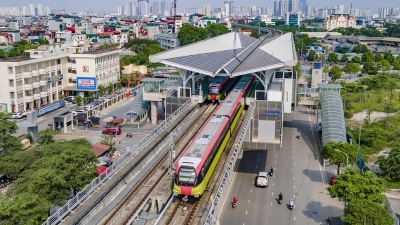
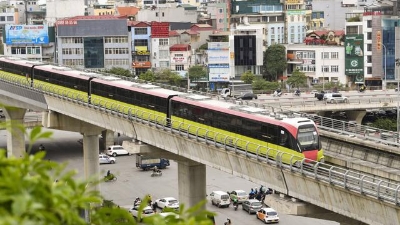
Construction of the Cat Linh - Ha Dong and Nhon - Hanoi Station lines began in 2010 and 2011, yet the former did not begin commercial service until late 2021, while the latter has experienced repeated delays. As Hanoi’s first urban rail projects, they introduced an entirely new category of infrastructure requiring sophisticated engineering, project management, and operational expertise.
At the time, virtually every aspect of the projects, from technology and design standards to equipment and management experience, relied heavily on international partners. While this accelerated the transfer of advanced technical expertise, it also complicated project coordination by involving multiple stakeholders with differing standards and procedures.
Land clearance proved to be another major obstacle. Urban rail lines must pass through densely populated neighborhoods, affecting housing, livelihoods, and extensive underground utility networks. In many cases, even minor delays in compensation, resettlement, or utility relocation were enough to stall overall construction progress.
After several years of operation, both the Cat Linh - Ha Dong line and the elevated section of the Nhon - Hanoi Station line have demonstrated that demand for high-capacity public transportation in Hanoi is real. Residents are clearly willing to use metro services when they are reliable, convenient, and well connected with other modes of transport.
At the same time, the experience has highlighted the limitations of developing metro lines individually. Though ridership has continued to grow, the existing routes still function largely as standalone corridors rather than components of a fully-integrated network, preventing the system from reaching its full potential.
For Hanoi, the strategic challenge is therefore no longer simply extending the rail network. The city’s broader objective is to build an integrated transportation ecosystem capable of seamlessly connecting commercial hubs, emerging growth centers, and new urban districts within a unified transit system.
Falling into place
If Hanoi’s first metro projects exposed the city’s implementation challenges, the simultaneous launch of five new lines suggests those lessons are now being translated into policy.
Institutional reforms have laid much of the groundwork. Politburo Resolution No. 02-NQ/TW on the development of the capital, the Capital Law 2026, and a series of special mechanisms supporting urban railway development have created a new legal framework for implementing large-scale infrastructure programs. Unlike previous approaches that focused on individual projects, these policies emphasize coordinated network development.
While institutional reform provides the necessary policy foundation, land acquisition remains critical to maintaining construction schedules. Drawing on past experience, Hanoi is separating land clearance into standalone projects so that site preparation can begin ahead of construction. Accelerating resettlement projects while expanding public consultation is also expected to build stronger consensus before implementation begins.
The city’s institutional capacity has likewise improved. More than a decade of experience with urban rail development has strengthened expertise in project management, construction supervision, and system operations. At the same time, domestic private companies are gradually moving deeper into the value chain for complex infrastructure development.
Despite these advantages, delivering more than 300 km of metro infrastructure remains an enormous undertaking. New policy mechanisms may streamline project preparation, while accumulated experience can help mitigate implementation risks. Even so, the scale of the current program means that every decision involving technical standards, construction quality, and operating models will have long-term implications for the future network.
The simultaneous launch of five metro lines signals that Hanoi’s public transportation network is entering a new stage of development. Experience from cities around the world suggests that the economic value of metro systems is determined not by breaking-ground ceremonies or ribbon cuttings, but by whether they ultimately function as a fully-integrated network, one capable of connecting growth centers, attracting sustained ridership, and reshaping the urban landscape.
As the country seeks to sustain high growth in a new era of development, Hanoi and Ho Chi Minh City have been identified as its two primary economic engines. Expanding high-tech zones, new urban districts, commercial centers, and logistics hubs will require significantly stronger transport connectivity to unlock future growth.





 Google translate