


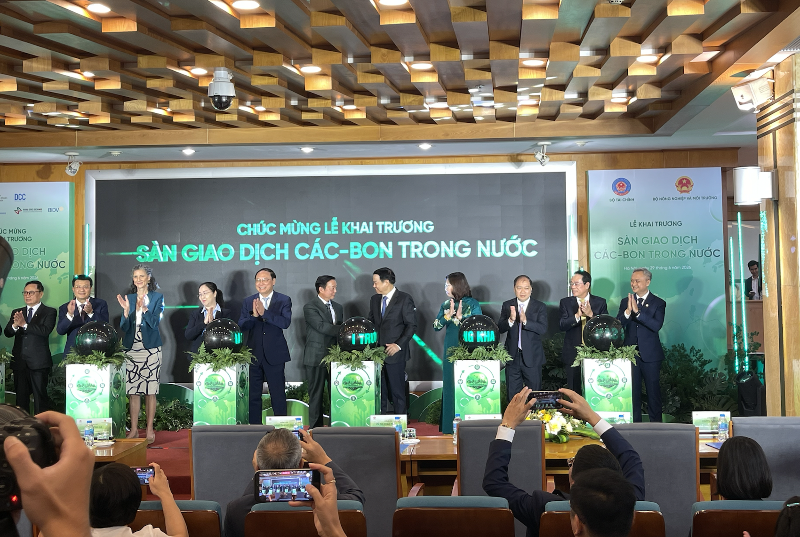
The domestic carbon exchange officially commenced operations at the Hanoi Stock Exchange (HNX) on June 29, with the quota code VN2025.
According to an announcement from the HNX, the first product traded was the VN2025 greenhouse gas emission quota. Its volume is 511,473,846 tons of CO2 equivalent, with the lowest offering starting at VND135,000 (around $5.14) per ton, for the compliance period of 2025-2026. The last trading day for this greenhouse gas emission quota is December 24, 2027.
Speaking at the launch ceremony, HNX Chairman Nguyen Anh Phong said that the launch of the domestic carbon exchange is the result of implementing the Project on establishing and developing the carbon market in Vietnam under Prime Ministerial Decision No. 232/QD-TTg.
According to the current roadmap, traded goods consist of two types: greenhouse gas emission quotas and carbon credits. Under the direction of the Vietnam Stock Exchange (VNX) and the State Securities Commission (SSC), the HNX has closely coordinated with the Department of Climate Change (DCC) under the Ministry of Agriculture and Environment (MAE), the Vietnam Securities Depository and Clearing Corporation (VSDC), BIDV, and other relevant units to develop the legal framework, with regulations for managing and operating the market, and its registration, trading, and settlement system.
To date, the information technology system connecting HNX, VSDC, the DCC and BIDV has been tested and is operating stably and smoothly. The relevant regulations and operational procedures have also been issued.
The membership system includes the first six securities companies that meet the market participation conditions and more than 100 emission sources included in the list of allocated greenhouse gas emission quotas.
"The launch of the domestic carbon exchange is not just a technical step, but also links environmental protection responsibility with the economic interests of businesses themselves, ensuring the sustainable development of the nation," said Mr. Phong.
Ms. Vu Thi Chan Phuong, Chairwoman of the SSC, also stated that after active and coordinated preparation between the Ministry of Finance (MoF), the MAE, and other relevant agencies and units, the conditions regarding the legal framework, technological infrastructure, operational procedures, and coordination mechanisms have been basically completed, allowing the domestic carbon exchange to officially begin operation.
Notably, to facilitate businesses during the pilot phase until the end of 2028, the Government has issued Decree No. 29/2026/ND-CP stipulating that no fees will be charged to businesses participating in the domestic carbon exchange.
"This policy demonstrates the Government's commitment to supporting the business community, contributing to reducing market participation costs, encouraging businesses to actively implement emission reduction solutions, innovate technology, and develop sustainably," Ms. Phuong shared.
According to Ms. Phuong, the establishment of a carbon exchange not only creates a mechanism for trading greenhouse gas emission quotas and carbon credits in a public, transparent, and fair manner, but also serves as an economic tool to help businesses proactively innovate technology, improve production efficiency, and reduce emissions.
For the financial market, this is a new component of the green financial ecosystem, opening up a channel for mobilizing and allocating resources for sustainable development projects, gradually approaching international practices in the development of capital and environmental markets.
Representing the operating units, Mr. Luong Hai Sinh, Chairman of the Board of Members of the VNX, stated that the launch of the carbon exchange is a significant milestone for the development of Vietnam's financial and carbon markets, but this is only the beginning.
"Safe, transparent, and efficient operation is not only a professional task but also contributes to achieving economic development goals, enhancing the competitiveness of Vietnamese businesses, and realizing the goal of net-zero emissions by 2050," Mr. Sinh affirmed.



 Google translate