


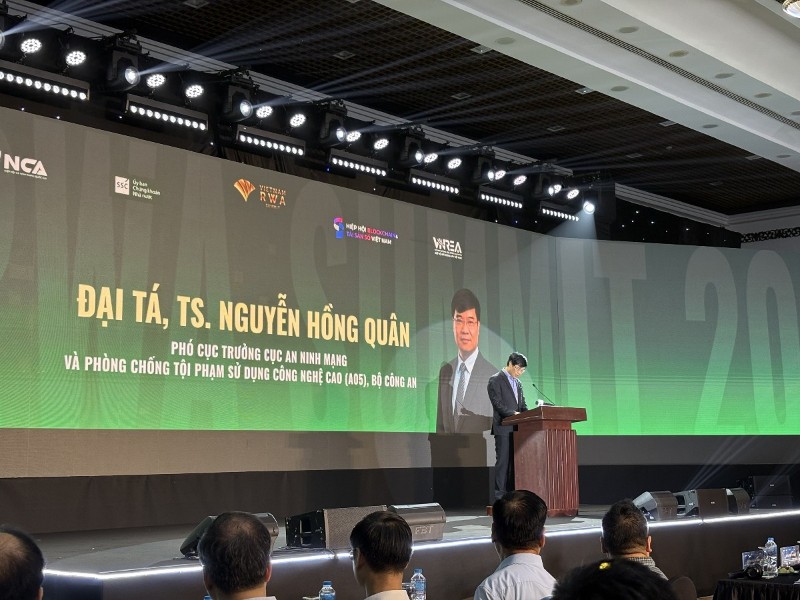
Crypto assets—and specifically tokenized Real World Assets (RWA)—are significantly impacting global financial markets. These technologies offer the potential to expand access to capital and unlock "sleeping" resources within the economy, stated Vice Chairman of the State Securities Commission (SSC), Mr. Bui Hoang Hai.
"For Vietnam, as the demand for capital to fund infrastructure, manufacturing, innovation, and digital transformation grows, RWA is viewed as a high-potential trend that requires serious research and cautious, long-term implementation," he told the Vietnam RWA Summit 2026 held on July 18.
However, Mr. Hai emphasized a cautious approach: "The fundamental principle is that technology does not change the economic and legal nature of an asset. The value of any asset must first stem from real-world existence, legal property rights, and verifiable cash flows."
Four strategic orientations for market development
Consequently, the SSC has outlined four major orientations for the development of the crypto asset market and asset tokenization models.
First, balancing innovation and risk management. The SSC will research and propose that relevant authorities issue policies to create a "sandbox" or controlled testing environment, allowing new models to operate within a managed framework.
Second, perfecting the legal framework. Building on the results of the pilot mechanism under Resolution 05, the SSC will continue to advise the Ministry of Finance and the Government. It will also coordinate with relevant agencies to gradually complete the legal framework for crypto assets and tokenized real-world assets.
Third, enhancing investor protection. Protecting investors will go beyond addressing damages after they occur. More importantly, the focus will be on early prevention through transparent disclosure mechanisms, risk management, and effective supervision.
Fourth, strengthening inter-sectoral cooperation. The SSC will work closely with the State Bank of Vietnam, the Ministry of Public Security, and other relevant ministries in the management and supervision of the market. Furthermore, regulatory bodies will maintain a regular dialogue with associations, businesses, and investors to listen to practical feedback and refine policies accordingly.
Mr. Hai reaffirmed that the market for crypto assets in general, and RWA in particular, can only develop sustainably if built on a foundation of legal clarity, transparent cash flows, secure infrastructure, and effective investor protection mechanisms.
Criminal activities masked as innovation
Also speaking at the event, Colonel Nguyen Hong Quan, Deputy Director of the Department of Cybersecurity and High-Tech Crime Prevention (A05) under the Ministry of Public Security, stated that a major current challenge is how to prevent criminals from fully exploiting the cross-border nature, anonymity, and rapid movement of digital assets.
These criminals utilize these features to commit various illegal acts, including investment scams, asset misappropriation, money laundering, data theft, system attacks, platform and identity spoofing, malware distribution, smart contract exploitation, and the concealment of illicit cash flows.
Notably, many of these violations are sophisticatedly disguised as "innovation," technology projects, digital investment platforms, or new financial products. These schemes are often combined with social media, Artificial Intelligence (AI), deepfake technology, and other digital tools to build false trust, expand their reach, and cause significant financial damage to the public.
"We believe that the development of Blockchain and digital assets must be approached through a lens of controlled growth—one that encourages innovation while ensuring security, safety, and legal compliance," said Mr. Quan, while outlining several key directions:
First, cybersecurity and safety must be considered the foundation of every new technological model.
Second, there is a need to enhance transparency and accountability among all market participants.
Third, there must be a decisive shift in mindset from reactive handling after a violation has occurred to proactive, early, and remote prevention.
Fourth, coordination mechanisms must be strengthened between state management agencies, businesses, and relevant organizations.






 Google translate