



Amazon Web Services (AWS) officially launched its first Local Zone in Hanoi on June 19, providing AWS-managed cloud infrastructure to the locality for the first time. AWS Local Zones are infrastructure deployments that extend core AWS services - computing, storage, networking, analytics, Artificial Intelligence/Machine Learning (AI/ML), and databases - to cities worldwide.
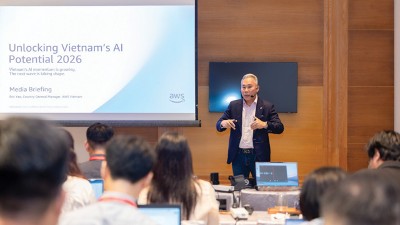
Mr. Eric Yeo, Country General Manager of AWS Vietnam, said Vietnam’s digital economy is entering a new phase. “Amazon has announced plans to invest more than $33 billion across Southeast Asia through 2039 in cloud and AI infrastructure, and we are not done yet,” he added. “There is tremendous demand for cloud and AI services in Southeast Asia, and particularly in Vietnam, so we will continue to invest here to meet our customers’ needs.”
New chapter for businesses
While cloud computing is the foundation of digital transformation, AI is becoming the new engine of economic growth. According to Mr. Yeo, the impact of the Local Zone goes far beyond simply improving performance. “One of the biggest barriers to AI is the requirement that data must not leave national territory,” he added. “Local Zone allows businesses to process AI tasks right here in Vietnam, directly addressing this issue.”
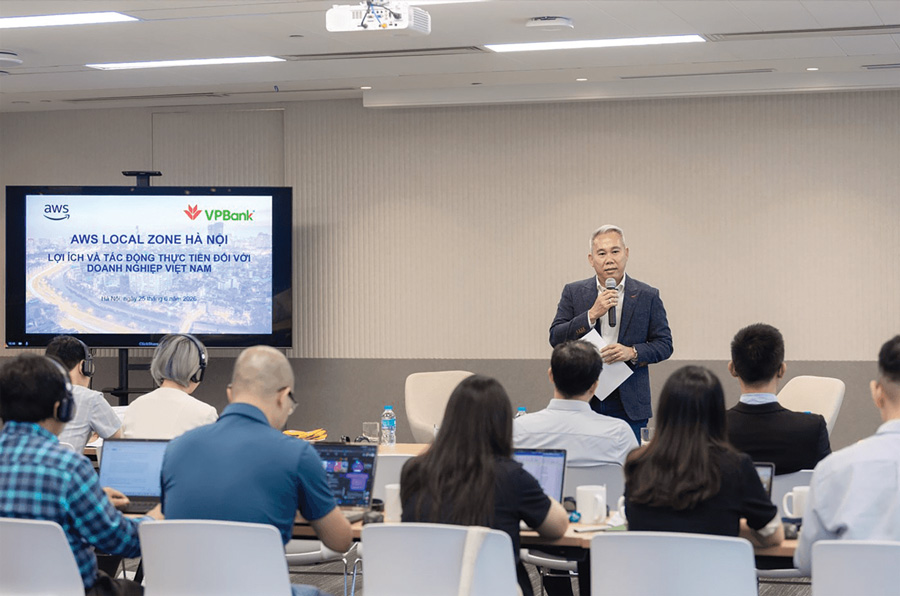

There is tremendous demand for cloud and AI services in Southeast Asia, and particularly in Vietnam, so we will continue to invest here to meet our customers’ needs.
The biggest impact of Local Zone indeed lies in its proximity. For the first time, data can be processed and stored right here in Vietnam, including Amazon S3 object storage, reducing latency to just milliseconds for domestic users.
In the digital economy, milliseconds can sometimes make a huge difference. For a bank, it can be the time it takes to detect and prevent fraudulent transactions. For a gaming company, low latency determines user experience and customer retention. In smart manufacturing, real-time data processing speed can determine whether an incident is detected and resolved promptly.
According to Mr. Yeo, many organizations in Vietnam previously faced barriers to cloud computing due to requirements for local data storage or the need for extremely low-latency processing. AWS Local Zone is designed to directly address such challenges.
The sectors expected to benefit most include banking, telecommunications, smart manufacturing, and the gaming industry - areas where data and processing speed are increasingly becoming key drivers of competitiveness.
In fact, many businesses have already begun building new technology architectures based on this model: low-latency applications and sensitive data are run domestically while still leveraging AWS infrastructure in the Asia-Pacific region to scale and exploit the full AWS service ecosystem.
From a business perspective, Mr. Nguyen Hong Trung, Group Chief Information Officer of VPBank, said that before migrating its services to the cloud, the bank faced three major challenges in its digital transformation journey spanning six to eight years.
The first challenge was dependence on physical infrastructure. Whenever a new initiative or service needed to be implemented, the bank had to plan well in advance to purchase, install, and operate server systems at its data center and backup center. However, this process was often lengthy and dependent on the supply capabilities of infrastructure providers.
“There were times when, by the time we completed the procurement and deployment of the infrastructure, the business opportunity or the opportune moment to launch an initiative had already passed,” Mr. Trung added.
The second challenge was the scalability of the system. As digital transformation accelerates, particularly in the digital banking sector, transaction volumes and service demand surge at various times. Traditional infrastructure lacks the flexibility to handle these periods of rapid growth. “If we remain entirely dependent on physical infrastructure, we won’t have the capacity to handle these business boom periods,” said Mr. Trung. “In fact, we have faced that situation many times.”
The third challenge is the issue of technology personnel. “We frequently face situations where our staff is poached by other businesses, while recruiting and training replacements cannot happen immediately,” he explained. “This directly impacts business operations.”
Collaborating with AWS has helped the bank gradually resolve these problems. The bank is no longer dependent on investing in and preparing physical infrastructure. In addition, the ability to automatically expand or contract resources according to actual needs helps it effectively handle peak periods without overinvesting in infrastructure. Regarding human resources, reducing reliance on operating physical infrastructure allows its technology team to focus more on innovation and product development.
A prime example is VPBank’s project to digitize its credit card issuance process. Previously requiring some 25 steps and more than 150 fields of information, the process was reduced to six steps with about 37 fields of information and was launched to the market in just three weeks.
Mr. Trung believes that modern digital infrastructure is increasingly becoming a decisive factor in competitiveness. “Digital infrastructure plays a similar role to the transportation system in the economy,” he added.
Looking forward
Vietnam’s digital economy is driven by the government’s efforts to accelerate digital transformation, businesses modernizing their core operations, a wave of technology startups, and growing consumer expectations for digital services.
The figures clearly reflect this trend. Vietnam’s digital economy contributed an estimated $72.1 billion, approximately 14 per cent of GDP, in 2025, and the government is targeting $300 billion in digital technology industry revenue by 2030. AI is increasingly the engine powering this trajectory: in 2024, nearly 170,000 Vietnamese businesses have adopted AI, a 39 per cent surge in just one year, with 61 per cent reporting revenue gains.
In the AI era, digital infrastructure is no longer simply a tool to support operations but is becoming a foundation for innovation and long-term growth. “The next chapter of innovation in Vietnam will not be built by any single organization, but by businesses, developers, educators, policymakers, and technology partners working together,” Mr. Yeo affirmed. “The presence of AWS Local Zone in Hanoi is therefore not just a new infrastructure investment, but also a signal that Vietnam is increasingly becoming an important destination in the region’s cloud and AI development strategy, and possesses the conditions to enter a new phase of acceleration in the digital economy.”
On the occasion of AWS launching its Local Zone in Hanoi, Mr. Trung also proposed further expanding technology human resources development programs in Vietnam. “Now that AWS has a Local Zone in Hanoi, we hope the company will continue to expand its cooperative model with universities, creating more opportunities for technology students to experience, practice, and directly access cloud computing platforms,” he said.
Previously, on May 22, Party General Secretary and State President To Lam met Mr. David Zapolsky, Senior Vice President and Chief Legal Officer for Global Relations at Amazon. The Party General Secretary and State President requested that Amazon further leverage its potential and positive results in its investment and business activities in Vietnam, continuing to be an important partner in Vietnam’s implementation of Politburo Resolution No. 57 on breakthroughs in science and technology, innovation, and digital transformation, making practical contributions in the fields of data infrastructure, AI technology, and high-quality human resources training in Vietnam.
Amazon’s leadership also emphasized the corporation’s long-term investment commitment in Vietnam, expressing its readiness to collaborate with Vietnam in developing digital infrastructure and training human resources, contributing to the achievement of Vietnam’s socio-economic development goals.
AWS has trained more than 157,000 Vietnamese personnel in cloud computing and AI since 2017. At the same time, it has partnered with 25 universities nationwide to integrate new technology skills into their training programs. “Technology will continue to develop and change very rapidly, but the decisive factor in the success of digital transformation remains people,” Mr. Yeo added. “Therefore, besides investing in infrastructure, our biggest priority in Vietnam is investing in people.”






 Google translate