


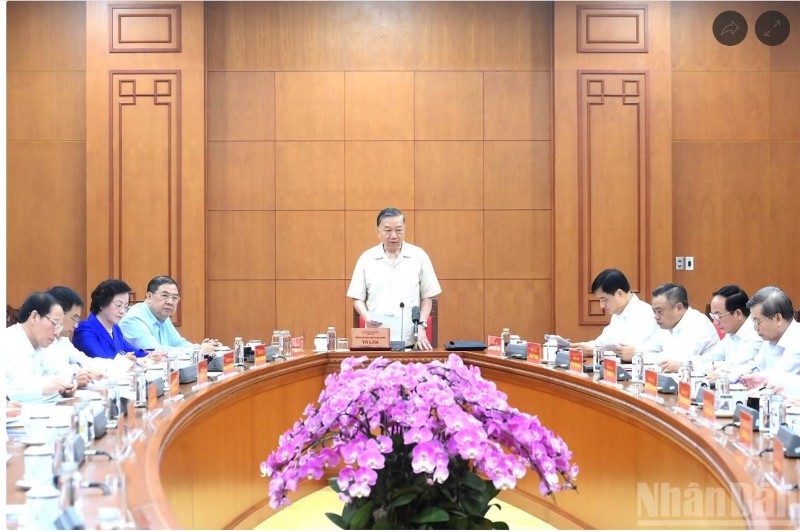
Infrastructure is no longer merely a service for production and daily life; it has evolved into a decisive factor for national competitiveness. Consequently, infrastructure efficiency must be measured by the tangible benefits provided to citizens, businesses, and the overall economy.
Party General Secretary and State President To Lam emphasized this during a working session with the Government’s Party Committee and relevant agencies on the development of synchronous infrastructure on August 6.
He noted that infrastructure planning and investment must ensure synchronicity and connectivity, with service quality and economic efficiency as the primary objectives. Development should harmonize physical, digital, and natural infrastructure.
Furthermore, infrastructure must be transformed into a strategic economic sector, fostering a vast market to enhance domestic production capacity, the leader said, adding that the State should play a guiding and leading role in mobilizing resources, prioritizing public investment in foundational, essential, and inter-regional projects with high spillover effects.
The General Secretary and President called for innovation in planning and infrastructure organization. Planning must align with the national development strategy, economic spatial organization, and the goal of boosting national competitiveness. It must also ensure a long-term vision, inter-sectoral and inter-regional connectivity, and the capacity to adapt to shifts in technology, markets, demographics, and climate change.
Alongside these goals, he stressed the need for synchronicity across economic, social, digital, data, science, technology, and innovation infrastructure. It is essential to enhance integration between various modes of transport, as well as between transportation and energy, logistics, urban areas, and other socio-economic infrastructure sectors.
Infrastructure development must strengthen connections between industries and regions, urban and rural areas, and domestic and international markets. This progress should be closely integrated with national defense, security, environmental protection, and the digital and green transitions.
Regarding inter-regional projects, the leader requested the refinement of regional financial coordination mechanisms. This, according to him, would ensure that localities collectively participate in decision-making, capital contribution, shared responsibility, and the distribution of benefits.
Another core mission is the fundamental reform of investment management and infrastructure asset governance, elevating the accountability of leaders. It is essential to enhance the quality of project preparation, construction, and operation, with a focus on managing the entire project lifecycle.
Investment decisions should only be finalized once all conditions regarding planning, land use, site clearance, capital, materials, technology, human resources, and connecting infrastructure are fully secured. Simultaneously, accountability must be clearly established for projects that fall behind schedule, undergo multiple adjustments, experience cost overruns, or operate inefficiently.
The top leader requested the urgent development of a unified database for planning, projects, and infrastructure assets. He also called for the accelerated application of digital technology and artificial intelligence (AI) in the investment, management, and operation of national infrastructure assets.
Investment efficiency should not be measured solely by the disbursement rate; it must be reflected in the progress, quality, connectivity, and operational effectiveness of key infrastructure works and projects.
Regarding strategic infrastructure systems, the leader urged a concentration of resources to complete transport and logistics corridors. This includes developing national and urban railways and waterway transport, integrated with technology transfer and the growth of domestic industry.
The energy sector must ensure synchronous and rational development across power sources, grids, and storage systems. Concurrently, it is necessary to develop digital infrastructure and national computing capacity, address bottlenecks in urban and social infrastructure, enhance resilience against climate change, and ensure water security and dam safety. These tasks require special attention in industrial hubs, seaports, coastal cities, and the Mekong Delta.
Concerning resource mobilization and allocation, alongside public investment, the leader required the continued refinement of Public-Private Partnership (PPP) mechanisms to attract private capital based on a fair distribution of benefits and risks. He also called for the development of mid-to-long-term capital markets, the utilization of increased land value generated by infrastructure, and the diversification of international funding sources.
In terms of a long-term vision, the General Secretary and President emphasized that the projects decided today will shape the nation for decades to come. Infrastructure must be prepared for the future economy, emerging technologies, and escalating climate risks.
By 2045, Vietnam aims to possess a synchronous, smart, green, safe, and highly resilient infrastructure system. This system must ensure seamless connectivity across the national territory, link the economy with global markets, and provide all citizens with access to essential services.






 Google translate