


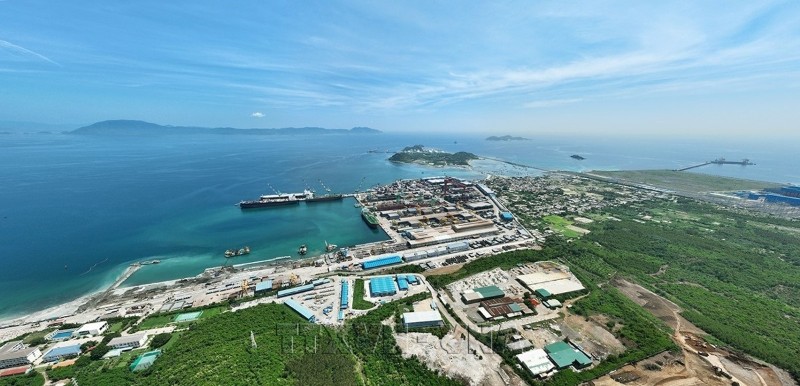
The People's Committee of the south central province has submitted a proposal to the Provincial Party Committee for consideration and feedback on the scope, boundaries, and draft dossier to be submitted to the Politburo and the Party Central Committee's hiSecretariat, seeking approval in principle for the establishment of the Van Phong Special Economic Zone (SEZ).
According to Proposal No. 159-TTr/DU dated October 27, 2026, the adjusted plan defines the Van Phong SEZ as covering the entire administrative area of Van Phong Ward, with a total natural area of 79,697 ha and a population of 239,734. The zone is envisioned as an international maritime transshipment hub, a center for energy and marine industries, and a high-end coastal tourism destination.
The water area of Van Phong Bay currently under the existing economic zone will continue to be managed in association with the special economic zone, covering an estimated 86,933 ha.
Under the proposed plan, Van Phong Ward would be established through the merger of six communes and wards in their entirety, along with portions of two other localities.
According to the draft proposal, after 20 years of development, Van Phong EZ has attracted 166 valid investment projects with a combined registered capital of around VND220.2 trillion (approximately $8.54 billion), including 117 projects already in operation. Within the proposed boundaries of the Van Phong SEZ alone, there are 149 projects with total registered capital of approximately VND219.8 trillion ($8.52 billion).
However, the proposal notes that key strategic functions, including an international container transshipment port, an airport, a free trade zone, and a high-end tourism complex, have yet to be developed. It identifies several bottlenecks, including the lack of a dedicated governance model for the economic zone, insufficient management authority, boundaries spanning multiple administrative units, the temporary nature of pilot mechanisms, and inadequate incentives to attract private investment in shared infrastructure for the transshipment port.
The establishment of the Van Phong SEZ is proposed as a solution to address these challenges while contributing to the national goal of developing three special economic zones by 2030 and supporting Khanh Hoa's ambition to become a centrally governed city.
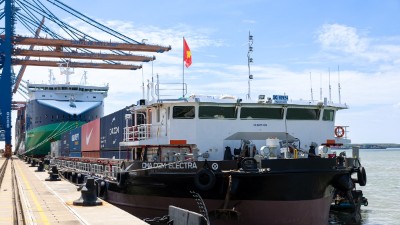
By 2030, the zone aims to attract VND450 trillion (nearly $17.5 billion) in new registered investment, with a disbursement rate of 75%. Authorities also plan to select a global port operator and complete preparations for Phase 1 of the transshipment port project, which is expected to include two berths with an annual capacity of 2-3 million TEUs. In parallel, the province seeks to complete planning procedures and investment preparations for Van Phong International Airport, while establishing the country's first free trade zone and non-tariff area.
By 2035, the transshipment port is projected to handle 5-8 million TEUs annually.
Looking further ahead, by 2045, Van Phong is envisioned as one of Southeast Asia's leading maritime transshipment and energy hubs.
The proposal estimates total investment demand for the 2027-2035 period at approximately VND774.6 trillion ($30 billion).
Under the proposed timeline, the Khanh Hoa People's Committee will submit procedures for the establishment of Van Phong Ward to the Ministry of Home Affairs in November 2026, with the National Assembly Standing Committee expected to issue a approval resolution in January 2027.






 Google translate