


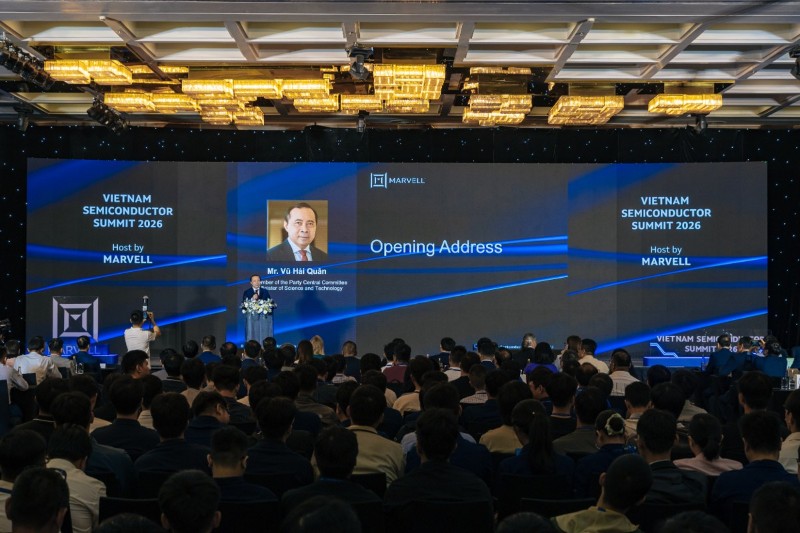
Speaking at the Vietnam Semiconductor Summit 2026 in Ho Chi Minh City on November 23, said Minister of Science and Technology Vu Hai Quan has identified three core strategic directions: chip design, advanced packaging and testing (ATP), and specialized chip development anchored by the domestic electronics industry as its primary output market.
The national strategy targets training roughly 50,000 semiconductor engineers and investing in around 30 university laboratories. Experts noted that Vietnam's well-established electronics manufacturing sector provides a natural demand base for specialized, Internet of Things (IoT), and application-specific chips.
However, the challenge lies not merely in headcount but in workforce quality, technological mastery, and meeting corporate requirements. The minister urged global chipmakers such as Marvell, Synopsys, and Renesas to help assess Vietnamese engineers, particularly their readiness for key design roles like chief architects, to build a talent competency map, identify skill gaps, and adjust training programs.
Vietnam also needs shared research infrastructure in integrated circuits and artificial intelligence (AI) accessible to enterprises, startups, and universities. Foreign direct investment (FDI) attraction must go hand in hand with opportunities for domestic firms to join supply chains and high-value segments. "The State plays a facilitating role for businesses to grow, not merely a regulatory one," Minister Quan stressed.
From an industry perspective, Dr. Le Quang Dam, General Director of Marvell Vietnam, said building a semiconductor industry requires effectively integrating technology, infrastructure, and human resources. Close coordination among businesses, universities, and the government is essential to develop high-caliber talent and position Vietnam as a vital hub in the global semiconductor ecosystem. International corporations should not only expand research and development (R&D) but also share expertise, participate in training, and connect Vietnamese engineers with global projects.
At the local level, Mr. Nguyen Van Duoc, Member of the Party Central Committee and Standing Deputy Secretary of the Ho Chi Minh City Party Committee, noted that surging demand for AI processors, memory chips, connectivity chips, computing capacity, and data center infrastructure presents a major opportunity for Vietnam to integrate deeper into global value chains.
Ho Chi Minh City is focusing on four core tasks: developing high-quality human resources aligned with corporate needs; accelerating R&D and innovation in chip design, AI, and data centers; perfecting institutions, streamlining administrative procedures, and upgrading tech infrastructure; and nurturing domestic semiconductor firms while strengthening linkages between FDI and local enterprises. Shifting from a supportive mindset to proactive facilitation, the city measures success by investment efficiency and long-term corporate growth as it aims to become a key regional semiconductor hub.
Mr. Noam Mizrahi, Executive Vice President and Chief Technology Officer of Marvell, remarked that unprecedented market velocity puts companies under constant pressure to innovate and execute faster than ever.
"Sometimes we have to build a bridge while walking on it, and such efforts require collaboration between the government, academia, and the entire ecosystem," he said, praising the talent, eagerness to learn, and ambition of Marvell's Vietnamese engineering team.
Meanwhile, Consul General at the U.S. Consulate General Ho Chi Minh City, Ms. Melissa A. Brown, underscored that resilient chip supply chains are vital to both modern economies and national security. She noted that bilateral semiconductor cooperation rests on complementary strengths, pairing US technology, technical standards, and long-term capital with Vietnam's engineering talent and strong government commitment.
The US Consulate General pledged to foster business-to-business connections, university partnerships, and an improved business environment alongside municipal authorities.
Summit discussions also covered system-on-chip architectures for autonomous vehicles, AI-driven chip design, advanced packaging, and intellectual property capacity. Ultimately, Vietnam's semiconductor opportunity depends not just on attracting foreign tech giants or scaling engineer numbers, but on cultivating high-value technical mastery, shared research infrastructure, and deeper supply chain participation for domestic enterprises.




 Google translate