


Developing a green economy is a strategic challenge for Vietnam during its 2026-2045 development period. A green economy is not simply about environmental protection, reducing pollution, or planting more trees. It represents a fundamental transformation of the growth model, production methods, consumption patterns, and strategies for attracting investment capital.
Recent development experience has reinforced a key principle: Vietnam cannot emerge as a developed industrial nation if it continues to rely primarily on a resource-intensive, energy-intensive, high-emissions growth model and remains positioned in low-value-added manufacturing and processing.
Five strategic orientations
Against this backdrop, the green economy has been identified as a new growth driver capable of delivering three mutually-reinforcing outcomes: accelerating GDP growth while improving its quality; strengthening technological capabilities and national competitiveness; and safeguarding energy security and sustainable development.
However, having the right understanding is only a necessary first step. For this large-scale transformation to proceed effectively, Vietnam must first establish a clear strategic framework. This requires defining five fundamental strategic orientations to serve as a compass guiding the entire economy toward a new growth trajectory.
First, Vietnam’s growth model should shift from extensive growth toward green growth and resource efficiency, moving beyond GDP expansion alone to focus on the amount of GDP generated per unit of energy, raw materials, and water consumed, as well as the emissions intensity of economic output.
Second, the national energy mix should be transformed through accelerated investment in renewable energy, offshore wind, solar power, and appropriate hydropower projects, alongside battery energy storage systems (BESS) and smart grid infrastructure.
Third, green transformation should extend across the entire production system rather than being confined to a handful of high-tech industries, encompassing manufacturing and processing, agriculture, construction, transportation, and logistics.
Fourth, domestic capabilities in green technology and industry should be strengthened to reduce dependence on imported green equipment, enabling Vietnamese businesses to progressively master the entire value chain, from design and component manufacturing to operations and technology transfer.
Fifth, Vietnam should strengthen its competitive advantages in attracting next-generation green FDI by developing an ecosystem encompassing green manufacturing, clean energy, green logistics, and internationally-compliant supply chains to attract investment from leading multinational corporations.
Ten groups of policy measures
Building on these five fundamental orientations, the immediate challenge is to translate strategic principles into coordinated policy measures that form an integrated, smoothly functioning ecosystem in which every component plays an indispensable role. Accordingly, consideration should be given to the following ten groups of measures.
First, establish a comprehensive institutional and policy framework for the green economy: Review and remove legal barriers across the regulatory frameworks governing investment, land, the environment, energy, taxation, and finance to unlock green investment capital. Introduce a unified national Green Taxonomy to classify green projects. At the same time, integrate carbon emissions and energy efficiency indicators into sectoral and regional development plans, while holding agency and local government leaders directly accountable for implementation results.
Second, make breakthroughs in clean energy and energy security. Prioritize offshore and onshore wind power projects while encouraging rooftop solar installations at IPs, manufacturing facilities, and commercial buildings. In parallel, invest in BESS, modernize power transmission infrastructure, and implement direct power purchase agreements (DPPAs) alongside a competitive electricity market. Research and gradually introduce green hydrogen and other clean fuels suited to Vietnam’s practical conditions.
Third, “green” the industrial park system. This is one of the measures Vietnam can implement relatively quickly while delivering substantial results. The priority should be to transform conventional industrial parks (IPs) into eco-industrial parks (eco-IPs), with 100 per cent of newly-established IPs required to meet standards in energy, water, and resource efficiency. Establish industrial symbiosis networks that enable businesses to reuse treated waste or exchange waste streams, develop shared logistics systems and low-emissions transportation, and digitalize emissions monitoring and environmental data disclosure.
In particular, Vietnam should develop the Industrial Park 2.0 model: green, smart, and circular IPs capable of providing clean energy services. IPs should no longer be evaluated solely on occupancy rates, leased land area, and investment capital attracted. Assessments must also consider resource productivity, emissions levels, recycling rates, value-added, and the extent of links between FDI enterprises and Vietnamese businesses.
Fourth, develop green technology industries and support industries: Identify priority green technology sectors to build domestic capabilities and supply chains. Particular attention should be given to enabling Vietnamese enterprises to participate more deeply in global green industrial supply chains.
Fifth, develop green finance and operationalize the carbon market. This is a critical lever for mobilizing private and international capital. Vietnam should therefore develop the green bond market, encourage commercial banks to expand green lending, establish green transition investment funds, attract international climate finance and private capital for green infrastructure, and help small and medium-sized enterprises access financing for technological transformation. Notably, Decree No. 29/2026/ND-CP, issued on January 19, 2026, on the domestic carbon exchange, has established an important legal foundation for developing carbon pricing instruments and trading emissions allowances and carbon credits.
Sixth, green agriculture and the marine economy. Vietnam has significant advantages in agriculture, forestry, and fisheries. Accordingly, priorities should include developing low-emissions agriculture, particularly the high-quality, low-emissions rice program in the Mekong Delta; expanding agricultural processing to increase value-added and reduce post-harvest losses; and developing the forest economy. Offshore wind development should also be linked to marine spatial planning, while the broader marine economy must grow in tandem with ecosystem protection.
Seventh, green transportation, urban development, and construction. Accelerate the transition of public and private transportation to electric power and low-emissions biofuels. Speed up urban railway projects, develop interregional rail connections, and make greater use of inland waterway transportation. Green building standards, including energy efficiency and thermal insulation requirements, should become mandatory in urban construction permitting, alongside modernized drainage systems and advanced waste treatment infrastructure.
Eighth, attract next-generation FDI through green investment. This is a particularly important issue in Vietnam’s FDI strategy. Rather than attracting foreign investment based primarily on capital size, the country should select investors according to the quality of their projects and their contributions to the green transition.
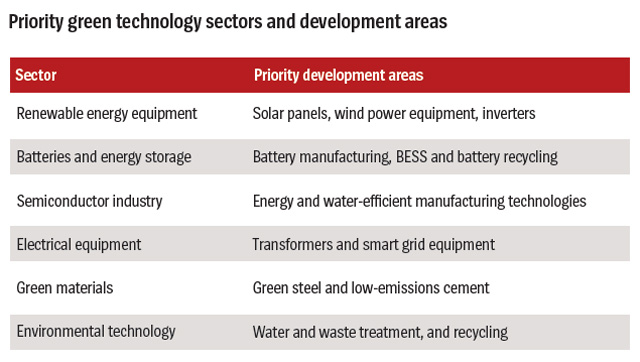
The assessment of potential investors should be based on six key criteria: the use of advanced, low-emissions production technologies; the efficient use of energy and natural resources; the capacity for technology transfer; the development of links with Vietnamese suppliers; the training and development of high-quality human resources; and compliance with environmental requirements and economic and technological security standards.
Particular effort should be made to attract leading multinational corporations in semiconductors, electrical equipment, renewable energy, batteries, energy storage, AI, and environmental technology. Green FDI must become an integral part of Vietnam’s strategy to upgrade its technological capabilities and national production capacity.
Ninth, develop a skilled green workforce. Vietnam should establish networks connecting universities, research institutes, and technology enterprises to deliver training based on actual industry demand. Priority should be given to developing specialized professionals, including renewable energy engineers, battery technology and advanced materials specialists, circular economy experts, greenhouse gas inventory and verification professionals, and specialists in green financial management and environmental, social, and governance (ESG) compliance.
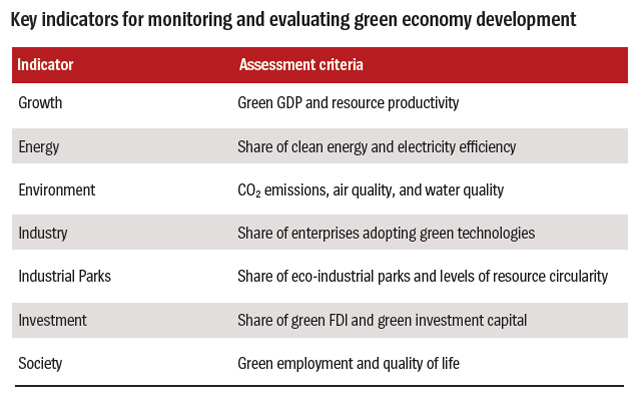
Tenth, establish a green economy index and monitoring framework. This is essential to prevent sound policy intentions from translating into ineffective implementation. Vietnam should develop a National Green Economy Index to regularly monitor and measure progress across indicators. These data points should be published regularly, with management agencies and local governments held accountable through specific, verifiable performance indicators.
Implementation roadmap
Given limited resources, attempting to implement all ten groups of measures simultaneously is unrealistic. International experience shows that the green transition requires appropriate resource allocation and a focus on initiatives capable of delivering the greatest impact. Accordingly, implementation should be divided into three phases.
From 2026-2030: Establishing foundations and achieving breakthroughs. The highest priorities should be completing the institutional and standards framework for the green economy; developing clean energy infrastructure and power transmission grids; converting eligible IPs into eco-IPs; making the carbon exchange fully operational and expanding green finance; selectively attracting green FDI; and accelerating workforce training and the development of green support industries.
From 2031-2035: Accelerating green industrialization. Vietnam should establish internationally-competitive green industrial clusters; develop domestic enterprises capable of manufacturing green equipment and technologies; expand circular economy models and low-carbon supply chains; and turn the ability to comply with international green standards into a competitive advantage in export markets.
From 2036-2045: Mastering the green economy. The focus should shift toward mastering key environmental and energy technologies, establishing a globally-competitive green industrial ecosystem, increasing the share of high value-added green products and services, and transitioning toward a low-emissions economy in pursuit of net-zero emissions by 2050.
Strengthening capacity and setting priorities
Vietnam has already issued its National Green Growth Strategy, under Decision No. 1658/QD-TTg, dated October 1, 2021, setting a target of reducing greenhouse gas emissions intensity per unit of GDP by at least 15 per cent by 2030 compared to 2014, while increasing renewable energy’s share of total primary energy to 15-20 per cent.
However, Directive No. 44/CT-TTg, issued on December 9, 2024, also identified several notable shortcomings: green objectives have not been fully integrated into socio-economic development plans and public investment; green finance policies remain fragmented; and implementation resources and capacity are still limited.
Vietnam therefore needs a national action program built around three key mechanisms. First, an adequately empowered coordinating body to ensure effective coordination among ministries, sectors, and local governments. Second, an integrated financial framework combining public funding, green credit, green bonds, FDI, and international capital. Third, a substantive performance evaluation mechanism that measures progress through actual emission reductions, productivity improvements, and economic value creation, rather than the number of policy documents issued or campaigns launched.
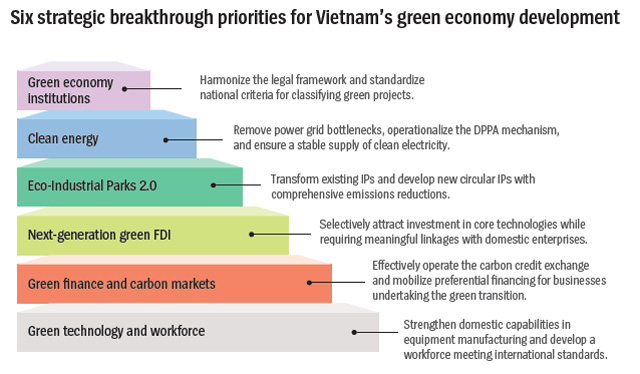
To bring its long-term development objectives together within a coherent framework, Vietnam should establish a Green Growth Model 2045. This model would integrate green growth with industrialization, modernization, and technological self-reliance, operating on six pillars: Clean energy and national energy security; Green industry and the Industrial Park 2.0 model; Green FDI and low-carbon supply chains; Green technology, technological self-reliance, and innovation; Green financial infrastructure and carbon pricing markets; and Sustainable agriculture, green urban development, and the circular economy.
In conclusion, the green economy should not be viewed as an additional cost incurred to meet international environmental commitments. Rather, it represents an investment opportunity, a new engine of economic growth, a source of national competitive advantage, and the most direct pathway to upgrading the country’s industrial base.
(*) Dr. Phan Huu Thang is the former Director General of the Foreign Investment Agency under the Ministry of Planning and Investment (now the Ministry of Finance).





 Google translate