


Nuclear power development presents a complex financing challenge for countries embarking on their first nuclear programmes. Large upfront capital requirements, long construction periods, extended payback horizons and significant project risks make it difficult to rely on a single source of funding.
For emerging nuclear markets in Southeast Asia, the challenge is not simply securing sufficient capital, but structuring projects in a way that can attract international lenders and private investors while distributing risks among governments, project developers, technology suppliers and financial institutions.
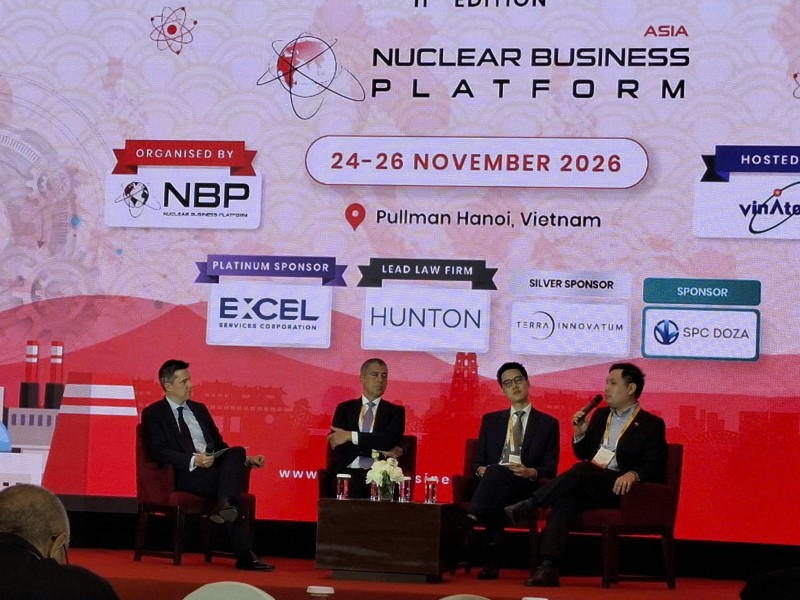
These issues were discussed at a panel titled “New Capital Stacks for ASEAN’s First Reactors - Multilaterals, ECAs, Climate Funds and Sovereign Models”, held during Nuclear Business Platform 2026 in Hanoi on November 24-26.
The discussion brought together international experts, including Julien Saigault, Partner at EY’s Global Nuclear Advisory; George Borovas, Head of Nuclear at Hunton; and Leslie Lau of Temasek Trust, alongside perspectives from UK Export Finance (UKEF)
A central message emerged: financing, technology selection and project development must be considered together from the outset, rather than treated as separate stages.
Export credit agencies and sovereign support underpin early financing
Export credit agencies (ECAs) are expected to play an important role in helping emerging nuclear markets such as Vietnam access international financing, particularly during the development of their first nuclear power projects.
Nuclear investments involve substantial capital commitments and long financing tenors. International lenders therefore assess not only the technical and commercial viability of a project, but also the creditworthiness of the host country and the strength of its financial guarantees.
During the discussion, a representative of UK Export Finance (UKEF) explained that ECAs can support projects through different instruments, including loan guarantees and direct lending. The appropriate structure depends on the project's size, financing requirements and risk profile.
The availability of ECA financing is also closely linked to technology suppliers and supply-chain arrangements. Export credit support is generally associated with goods, equipment, services and economic activities connected to the exporting country.
This means that technology selection, procurement strategies and the choice of contractors can directly influence how much export credit financing a project can mobilise.
The representative also highlighted the possibility of engaging ECAs at an early stage, including during project preparation, feasibility studies and the appointment of international consultants. Such involvement can help developers build a financing structure that is compatible with international lending requirements.
Beyond export credit, official development assistance, development finance institutions and international commercial banks can contribute to the overall funding structure.
However, experts stressed that government support remains particularly important for first-of-a-kind nuclear projects. Sovereign guarantees can help address country-related credit risks, improve lenders' confidence and make it easier to mobilise commercial financing.
The challenge is to design these mechanisms in a way that supports initial investment without leaving governments responsible for all project risks throughout the entire lifecycle.
Private capital and SMRs could broaden financing options
George Borovas, Head of Nuclear at Hunton, argued that private-sector participation should begin early in the project development process.
He noted that commercial banks are becoming increasingly comfortable with nuclear investments. Nevertheless, purely commercial financing without government guarantees remains difficult for a country's first nuclear project.
In his view, financing conditions evolve as a project progresses through different stages.
The early development phase carries considerable uncertainty, particularly regarding site selection, design, supply chains and project delivery arrangements. As construction advances, equipment is delivered and implementation milestones are achieved, some of these uncertainties begin to decline.
This creates opportunities for investors with different risk appetites to enter the project even before commercial operation begins. Once a nuclear facility becomes operational and establishes a reliable cash-flow record, access to commercial bank financing becomes considerably easier.
For countries developing multiple reactors or sites, the successful completion of an initial project could also create opportunities for refinancing and more efficient financing arrangements across subsequent projects.
Small modular reactors (SMRs) could offer another route towards more diversified financing structures.
Compared with conventional large-scale nuclear power plants, SMRs generally involve smaller individual project capacities and potentially more manageable initial investment requirements.
Their proposed advantages include modular construction, factory-based manufacturing and the possibility of repeated deployment. These features could support standardisation, improve construction efficiency and gradually reduce costs through learning effects.
However, experts cautioned that these benefits have yet to be fully demonstrated through large-scale commercial deployment.
SMRs may also attract a broader range of private-sector participants because of their potential applications and more diverse electricity customers. Private investors could participate in project development, equity financing or other stages of the investment cycle.
Government-to-government arrangements, build-operate-transfer (BOT) and build-own-operate (BOO) models could all be considered, depending on the project's characteristics.
Nevertheless, smaller project size does not eliminate the fundamental requirements of project finance. Financial modelling, economic assessments, environmental and social evaluations, and appropriate safety regulations remain essential.
Regulatory frameworks will also need to accommodate the specific characteristics of modular deployment, including phased construction and the potential for repeated reactor installations.
PPAs, grid infrastructure and regional cooperation are critical to bankability
A project's ability to secure long-term revenue is another fundamental requirement for attracting lenders.
Experts at the panel highlighted the importance of power purchase agreements (PPAs) in establishing the bankability of nuclear projects.
A PPA needs to provide sufficient contractual certainty over the electricity price, volumes, payment obligations and allocation of risks. Its duration should also be compatible with the repayment period of the financing structure.
The financial strength and creditworthiness of the electricity buyer are equally important.
One expert shared experience from another market where negotiations between the electricity off-taker and the project developer had taken approximately 18 months to establish a PPA structure capable of supporting financing.
Grid infrastructure presents another challenge. As one participant from Mace pointed out, the risks are not limited to contractual arrangements between the project owner and the electricity buyer. The ability to transmit and evacuate generated power must also be addressed.
Clear responsibilities for grid connections, transmission investment and the allocation of associated risks are therefore necessary to support project financing.
The growing electricity demand from data centres and artificial intelligence (AI) infrastructure could create additional opportunities for nuclear power developers.
George Borovas noted that some technology companies and hyperscalers in the United States are increasingly willing to pay a premium for clean and reliable electricity to support their operations.
Some companies have also invested in nuclear technology businesses, indicating an interest in the sector beyond their role as electricity consumers.
However, he cautioned that direct investment by hyperscalers in nuclear projects, particularly taking on construction risks, has not yet become an established financing model.
The panel also addressed currency risks associated with international nuclear financing. The choice of borrowing currency needs to reflect the project's expected revenues, imported equipment costs and available hedging instruments.
Matching debt currencies with revenue currencies, where possible, can help reduce foreign-exchange exposure. Local banks can also work alongside international lenders to structure financing that better reflects the project's cash flows.
At the regional level, Leslie Lau of Temasek Trust emphasised the need for a systems-based approach to nuclear development.
He argued that nuclear financing cannot be assessed solely through reactor technology. It must also account for safety, security, workforce capabilities, infrastructure and the institutional capacity required to support a nuclear programme.
Regional cooperation could help ASEAN countries share knowledge, site-related information, reference databases and cost data. Regulators could also benefit from each other's assessments, reducing duplicated work and making better use of existing expertise.
While each country retains its sovereign responsibility for nuclear safety, regulatory requirements and national decisions, greater cooperation could generate significant efficiencies.
Grid upgrades were also highlighted as an important government responsibility, benefiting not only nuclear projects but the wider electricity system and end-users.
Overall, the discussions at Nuclear Business Platform 2026 underscored that nuclear financing requires an integrated approach throughout the project lifecycle.
For emerging nuclear markets such as Vietnam, sovereign support and export credit financing can provide the initial foundation. Over time, stronger project structures, reliable revenue arrangements and a proven construction and operational track record could help attract more commercial banks and private investors.
The long-term objective is not to replace government support entirely, but to build a diversified capital structure in which risks are allocated more effectively and private capital can participate progressively as projects become more mature and bankable.
Currency risks and financing options for SMRs in Vietnam
During the Q&A session, a representative from the Ninh Thuan 1 nuclear power project raised a question about foreign-exchange risks in international project financing. The representative noted that technology-supplying countries often seek to have loans denominated in their own currencies, and asked what risks project owners might face if they accepted such arrangements and how those risks could be managed.
In response, the representative of UK Export Finance (UKEF) said that borrowers could work with international and domestic banks to consider financing currencies that best fit the needs of the project. The decision should take into account the project's cost structure, expected revenues and available hedging mechanisms. Where a project generates foreign-currency revenues from electricity exports, a natural hedge may also be possible, helping align revenue streams with debt-service obligations.
Another question came from a representative of Vietnam's Electric Power University, who asked whether small modular reactor (SMR) projects could be financially viable without government support and what financing or project-delivery models could enable private-sector participation.
The question noted that government-to-government (G2G), build-operate-transfer (BOT) and build-own-operate (BOO) arrangements are commonly discussed in connection with large-scale nuclear power plants. The representative therefore sought to understand whether these models could also work for smaller SMR projects.
The panellists said that G2G, BOT and BOO structures could, in principle, be applied to both large nuclear power plants and SMRs. However, SMRs could create more opportunities for private-sector involvement because of their smaller upfront capital requirements, broader range of potential applications and wider pool of prospective offtakers. Private companies could participate in project development, equity investment and financing structures tailored to different stages of deployment.
Nevertheless, the experts stressed that SMR projects would still need to meet the fundamental requirements of project finance, including financial modelling, economic analysis, environmental, social and governance (ESG) assessments, and appropriate regulatory and nuclear safety frameworks. Modularity and repeat deployment could make SMRs more attractive to investors, but their commercial performance and potential cost reductions still need to be demonstrated in practice.






 Google translate