


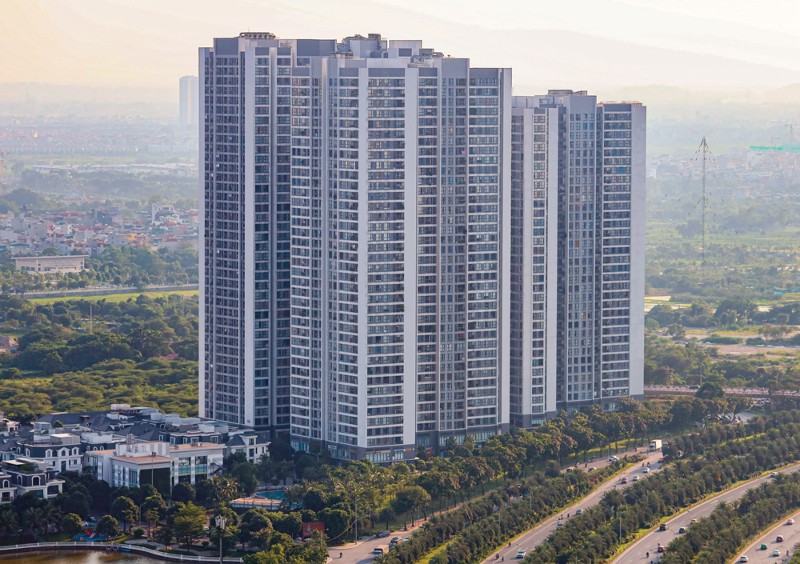

We recognize that Vietnam’s property market has traditionally favored homes for sale over rental housing.
First, this stems from the deeply-rooted Vietnamese culture of homeownership. The concept of “settling down before building a career” remains deeply ingrained, with many people believing that wherever they work, they should eventually buy a home, establish a family, and educate their children there. Renting is often associated with instability, lack of success, or an inability to provide for future generations.
As a result, Vietnam’s homeownership rate is among the highest in the world. According to Kentucky-based real estate company Garret, Vietnam ranks third globally with a homeownership rate of 90 per cent, behind only Romania and China. Meanwhile, data from Global Property Guide places Vietnam 13th globally, also with a homeownership rate of 90 per cent.
This mindset has also contributed to the rapid rise in housing prices. Figures show that Vietnamese property prices increased by approximately 59 per cent over the past five years, higher than in the US (54 per cent), Australia (49 per cent), Japan (41 per cent), and Singapore (37 per cent), according to VietnamPlus. Rental yields in Vietnam range from 2-4 per cent annually, depending on location; significantly lower than the 5-7 per cent typically seen in many regional markets.
Vietnam’s house price-to-income ratio is also extremely high, ranging from 23.7 to 30-times annual income. In other words, households would need to save the equivalent of 23-30 years of total income, without spending anything, to purchase an average home. This is roughly 1.6 to 2-times higher than the global average of 11 to 15-times, while the generally accepted affordable threshold is 5 to 7-times.
Second, Vietnam’s long-term capital market remains underdeveloped, including the market for Real Estate Investment Trusts (REITs).
Third, development costs, regulatory compliance costs, and borrowing costs remain high.
Fourth, the institutional framework has largely favored housing-for-sale development. The State derives significant revenues from land-use fees, while developers prefer projects for sale because they can access financing more easily, mobilize capital before project completion, recover investment more quickly, and face shorter-term obligations, which are generally fulfilled upon handover of homes to buyers and transfer of technical infrastructure to the authorities.
However, Vietnam’s socio-economic landscape is changing rapidly. Urbanization continues to accelerate, urban populations are expanding, and labor mobility is increasing at an unprecedented pace. At the same time, housing prices remain high and continue to rise, placing homeownership beyond the reach of many young people, workers, professionals, scientists, and middle-income households. This poses growing challenges for social welfare and housing accessibility.
As representatives of the real estate business community, we strongly support the government’s efforts and hope it will establish appropriate mechanisms to encourage private sector participation in the development of rental housing and affordable housing in line with the Party and government’s policy directions.
Specifically, the State should play a facilitating role through institutional reforms, planning, land allocation, and credit policies, based on the principle of neither providing blanket subsidies nor leaving the market entirely to self-regulate.
The role of businesses is to participate in developing rental housing with reasonable profit expectations while ensuring professional management and operations.
* * *
Over the past several years, the government has submitted a range of mechanisms and policies to the National Assembly (NA) aimed at removing bottlenecks in the land sector in general and the housing and real estate market in particular. The NA has issued Resolution No. 254 and the government has adopted Resolution No. 49, both of which contain important measures to unlock resources for the market.

First, regarding land resources for housing development, local authorities have been given greater autonomy to review, identify, and allocate suitable land for different housing types based on local demand and development needs.
Second, with respect to stalled projects, a number of mechanisms have been introduced to address obstacles related to compensation and site clearance. In practice, many projects have completed more than 70 per cent of compensation work but have been unable to move forward due to procedural difficulties. The introduction of these measures has enabled many real estate projects to resume implementation, helping increase market supply.
Third, on land pricing policy, the previous requirement to determine land values on a project-by-project basis created significant challenges for investors in managing timelines, cash flow, and investment costs, while also resulting in large disparities between projects. New regulations now allow the application of land price tables combined with land price adjustment coefficients in certain cases, helping simplify procedures, improve transparency, and create a more predictable investment environment. For social housing projects, exemptions from land-use fees remain an important policy tool to reduce development costs and support growth in this segment.
We view rental housing as a particularly important segment. At this stage, developing rental housing should be regarded as a priority, a key pillar and a major growth driver for the future direction of Vietnam’s housing and real estate market.
In my view, one of the biggest challenges today is that we have not yet fully identified the role, scale and actual demand for rental housing within the broader housing market. Therefore, it is important to conduct a comprehensive nationwide assessment of rental housing demand as soon as possible. This would provide the basis for local authorities to allocate land, prepare planning frameworks, and introduce appropriate policies to support the sustainable development of the sector.
There are two areas where pilot rental housing programs could be prioritized. The first is in city centers and Transit-Oriented Development (TOD) areas, where large numbers of young professionals, skilled workers, and experts are concentrated. Land for such projects could be supported through preferential policies, including reduced or zero land-use fees, to attract private investment.
The second is rental housing in industrial parks, targeted at workers on modest incomes. This segment has significant potential to improve living conditions for workers while supporting workforce stability and economic development.
* * *
First and foremost, rental housing is an essential segment in the current context. However, from a legal perspective, the regulatory framework governing this segment remains incomplete.

The National Assembly has adopted several relevant resolutions, but a key issue remains: how rental housing should be formally defined within the legal system. Without a clear legal definition, it will be difficult to design appropriate policies and management mechanisms. At present, the Law on Housing 2023 contains a dedicated chapter on social housing, but there is no comprehensive and separate framework governing rental housing. This legal gap should be addressed as soon as possible.
Therefore, during the planned amendments to the Land Law 2024, the Law on Housing 2023, and the Law on Real Estate Business 2023 this year, I believe it is necessary to introduce at least one dedicated chapter or a specific set of provisions governing rental housing. This would help complete the legal framework and create a foundation for the systematic and sustainable development of the sector.
In addition to general provisions on land access, there should be stronger incentive mechanisms that make it easier for businesses to access land and develop rental housing projects.
Another important issue is planning. The government should clearly assign responsibility to local authorities for preparing land reserves specifically designated for rental housing. At the same time, legislation should specify the proportion, location, and allocation criteria for such land reserves to ensure transparency and consistency in implementation. This is a matter of particular concern to the business community.
It is also necessary to clarify mechanisms for exemptions and reductions of land rental fees, as well as the State’s responsibility in facilitating land access for developers of rental housing projects. Only when input costs are kept at reasonable levels can rental prices remain affordable for tenants, thereby supporting the sustainable development of the sector.
A key question is whether the current Land Law clearly defines the responsibilities of local authorities in land clearance and site preparation to create clean land funds for rental housing development.
In practice, existing regulations remain relatively general and do not clearly distinguish or specify these mechanisms.
In addition, it remains unclear what specific incentives exist regarding land-use rights and obligations for rental housing developers compared with other forms of real estate development. This is widely regarded as one of the major implementation bottlenecks.
For tenants, greater legal clarity is also needed regarding their rights and protections, including occupancy rights, lease terms, administrative procedures and dispute-resolution mechanisms. Currently, these matters are largely governed by general regulations rather than provisions tailored to the specific nature of rental housing.
In my view, these issues should be studied carefully and incorporated into the law through a more comprehensive and coherent framework. Only then will businesses have the confidence to invest, and only then can the rental housing market develop in a truly sustainable manner.
* * *
I believe rental housing is often treated as a special segment, but in reality it is not fundamentally different from what already exists in the market. Today, rental activity spans the entire housing spectrum, from luxury apartments and commercial housing to studio units and informal rental properties along the Red River. Rental housing is already an integral part of Vietnam’s real estate market.

Any market is ultimately driven by supply and demand. There must be landlords willing to rent out properties and tenants willing to lease them. Therefore, an important question is whether Vietnam truly needs a separate legal framework dedicated solely to rental housing.
In my view, the more important issue is how urban space is organized and how appropriate development mechanisms are designed. In China, for example, authorities have introduced the R4 land-use category, which is specifically designated for long-term rental housing developed and operated by private investors. Modern urban planning also no longer draws rigid distinctions between commercial housing, social housing, and rental housing. Instead, the focus is on ensuring that all urban residents have equal access to quality housing services. A well-integrated mix of housing types can help create more livable and inclusive cities.
Transit-Oriented Development (TOD) linked to metro systems presents a particularly significant opportunity for commercial housing, social housing, and rental housing alike. In practice, demand for rental housing around TOD hubs is substantial. Along the Ben Thanh - Suoi Tien Metro Line in Ho Chi Minh City, for example, many students and lower-income residents rely on the system and represent a strong potential tenant base.
However, relatively few developers remain genuinely interested in rental housing projects. This raises an important question: to what extent should the State intervene?
Japan’s experience offers useful lessons. There, developers are given considerable autonomy in TOD projects while being encouraged to allocate a certain proportion of development to rental housing, social housing, and commercial housing.
I believe developers can successfully invest in rental housing and generate reasonable returns, much as has been done in China. Such an approach would help gradually build a more stable, sustainable and self-regulating real estate market, rather than one that alternates between periods of excessive expansion and abrupt slowdowns.
I am not pessimistic about Vietnam’s real estate market. However, we should be mindful of the risk of creating cities that lack vibrancy; places where housing units are sold but remain largely unoccupied, leaving neighborhoods dark and inactive at night.
For *that reason, the most important question is determining the appropriate balance between rental housing and other housing segments. This is an issue that both policymakers and developers must carefully assess based on the specific characteristics and needs of each city.
* * *
In the past, homeownership was widely viewed as a prerequisite for stability and career success. Today, however, the labor market has changed significantly. Previous generations often spent their entire careers with one employer, making homeownership central to “settling down.” Younger generations are more mobile, frequently changing jobs and locations to pursue new opportunities.

As a result, being tied to a home purchased years earlier can be less practical than renting, which offers greater flexibility. Rental housing allows people to live closer to work, move between neighborhoods, and adjust their housing arrangements as their needs evolve. Young couples and financially-independent single adults are increasingly choosing to live separately from their parents before they have accumulated enough savings to buy a home.
Renting also helps avoid the burden of long-term mortgage debt. Many homeowners spend decades repaying housing loans, limiting their ability to invest in other aspects of their lives. Consequently, demand for rental housing is rising rapidly, particularly in major cities, making it an increasingly important component of urban development.
Given these realities, Vietnam needs a comprehensive strategy for developing the rental housing market. If rental housing is to become a sustainable segment, it will require both public and private sector participation.
If the State acts alone, resources will be insufficient and long-term operation and maintenance may be difficult to sustain. Conversely, if the market is left entirely to private investors under current conditions, rental housing cannot effectively compete with housing developed for sale. Development costs are high, while rental income is often insufficient to cover financing costs, let alone recover the initial investment. This makes State leadership particularly important.
The government should play a central role in urban planning by allocating land for rental housing in areas close to city centers, with good transportation links but lower commercial value.
Classical urban development theories suggest that the most commercially-valuable central areas should be reserved for business and service activities, while nearby areas with lower commercial value are better suited to high-density residential developments that meet rental housing demand.
This approach aligns with the evolution of mature real estate markets. During periods of rapid expansion, developers tend to build homes for sale because capital can be recovered quickly. As markets mature and land becomes scarcer, investment increasingly shifts toward generating long-term income from existing assets, creating natural conditions for a larger rental housing market.
For this reason, rental housing policies should initially focus on major urban centers where demand is strongest. Suitable land should be allocated in locations supported by quality infrastructure, public services, and convenient transportation.
Land costs are another critical issue. Land-use fees often account for a significant portion of development costs, particularly in central urban areas. To reduce financing burdens, land-use payments for rental housing should shift from large upfront payments for permanent residential land rights to annual land rental payments.
For the rental housing market to develop effectively, coordinated reforms are needed across legal, land-use and investment policies. The goal should be to create rental communities that offer quality living environments, comprehensive amenities, and genuine long-term value, rather than serving merely as temporary accommodation for those unable to purchase homes.
If Vietnam can implement a coordinated strategy, rental housing can become a major and sustainable pillar of the country’s real estate market in the years ahead.
* * *
Following the administrative merger, the new Ho Chi Minh City is home not only to nearly 3 million migrants already residing in the city but also to more than 1.2 million migrant workers from former Binh Duong province. As many as 974,000 people are estimated to need social housing through purchase, lease, or lease-to-own schemes. However, during the 2021-2025 period, only 17,902 social housing units were completed.

The social housing development target for 2026-2030 is 181,498 units. Even if the city succeeds in delivering 199,400 social housing apartments by 2030, supply will still fall short of the housing needs of workers and low-income urban residents, particularly in the rental segment.
To encourage greater private sector participation in the development of affordable rental housing, the Association proposes incorporating a dedicated policy framework for “rental housing affordable to middle and low-income urban residents” into the amended Law on Housing and related legislation.
This framework should include exemptions from land-use fees and land rental payments for land acquired by developers through negotiated transfers for affordable rental housing projects. These incentives should apply throughout the entire life cycle of the project.
Affordable rental housing projects and social rental housing projects typically require at least 20 years to recover investment costs. Therefore, projects should be required to maintain rental operations for a minimum of 20 years in order to qualify for preferential policies. Such a requirement would align incentives with the long-term nature of these developments and ensure consistency throughout the project’s life cycle.
The Association proposes reinstating the policy of reducing value-added tax and corporate income tax rates by 70 per cent for developers of social rental housing projects and affordable rental housing developments. Relevant tax legislation should also be amended to further reduce development costs and rental prices.
In addition, the Association recommends that the State regulate only the maximum rental rate for affordable rental housing projects, similar to the existing framework for social housing rentals. Developers should retain the right to determine tenant eligibility for affordable rental units within their projects.
The Association further proposes amending the Law on Housing and related regulations to establish minimum standards for studio apartments and rental units, with a minimum floor area of no less than 15 sq m. This would facilitate the development of small rental apartments that are better suited to single-person households, two-person households, and changing demographic trends.







 Google translate