


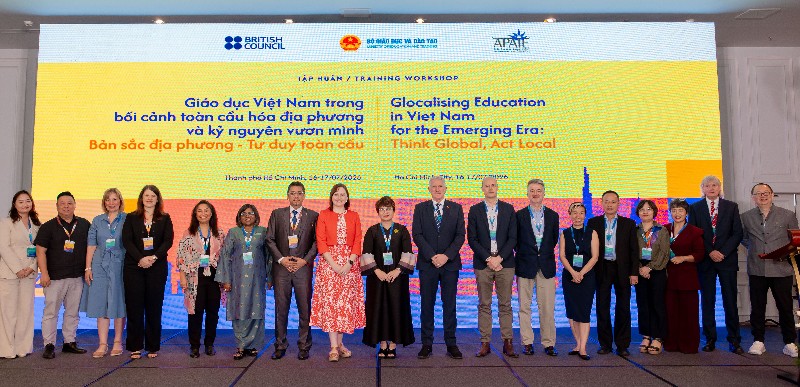
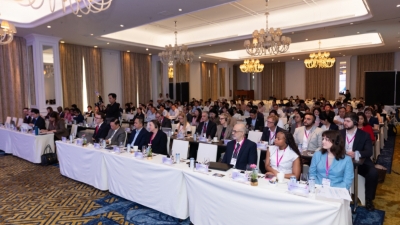
Internationalisation, transnational education and global partnerships were at the centre of discussions as policymakers, university leaders and education experts from Vietnam, the UK and other countries met in Ho Chi Minh City on July 16–17.
Jointly organised by the Vietnamese Ministry of Education and Training (MOET), the British Council and the Asia-Pacific Association for International Education (APAIE), the programme, themed "Vietnamese Education in the Context of Glocalisation and the Era of Emergence – Think Global, Act Local," comes as Vietnam accelerates reforms to modernise its higher education system and deepen international integration. The event was attended by Ms. Rhiannon Harries, UK Deputy Trade Commissioner for Asia Pacific (Southeast Asia), along with senior officials from MOET, the British Council and representatives of Vietnamese and international higher education institutions.
Universities as “knowledge ambassadors”
Opening the event, Associate Professor Dr Nguyen Thu Thuy, Director General of the International Cooperation Department under MOET, said international cooperation has evolved from a supplementary activity into a strategic pillar of university development in Vietnam.
She noted that Vietnam's higher education system is undergoing profound transformation as knowledge, technology and talent become increasingly important drivers of national competitiveness. In line with Politburo Resolution No. 71-NQ/TW and the Government's roadmap for international integration in education through 2030, universities are expected to strengthen international partnerships, research collaboration, innovation and institutional governance while raising the global standing of Vietnamese higher education.
Dr. Thuy stressed that internationalisation should not be measured by the number of cooperation agreements or overseas programmes alone. "The theme 'Think Global, Act Local' reflects the idea that successful internationalisation must be built upon each university's mission, strengths and identity while responding to local and national development needs," she said. "The stronger an institution's local identity, the more meaningful and distinctive its global engagement can become."
Speaking to Vietnam Economic Times / VnEconomy, Dr Thuy said internationalisation should be regarded as a means of development rather than an end in itself.
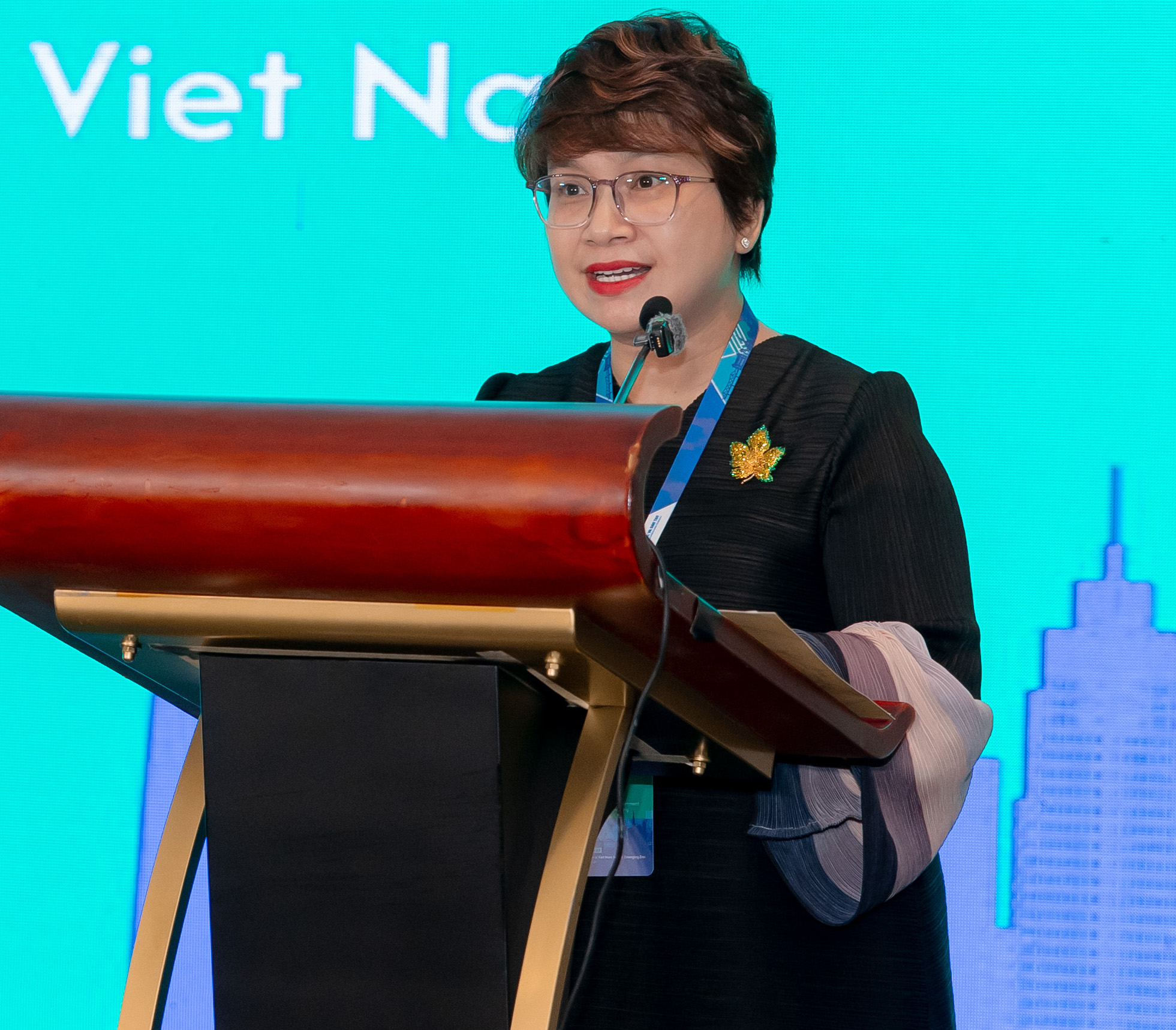
"For many years, internationalisation was often associated with sending students abroad or signing more international cooperation agreements. Today, that approach has fundamentally changed," she said. "Our objective is not to replicate overseas models, but to proactively adopt advanced knowledge, emerging technologies and modern governance practices to address Vietnam's own development needs."

We hope every university will become a 'knowledge ambassador' for Vietnam, introducing not only Vietnamese culture but also Vietnamese research, innovation and development solutions to help address regional and global challenges.
She argued that local identity and global thinking are mutually reinforcing rather than contradictory. "International integration does not mean losing one's identity. Successful internationalisation means preserving institutional identity while strengthening internal capacity to create greater value for learners, local communities and the country."
From a policymaking perspective, MOET is encouraging universities to shift from pursuing international cooperation simply to increase the number of activities towards partnerships that generate measurable impact through co-creation.
"The key question is no longer how many international partners or joint programmes a university has, but how those partnerships improve teaching quality, research capacity, innovation and socio-economic development," Dr. Thuy said.
Looking ahead, she said the most successful universities would be those capable of selecting the right partners and priority areas while effectively connecting global resources with Vietnam's development needs.
She also called on universities to become "knowledge ambassadors" for Vietnam, evolving from recipients of global knowledge into active contributors to regional and international academic communities through research collaboration, transnational education and innovation. "Our vision is for Vietnam to be recognised not only as a country that sends students abroad, but also as a trusted ASEAN destination for learning, research and innovation," she added.
UK sees Vietnam as a strategic higher education partner
Representing the UK, Ms. Rhiannon Harries, Deputy Trade Commissioner for Asia Pacific (Southeast Asia), described education as one of the strongest pillars of the UK–Vietnam Comprehensive Strategic Partnership.
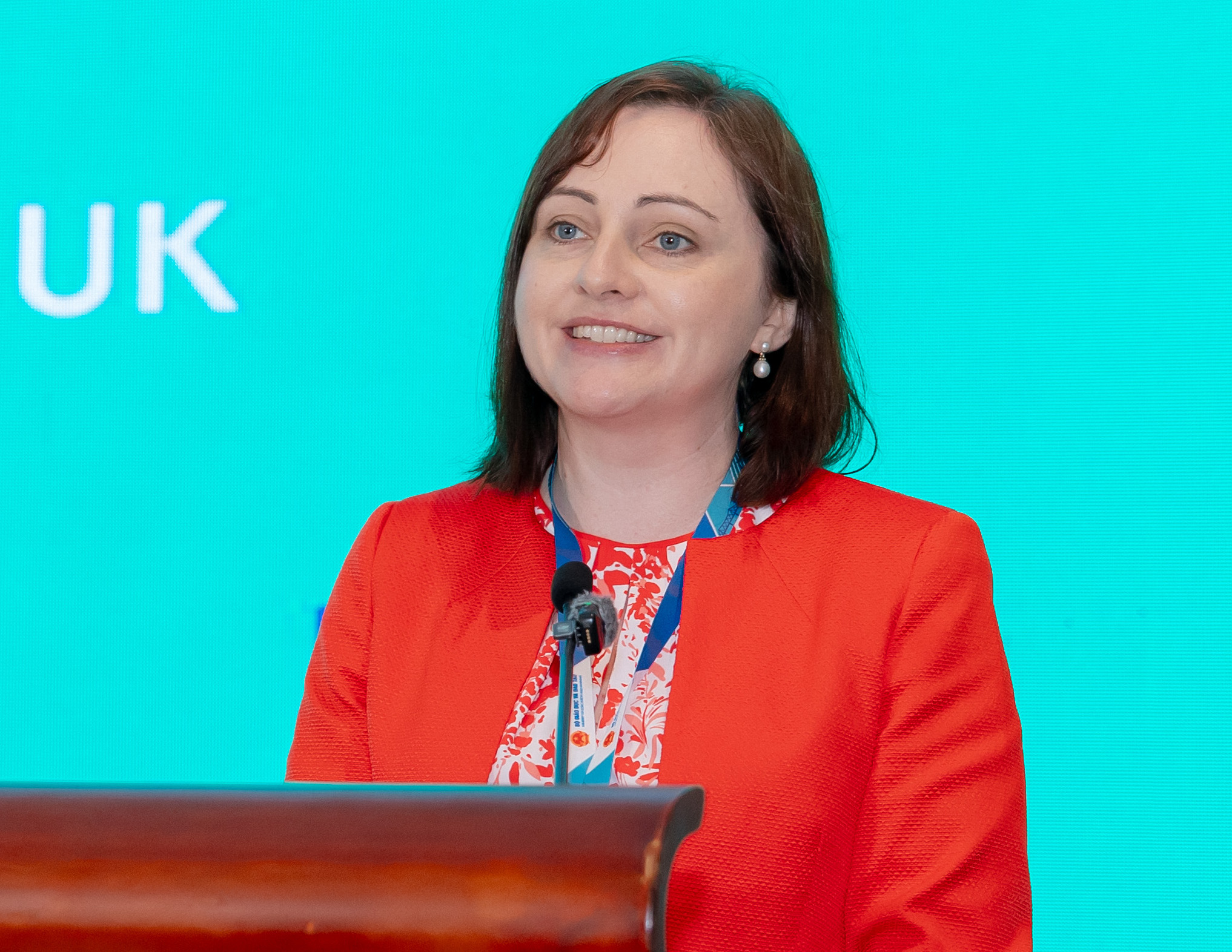
She said rapid technological change, evolving labour market demands and increasingly complex global challenges are reshaping higher education, making cross-border collaboration more important than ever.
"No country can navigate these changes alone. The institutions that will thrive are those that embrace collaboration, share knowledge and build partnerships that transcend borders," Ms. Harries said.
She reaffirmed the UK's commitment to supporting Vietnam through transnational education, research collaboration and long-term institutional partnerships.
Vietnam has become one of the UK's priority education partners and currently hosts the largest number of UK transnational education (TNE) programmes worldwide. According to the UK's Higher Education Statistics Agency (HESA), approximately 13,285 Vietnamese students were enrolled at UK higher education institutions during the 2024–2025 academic year.
The UK also continues to support Vietnam's broader education reform agenda. Ms. Harries noted that the UK is a leading contributor to the Global Partnership for Education (GPE) System Capacity Grant, implemented by UNESCO and UNICEF, providing $2.35 million to help MOET strengthen education governance, improve data systems, accelerate digital transformation and promote inclusive education through 2028.
According to Mr. James Shipton, Director of the British Council in Vietnam, internationalisation is "no longer a luxury, but a necessity," citing leading higher education scholar Hans de Wit.
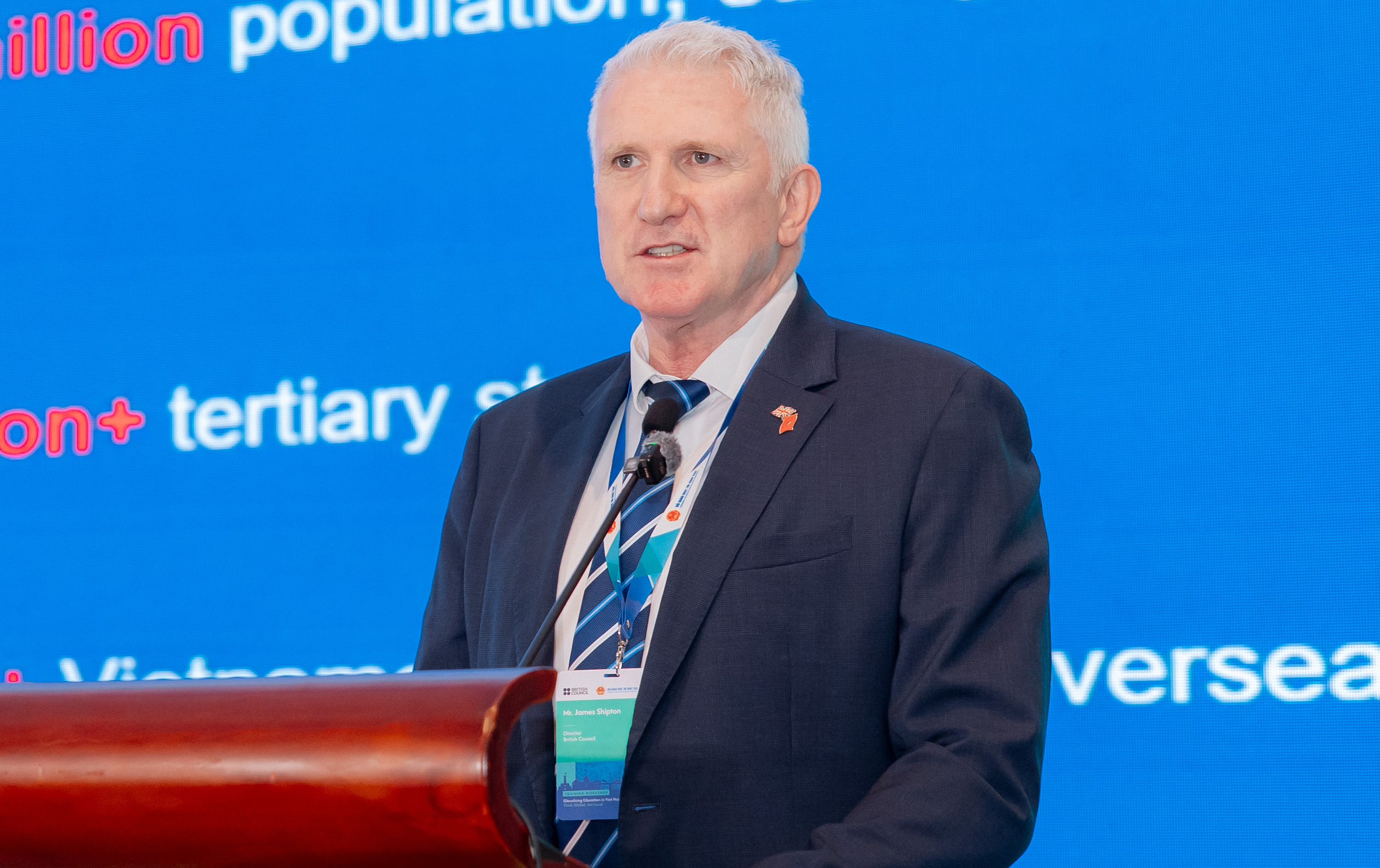
He said universities now face a more important question than whether to internationalise: how to strengthen global engagement while remaining responsive to local priorities. "The most successful universities in this new era will not necessarily be those undertaking the largest number of international activities, but those making the clearest strategic choices," he said.
Mr. Shipton highlighted Vietnam's expanding higher education system, with more than 2 million students, and its growing importance as a destination for UK transnational education in East Asia. He also welcomed MOET's Decision No. 1600 on International Integration in Education, saying it signals a shift from viewing internationalisation as a collection of individual activities to treating it as a driver of system-wide transformation.
He noted that the UK's experience shows that successful internationalisation is not about choosing between international standards and national identity. "International engagement is about using global knowledge and partnerships to strengthen national priorities," he said.
Vietnam's strong cultural identity and clear development vision provide a solid foundation for deeper international cooperation. Rather than introducing entirely new education models, future UK–Vietnam cooperation will increasingly focus on research, innovation, technology, skills development and transnational education.
He said the British Council is working closely with MOET, Vietnamese universities and UK partners through initiatives such as EmpowerTNE and iTechPath to strengthen institutional capability, improve education quality and better connect higher education with innovation and future workforce needs. "The future of UK–Vietnam cooperation is one of mutual learning and co-creation, and we are excited to be part of that journey," Mr. Shipton said.
During the two-day programme, participants discussed global trends in higher education, transnational education models, international quality assurance, research collaboration, international student recruitment and institutional strategic planning. Organisers said the initiative reflects the shared commitment of MOET, the British Council and APAIE to supporting Vietnam's ambition of becoming a regional hub for education, research, innovation and talent development through internationally connected, locally relevant and sustainable higher education.
 Google translate