


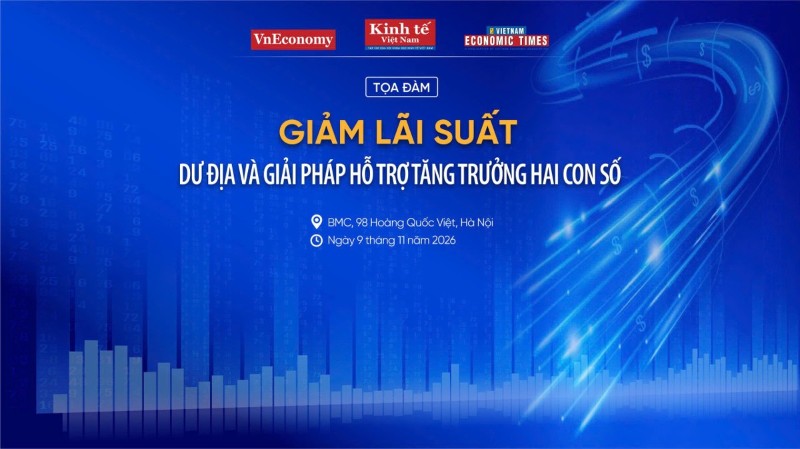
Tap chi Kinh te Viet Nam / Vietnam Economic Times/VnEconomy will host a seminar titled "Lowering Interest Rates: Leeway and Solutions to Support Double-Digit Growth" on the afternoon of November 9.
Experts from the Vietnam Banks Association (VNBA), the Vietnam Bond Market Association (VBMA), and the Vietnam Asset Management Company (VAMC), among others, are expected to dissect root causes and propose measures to cool down lending rates, thereby bolstering double-digit economic growth.
For decades, bank credit has served as the primary financing channel for the economy, providing not only working capital for production, business, and consumption, but also shouldering a significant portion of medium- and long-term funding requirements for development investment.
An overreliance on bank credit—particularly during periods of volatile capital supply and demand driven by anti-inflation efforts—has triggered unintended consequences, ranging from tight credit access and elevated interest rates to mounting non-performing loans (NPLs), with severe repercussions for banks, enterprises, and the broader economy.
Since early 2026, Vietnam’s economy has navigated numerous external and domestic headwinds, including Federal Reserve interest rate hikes, lingering pandemic-induced export slowdowns, the fallout from US President Donald Trump's tariff shocks, and unbridled real estate price inflation. Consequently, macroeconomic management has confronted complex challenges in controlling foreign exchange rates, curbing inflation, and maintaining stable interest rate levels to drive economic expansion.
Against this backdrop, the Vietnamese Government and the State Bank of Vietnam (SBV) have issued decisive directives to lower overall interest rates while safeguarding banking system stability and improving credit quality.
However, solving the interest rate equation remains a formidable challenge amid (i) a sluggish property sector tying up immense capital and driving up bad debt, (ii) an uneven export recovery among domestic firms, and (iii) subdued purchasing power—all while the economy urgently requires massive funding for transformative, foundational projects. That explains why, nearly three weeks after the Government and the SBV strongly urged credit institutions to lower rates, and despite nearly 30 commercial banks announcing cuts on deposit and lending rates, the reductions have remained fragmented and modest, falling short of the targeted 1.5% to 2.0% decrease in general rate levels.
To address these realities, Tap chi Kinh te Viet Nam / Vietnam Economic Times / VnEconomy is convening the seminar "Lowering Interest Rates: Leeway and Solutions to Support Double-Digit Growth" to analyze the drivers of high rates and identify fundamental, sustainable solutions to keep rates within an optimal corridor.
Through the seminar, the media group seeks to gather multi-dimensional analyses and practical recommendations from financial and banking experts, associations, and market institutions, helping inform policy formulation aimed at sustainably reducing interest rates, fostering economic growth, and preserving financial system safety.
The seminar will center on six key discussion pillars:
First, analyzing how high interest rates impact manufacturing, commerce, household borrowing, and banking performance, while identifying formulas to balance the interests of depositors, borrowers, and financial institutions.
Second, clarifying why interest rates cannot decline rapidly over the short run, focusing on structural imbalances in capital mobilization and allocation; overdependence on bank loans for long-term financing; sectoral capital concentration; corporate bond maturity pressures; non-performing loans; and cash flow shifts across asset classes.
Third, formulating measures to elevate credit quality and capital efficiency, bolster risk controls, and improve corporate cash flows and debt-servicing capabilities; identifying priority sectors and tenors for rate cuts; and considering relief adjustments for existing home mortgages and consumer credit.
Fourth, unblocking obstacles in NPL resolution, particularly disputes and legal hurdles surrounding loan collateral, while developing the secondary debt market to liberate economic resources.
Fifth, setting roadmaps and priorities for reforming the capital market and advancing corporate bond issuances and long-term financing instruments—especially for strategic infrastructure projects—to ease structural reliance on commercial bank lending.
Sixth, evaluating conditions required for sustainable rate reductions against global macroeconomic headwinds; aligning monetary, fiscal, and trade policies to stabilize exchange rates, contain inflation, and protect banking solvency; and assessing cross-border fundraising potential for domestic banks and enterprises while balancing costs against foreign exchange risks.
The seminar will be broadcast live across VnEconomy's digital platforms and official Facebook Fanpage.







 Google translate