


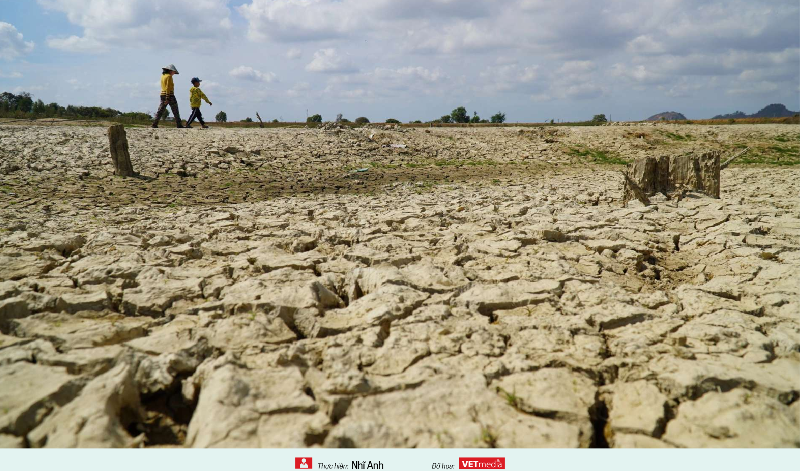
Meteorological agencies are warning that the El Niño climate phenomenon has officially formed over the central equatorial Pacific and is expected to strengthen significantly in the months to come, raising concerns over prolonged heat, drought, water shortages, and disruptions to agricultural production in Vietnam and beyond.
Major international climate centers, including the Tokyo Climate Center (TCC), the Climate Prediction Center of the US National Oceanic and Atmospheric Administration (CPC-NOAA), and the Asia-Pacific Climate Center (APCC), have all forecast a continued strengthening of El Niño conditions. Their forecasts point to reduced rainfall and above-average temperatures across many regions.
The United Nations’ World Meteorological Organization (WMO) estimates the probability of El Niño developing between June and August at around 80 per cent and has warned that the phenomenon could intensify extreme weather events and trigger unusual rainfall patterns worldwide.
According to Ms. Dang Thanh Mai, Deputy Director General of the Vietnam Meteorological and Hydrological Administration at the Ministry of Agriculture and Environment, the 2026 El Niño weather pattern has developed more rapidly than many previous cycles.
Strong El Niño risk rises
Observation data show that sea surface temperature anomalies in the Nino 3.4 region - a specific area of the equatorial Pacific Ocean used by meteorologists to monitor and define the El Niño-Southern Oscillation (ENSO) cycle - reached the El Niño threshold of +0.5°C in May and rose further, to approximately +0.7°C, in early June, confirming the event’s formation.
Experts say the transition from neutral conditions to El Niño has occurred unusually quickly, reflecting rapid warming in the central Pacific and favorable ocean-atmosphere interactions that could fuel further intensification.
Climate models from both domestic and international forecasting centers suggest El Niño will persist through the remainder of 2026, strengthen toward the end of the year, and potentially continue into early 2027. The probability of a very strong El Niño is currently estimated at 60-65 per cent.
Meteorologists note that current conditions resemble those seen during the 2023 El Niño and could ultimately reach a strength comparable to the 2015-2016 event, which was one of the most powerful El Niño episodes recorded since 1950.
If that scenario materializes, Vietnam could face significantly higher temperatures, fewer cold-air outbreaks, and widespread rainfall deficits. Central Vietnam, the central highlands, and the southern region are expected to be particularly vulnerable to drought, water shortages, and saltwater intrusion during late 2026 and early 2027.
“Though the El Niño weather pattern often brings fewer storms and tropical depressions affecting Vietnam, very powerful storms can still occur and cause severe damage,” Ms. Mai cautioned. “We cannot afford to be complacent about natural disaster risks.”
Mr. Mai Van Khiem, Director General of the National Center for Hydro-Meteorological Forecasting, said authorities have been monitoring El Niño developments since the beginning of the year and continually update forecasts to support government agencies and local authorities.
Notably, the probability of a strong El Niño weather pattern has increased rapidly in recent forecasts. The likelihood was estimated at only 20 per cent in April, then rose to 37 per cent in May and reached 60-65 per cent in June. “The current trend suggests a very high probability of a strong El Niño event, potentially comparable to 2015-2016 or even stronger,” Mr. Khiem said.
The growing risk has attracted international attention. Earlier this month, the United Nations Secretary-General urged countries to prepare response plans to mitigate the impacts of the climate phenomenon.
Lessons from past events
Meteorologists point to the 2015-2016 El Niño event as a reminder of the challenges Vietnam could face. That weather pattern brought prolonged and intense heatwaves throughout the country. In central Vietnam, record-breaking heat persisted for weeks, with the longest heatwave lasting 32 days along the south-central coast, 36 days in the central region, and 39 days along the north-central coast.
Temperatures in north-central Vietnam frequently reached 39-41°C, with a peak of 42.7°C recorded in Con Cuong district of Nghe An province in May 2015.
At the same time, severe rainfall deficits triggered widespread drought conditions. River flows in central and southern Vietnam declined sharply, while saltwater intrusion in the Mekong Delta advanced deep inland, affecting agricultural production and local livelihoods. Storm activity also declined significantly. Only five storms and two tropical depressions were recorded in the East Sea in 2015, or roughly half the long-term average.
Experts believe the most concerning impacts of El Niño in Vietnam typically include prolonged heat, reduced rainfall, drought, water shortages, and saltwater intrusion. Current forecasts suggest temperatures nationwide during the second half of 2026 could be 0.5-1.5°C above average, with temperatures during the October-December period potentially exceeding normal levels by 1-2°C. Northern and central Vietnam are expected to experience more frequent heatwaves than usual, with the possibility of new temperature records being set.
Rainfall deficits of 25-50 per cent are also forecast for many regions, particularly the south-central coast, central highlands, and southern provinces. Such conditions could increase the risk of localized or widespread drought, especially in areas with high water demand for agriculture and daily consumption.
Despite the overall decline in rainfall associated with El Niño, experts caution that extreme rainfall events can still occur and may even establish new short-term precipitation records. According to Mr. Khiem, while the number of storms and tropical depressions may fall, other extreme weather events, including urban flooding, landslides in mountainous areas, and flash floods, remain possible.
Economic risks and opportunities
Beyond the weather impact, authorities are increasingly focused on the implications of El Niño for economic growth, agricultural production, and global supply chains.
The Hydrometeorology Administration noted that lessons from the 2019-2020 drought and saltwater intrusion event demonstrated the value of early forecasting and proactive adjustments to agricultural production schedules, which helped reduce losses significantly.
Vietnam’s meteorological authorities are now working with international organizations and foreign weather agencies to assess the broader economic implications of El Niño, including potential disruptions to global supply chains.
Mr. Khiem noted that the weather pattern is expected to affect many countries across Asia and Africa, increasing drought risks and reducing water availability for agriculture. Several major agricultural producers, including Thailand, have already begun implementing response measures, such as increasing water storage within Mekong River basin systems.
Recognizing the broader economic implications, Deputy Minister of Agriculture and Environment Le Cong Thanh recently emphasized the need to identify the specific impacts of El Niño on each economic sector as part of Vietnam’s efforts to sustain double-digit growth.
He called on meteorological authorities to explore climate-economic impact models capable of quantifying the effects of El Niño on economic growth, water security, agricultural production, and social welfare. Such assessments could help the government develop sector-specific adaptation plans and launch coordinated inter-ministerial programs aimed at reducing risks while taking advantage of opportunities arising from climate-related market shifts.
Over the longer term, authorities are seeking to establish an early-warning system that assesses not only weather risks but also the socio-economic impacts of major climate phenomena such as El Niño and La Niña. The initiative is expected to strengthen climate-risk management, support sustainable development, and lay the foundation for climate-information services around Vietnam.
While El Niño poses significant challenges, officials note that it could also create opportunities. If drought conditions reduce agricultural output in major producing countries, global prices for commodities such as rice and coffee could rise, potentially benefiting countries capable of maintaining stable production.
To capitalize on such opportunities while minimizing any risks, authorities are focusing on measures to strengthen water security, improve irrigation management, adjust agricultural production structures, safeguard energy supplies, and enhance the economy’s resilience to drought and water shortages.






 Google translate