


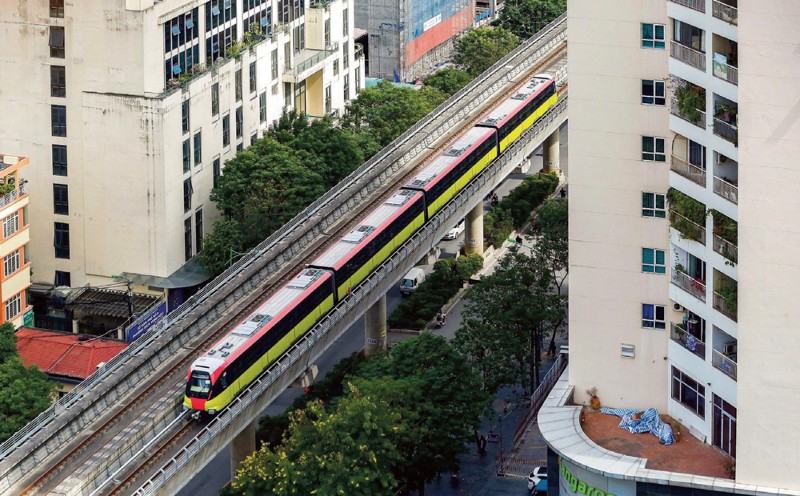
The breaking of ground at five new urban railway projects in Hanoi marks a pivotal moment in the capital’s development, laying the foundation for a Transit-Oriented Development (TOD) model that aims to reshape how the city grows. By integrating transport with housing, commercial development, and public services, the metro network is expected to create new growth centers while unlocking land value along its corridors.
These new projects represent Hanoi’s largest transport infrastructure program to date and one of Vietnam’s most ambitious urban investments, signaling a shift from developing individual metro lines to building an integrated rail network that reduces road congestion, expands the city’s development footprint, and improves quality of life.
To prepare for construction, the engineering, procurement and construction (EPC) contractor consortium of Vinhomes and VinSpeed has completed route surveys, procured large numbers of tunnel boring machines (TBMs), expanded its fleet of diaphragm wall and bored-pile equipment, and mobilized thousands of transport vehicles for excavation works. The consortium is also working with leading consultants from Europe, Japan, South Korea, and China on detailed designs while partnering with experienced international tunneling contractors and suppliers of trains and signaling and operating systems.
“The consortium is committed to mobilizing substantial resources, implementing construction systematically and applying advanced technologies to ensure quality, safety, and progress,” said Mr. Nguyen Viet Quang, Vice Chairman and CEO of Vingroup. “We will make every effort to minimize disruption to residents while ensuring the projects meet all technical and regulatory requirements.”
Creating opportunities
Historically, residential and commercial projects near metro stations have often recorded strong price appreciation once rail lines become operational. That has fueled expectations that Hanoi’s five new metro lines will generate sustained demand for housing and boost property values along their routes.
Mr. Nguyen Van Ngoc, Deputy CEO of Newstarland, believes metro infrastructure will be the single most influential driver of urban real estate values over the next 10 to 20 years. “In the short term, metro projects create market expectations,” he said. “In the long term, they create real value and establish a new pricing benchmark.”
Property values rise not simply because a metro line passes through an area, he continued, but because improved accessibility attracts residents, jobs, businesses, and services. The biggest beneficiaries are typically major interchange stations, large integrated townships along metro corridors, gateway districts, and satellite cities directly connected to central Hanoi. He added that metro-driven appreciation generally follows four stages: planning announcements, breaking of ground, construction, and commercial operation.
With all five projects now entering the construction phase, surrounding real estate markets are beginning to attract medium and long-term investment. However, Mr. Ngoc cautioned against speculative buying. “This is a stage for long-term asset accumulation rather than short-term speculation,” he said. “Even under optimistic timelines, the metro network will not be completed until around 2030, while surrounding urban areas and supporting infrastructure will require additional years to mature.”
Mr. Nguyen Dang Nhien, Investment and Asset Management Adviser, said many investors mistakenly assume that any property near a metro line will automatically appreciate in value. “A metro line does not increase the value of every surrounding property,” he said. “It creates substantial value only for assets located at the intersection of transport infrastructure, pedestrian flows, commercial activity, and genuine live-work ecosystems. Metro lines are a powerful catalyst, but cannot rescue properties with weak locations, poor planning, or limited liquidity.”
Rather than focusing on the scale of investment or the number of new lines, Mr. Nhien said the more significant development is Hanoi’s adoption of a comprehensive TOD strategy. “The objective is no longer simply reducing traffic congestion,” he said. “It is about redistributing the population, expanding the urban footprint, creating new growth centers, and fundamentally revaluing land across the city.”
Location still key
Mr. Nhien believes eastern and northeastern Hanoi, including Dong Anh, Gia Lam, and areas east of the Red River, are among the strongest long-term prospects. These districts still have significant land reserves, are receiving major investment in roads and bridges, and fit naturally into Hanoi’s long-term multi-center development strategy.
However, he warned that they are also among the areas most vulnerable to speculative price inflation. “Anyone buying solely on rumors or market hype risks paying for someone else’s expectations,” he said.

TOD and the development of new economic centers are the inevitable direction for major cities such as Hanoi. As the government invests in transport infrastructure and new growth poles, areas connected by public transit are expected to become future residential hubs. However, infrastructure alone is not enough. New urban areas must also integrate housing, jobs, education, healthcare, and other social amenities. Only then can satellite cities ease pressure on the urban core while creating new momentum for the real estate market.”

Western Hanoi, particularly Hoa Lac and its surrounding technology and education corridor, also offers long-term potential. If metro connectivity is completed as planned, the area could evolve into a major hub for technology professionals, researchers, students, and supporting services.
Meanwhile, southern Hanoi already benefits from established communities, commercial activity, and genuine housing demand. Metro connectivity would therefore enhance not only market expectations but also the practical value and income-generating potential of residential property.
Still, Mr. Nhien stressed that proximity to a metro line alone should never drive an investment decision. For metro-oriented developments, distance to the station matters far more than distance to the railway itself. A property within a five to 10-minute walk of a station may perform significantly better than one located beside the tracks but several kilometers from the nearest stop.
Rather than buying indiscriminately along metro corridors, investors should focus on properties with genuine end-user demand, strong rental or commercial potential, and prices that have not already fully reflected future infrastructure benefits. “If a property’s only selling point is that a metro line will eventually pass nearby, that’s closer to speculation than investment,” he believes.
Improving affordability
While metro infrastructure is expected to reshape Hanoi’s real estate market, experts argue that TOD should ultimately be judged by broader urban development goals rather than rising land prices.
Ms. Giang Do, National Head of Valuation and Feasibility Studies at Savills Vietnam, said the success of TOD should be measured by its ability to improve access to housing, employment, and public services. “The fundamental goal of TOD is sustainable urban development, not simply increasing land values around metro stations,” she said.
The issue is becoming increasingly important as housing affordability continues to deteriorate in Vietnam’s major cities. According to Savills Vietnam, affordable Grade C apartments accounted for more than 80 per cent of apartment transactions prior to 2020. Between 2021 and 2025, that share fell below 35 per cent, while Hanoi recorded no new Grade C apartment launches in the first quarter of 2026. Over the same period, the city’s apartment price index has more than doubled compared to 2009.
“If TOD pushes land prices around metro stations even higher without appropriate policy intervention, the people who rely most on public transport - workers and middle-income households - could ultimately be priced out of the areas with the best infrastructure,” Ms. Giang said. To avoid that outcome, she outlined three priorities.
First, planning around metro stations should prioritize dense, mixed-use neighborhoods where residents can live, work, and access services within walking distance. Affordable and social housing should be integrated into TOD zones, particularly within a 300 to 500-meter radius of stations.
International planning experts have also advocated balanced housing mixes in TOD projects, often described as a “1-3-6” ratio: one part ultra-luxury housing, three parts premium housing, and six parts affordable or social housing. While the exact proportions should vary by location, Ms. Giang said housing diversity should be built into planning from the outset rather than left entirely to market forces.
Second, financing mechanisms must encourage private sector participation. Simply requiring developers to build affordable housing without financial incentives is unlikely to be sustainable. One widely adopted approach is floor area ratio (FAR) bonuses, allowing developers to increase building height or floor area in exchange for providing affordable, social, or rental housing.
TOD should be viewed within the broader context of Vietnam’s strategic technology agenda, where high-speed rail is closely linked to urban development. As Hanoi and Ho Chi Minh City expand their metro networks, the focus should extend beyond transport infrastructure to include research, technology, technical standards and workforce development. Without clear standards, technical guidelines, and skilled professionals, TOD will be difficult to implement effectively.

Third, land management should ensure the benefits of new infrastructure are shared more broadly. When allocating or auctioning land near metro stations, authorities should include public interest requirements such as affordable housing, public spaces, pedestrian connections, and rental housing.
Ms. Giang also highlighted land value capture mechanisms, whereby part of the increase in land value generated by transport infrastructure can be reinvested into affordable housing funds, rental subsidies, or resettlement programs rather than being used solely for new infrastructure projects.
She noted that Vietnam’s revised Capital Law and National Assembly Resolution No. 188/2025/QH15 have established a stronger legal foundation for TOD by supporting compact urban development, integrated land use, and closer coordination between housing and public transportation.
“The question is no longer whether Vietnam should pursue TOD,” Ms. Giang believes. “The challenge is ensuring that planning, financing, and land management are implemented together. If done well, TOD could become one of the country’s most important tools for addressing urban housing needs over the next 10 to 20 years.”






 Google translate