


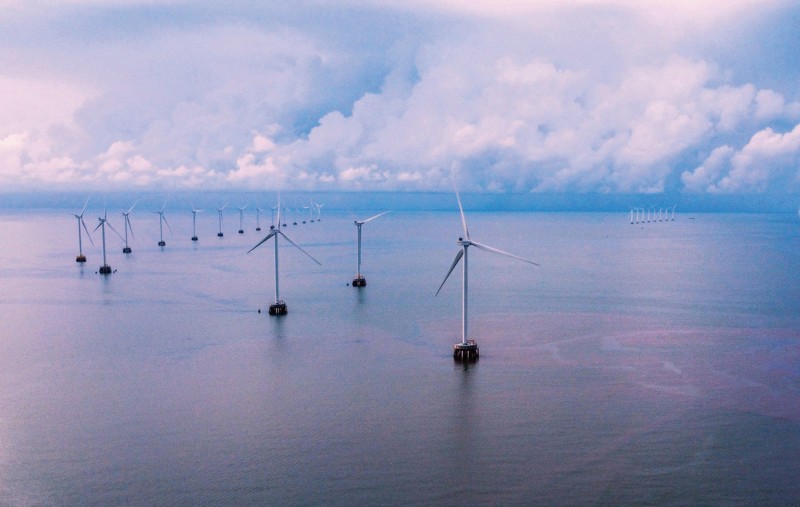
With its long coastline, abundant wind resources, and commitment to achieving net-zero emissions by 2050, Vietnam is considered one of the most promising offshore wind power markets in the Asia-Pacific region. Its revised National Power Development Plan VIII (PDP8) also sets a target for the development of offshore wind power, with a capacity of approximately 6,000-17,000 MW to be operational during the 2030-2035 period. “This is a very ambitious goal and a significant challenge for Vietnam, but it also serves as a foundation, opening up a vast new market for the business community,” Deputy Minister of Industry and Trade Nguyen Hoang Long said at the APAC Wind Energy Summit 2026, held by the Global Wind Energy Council (GWEC) on June 10 in Hanoi.
Unlocking potential
Accelerating the implementation of energy projects to meet electricity demand for economic growth, he continued, is an urgent issue. Vietnam needs more energy sources and new projects to meet the demands of economic development, but it is crucial that this process is implemented in an efficient and sustainable manner. Accordingly, the institutional system and legal framework are being comprehensively improved, with offshore wind power placed at the center of the national energy development strategy.
“Developing offshore wind power not only contributes to supplementing clean electricity sources but also opens up strategic opportunities for developing support industries, forming domestic supply chains, upgrading port infrastructure, and creating many high-skilled jobs,” Mr. Long added. “Vietnam is currently focusing on building a legal framework and incentive mechanisms for this sector, while promoting the localization of mechanical components, wind turbines, submarine cables, and operational services.”
From an international perspective, Mr. Ben Backwell, CEO of the GWEC, believes that Vietnam is in a very favorable position to promote its energy transition given its vast, almost limitless renewable energy resources. Offshore wind power alone has a technical potential of approximately 600 GW, representing a crucial resource for Vietnam to seize new development opportunities.
Besides its resource advantages, Vietnam also possesses a strong industrial base, a rapidly-growing economy, and a highly-skilled workforce. These factors open the possibility for it to become a leading country in renewable energy-based electrification in Southeast Asia and, more broadly, across Asia.
“A crucial foundation has been established through the PDP8, recent policies and laws, the legal framework, licensing mechanisms, and environmental regulations,” Mr. Backwell affirmed. “In the years to come, wind power, solar power, and power generation capacity will continue to expand. In particular, offshore wind power is expected to become a dynamic industry, driving shifts in supply chains, localizing production, developing port infrastructure, and creating hundreds of thousands of high-skilled jobs.”
The key to turning projects into reality lies in optimizing coordination mechanisms and simplifying administrative procedures. “When every step becomes clear and transparent, investor confidence will be strengthened,” he continued. “In particular, finalizing power purchase agreements (PPAs) with strong financial backing will be a crucial foundation for attracting capital, thereby establishing a robust and professional investment environment for the offshore wind power industry.”
A recent report from the International Renewable Energy Agency (IRENA) on 24/7 renewable energy solutions shows that the combination of wind, solar, and energy storage is opening up a new trend, in which the cost of providing a stable power supply is rapidly decreasing and gradually becoming competitive with new thermal power projects in some countries. “With nearly 165 GW of wind power commissioned last year, the momentum for global wind power development has clearly formed,” said Ms. Gauri Singh, Deputy Director General of IRENA. “With the political will of countries like Vietnam, this momentum can be translated into benefits for each nation, while also promoting regional cooperation.”
Lessons from abroad
Offshore wind power remains a relatively new field in Vietnam, requiring thorough preparation in terms of technical capacity, project development, coordination mechanisms, and implementation infrastructure. In this context, Deputy Minister Long affirmed that international cooperation, experience sharing, and technical support from reputable partners such as the GWEC and the international business community are particularly important.
Within the framework of the Summit, Mr. Long announced the launch of a cooperative initiative to boost offshore wind development, establishing a new coordination mechanism to support the growth of Vietnam’s offshore wind market.
According to the Deputy Minister, in addition to developing power generation projects, Vietnam needs to focus on building a complete offshore wind ecosystem, including a domestic supply chain, port infrastructure, and related support industries and services. This is not only a crucial condition for ensuring the sustainable development of the offshore wind industry but also opens up opportunities to attract global supply chain shifts, creating hundreds of thousands of high-skilled jobs in the future.
“The Ministry of Industry and Trade greatly appreciates the cooperation proposal from the Embassy of the UK in Vietnam and is committed to closely coordinating to effectively implement technical support and capacity-building activities within the framework of the Just Energy Transition Partnership,” Mr. Long said. “The Ministry believes that the partnership to promote offshore wind power between the UK and Vietnam will make a significant contribution to realizing Vietnam’s offshore wind power potential, while also opening up more opportunities for deeper cooperation between the two sides in the clean energy sector.”
Notably, Norway’s participation is being led by Norwegian Energy Partners (NORWEP) and includes DNV AS, Fred. Olsen Windcarrier, Glamox AS, Øglænd System/Hilti, the Norwegian Geotechnical Institute (NGI), and Reach Subsea. Together, this delegation represents expertise across key segments of the offshore wind value chain.
While some members of the delegation are visiting Vietnam for the first time, all are engaging with Vietnamese stakeholders through a series of meetings and networking activities during the Summit.
“Norwegian companies bring expertise spanning the entire offshore wind value chain, from seabed surveys and geotechnical investigations to certification, turbine installation, subsea operations, and offshore infrastructure,” said Mr. Jon Dugstad, Director of Renewables at NORWEP. “Drawing on experience from projects in the North Sea, the UK, and Taiwan (China), we bring competence and capacity and are keen to work with local partners, including developers and engineering firms, in support of the efforts of the government of Vietnam to develop a safe, sustainable, and competitive offshore wind industry.”
The focus on long-term industry development was echoed by H.E. Hilde Solbakken, Ambassador of Norway to Vietnam. Sharing Norway’s experience in developing one of the world’s most advanced offshore wind industries, Ambassador Solbakken highlighted the importance of regional cooperation in accelerating offshore wind deployment across the Asia-Pacific region. She noted that collaboration on supply chains, workforce development, port infrastructure, and grid integration would be critical to scaling up the sector.
“Developing offshore wind is not only about generating renewable electricity,” she said. “It requires the entire ecosystem to move forward together, from grid infrastructure and market arrangements to ports, supply chains, and workforce development. Ensuring that these elements are developed in parallel is one of the key challenges facing all countries seeking to build a successful offshore wind industry.”
The Ambassador also encouraged Vietnamese stakeholders to engage with Norwegian companies attending the Summit and explore opportunities for future collaboration. “As Vietnam continues to refine its energy transition plans, industry participants at the Summit say international partnerships and knowledge sharing will play an important role in supporting future offshore wind development,” she noted.




 Google translate